
Decoding Human Mobility: A Multi-Dimensional Approach to POI Recommendations
Point-of-interest recommendations in location-based social networks
This paper presents a comprehensive framework for Point-of-Interest (POI) recommendations in Location-Based Social Networks (LBSNs). It introduces specialized modeling techniques for five critical dimensions—social, categorical, geographical, sequential, and temporal—to capture complex human check-in behaviors and achieve state-of-the-art personalized recommendations.
TL;DR
Point-of-Interest (POI) recommendation is more than just matching users to places; it’s about understanding the "where," "when," "why," and "with whom." This paper proposes a holistic framework that models Social, Categorical, Geographical, Sequential, and Temporal influences. By leveraging Kernel Density Estimation (KDE) and Power-Law distributions, the authors move beyond simple collaborative filtering to capture the "rhythm" of urban life.
Background: The Complexity of the Physical World
In digital ecosystems like Netflix or Amazon, "items" have no physical location. In LBSNs (Foursquare, Yelp), items are anchored in space and time. A user's preference isn't just about a "good restaurant"; it’s about a "good restaurant that is near my office, visited by my friends, and typically visited after a movie on a Friday night." Existing SOTA methods often struggle with Data Sparsity—most users only visit a fraction of a city's POIs—making traditional matrix factorization insufficient.
Methodology: The Five Pillars of Preference
1. Social & Categorical Influence: The Power-Law Reality
The authors discover that social check-in frequency (how many of your friends visited a place) and categorical popularity follow a Power-Law Distribution. Instead of raw counts, they use the Cumulative Distribution Function (CDF) to calculate a normalized relevance score.
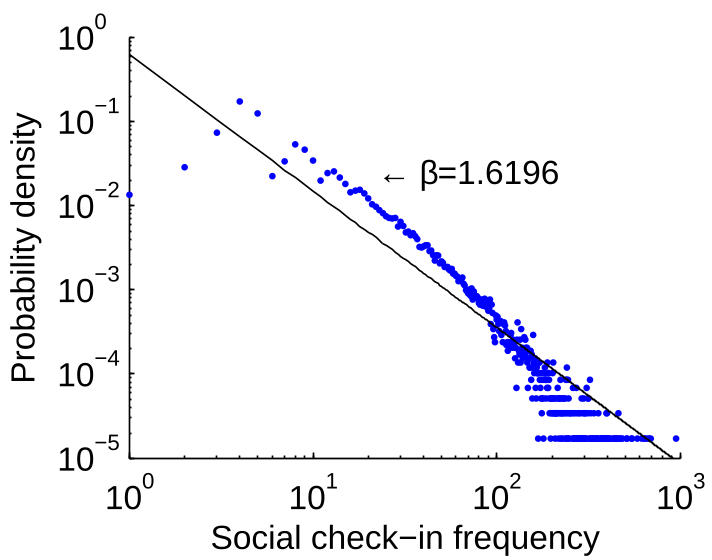 Figure: Social check-in frequency fitting a power-law distribution on Foursquare and Yelp.
2. Personalized 2D Geography
Earlier works modeled geography as a 1D distance decay (people prefer closer places). This paper argues that mobility is multimodal. People have "activity centers" (home, work, favorite mall). Using 2D Kernel Density Estimation (KDE), the model builds a personalized probability map for every user, allowing it to predict visits to unexplored areas that share similar spatial characteristics with known favorites.
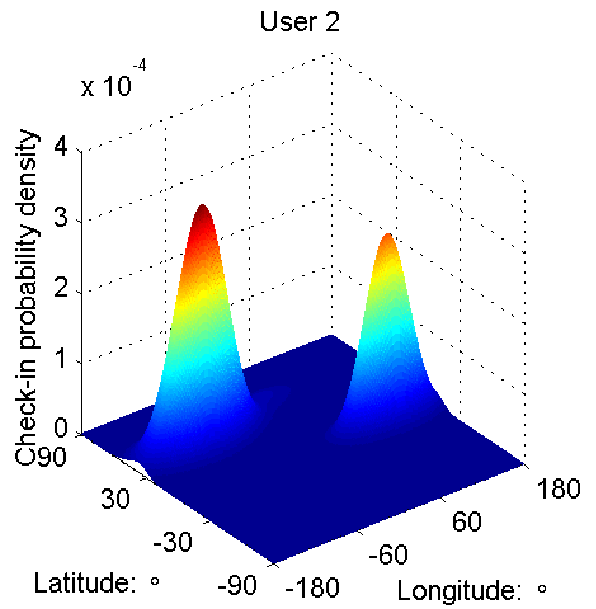 Figure: Unique, multimodal geographical footprints of three different users.
3. Sequential & Temporal Dynamics
Human movement isn't random. It is a sequence. The authors utilize an Additive Markov Chain (AMC). Unlike standard Markov chains that only look at the last location, AMC looks at the entire recent sequence with a decay factor, acknowledging that your morning coffee might still influence your lunch choice, but less so than your immediate previous meeting location.
For the Temporal aspect, the paper rejects the "time slot" (binning) approach. Instead, it uses a continuous probabilistic framework to answer not just what to visit, but when.
Key Insights from Experiments
- Data Validity: The empirical analysis of Foursquare and Yelp data confirms that social and categorical behaviors are not Gaussian but heavy-tailed (Power-Law).
- The Power of "Personalized" Geography: As shown in Figure 4, different users have vastly different mobility masks. A "one-size-fits-all" distance decay model fails to capture the "outdoorsy" vs. "indoorsy" nature of different individuals.
- Sequential Decay: The experiments validate that recent check-ins have a higher predictive weight () than older ones, proving that short-term intent is the strongest signal for the next move.
Critical Analysis & Conclusion
This work excels in its physical intuition. By using KDE, the authors treat the world as a continuous canvas rather than a discrete grid.
Limitations: While the modeling of individual influences is robust, the fusion of these five distinct scores (Social + Categorical + Geographical + Sequential + Temporal) remains a challenge. The paper suggests the "Product Rule" or "Gravity Models," but in highly dynamic environments, the weights of these factors might shift (e.g., on vacation, geographical proximity might matter less than social recommendations).
Future Outlook: The next frontier lies in Opinion Mining. Integrating textual sentiment from reviews alongside these spatial-temporal signals will allow models to understand not just that a user visited a place, but what specific aspect (the coffee, the Wi-Fi, the view) they liked.