
Decoding the Social DNA of Places: Discovering POI Signatures via Group Features
Discovering Point-of-Interest Signatures Based on Group Features from Geo-social Networking Data
The paper proposes a novel framework to discover "POI Signatures" by analyzing group features from Location-Based Social Networking Services (LBSNS) data. It characterizes Points-of-Interest not just by individual preferences, but by the scale, tightness, and closeness of social groups that visit them.
TL;DR
While most recommendation systems treat you as an isolated individual, your behavior changes depending on who you are with. This paper moves beyond individual "check-ins" to discover POI Signatures—a unique behavioral profile for points-of-interest based on the scale and social intimacy of groups that frequent them. By mining trajectories from Brightkite, the authors show that a theater and a restaurant might both be "popular," but they host fundamentally different social structures.
Background: Beyond the Individual Check-in
Traditional Location-Based Social Networks (LBSNs) research focuses on the "What" (category) and "Where" (distance). However, there is a missing dimension: the "Who with?". A Starbucks might be a "small group" destination, while a park might attract larger, loosely connected crowds. Prior work often treated group recommendations as an aggregation of individual preferences, ignoring the intrinsic "social capacity" or "social vibe" of the venue itself.
The Core Insight: Graph-Theoretic POI Signatures
The authors argue that every POI has a signature defined by three social dimensions:
- Group Scale (): Simply the number of people in a visiting group.
- Tightness (): Measured by the Beta Index (ratio of edges to vertices). It answers: How many group members actually know each other directly?
- Closeness (): Based on the Graph Diameter. It answers: What is the maximum social distance between any two people in the group?
Methodology: From Trajectories to Signatures
Since people don't always check in at the exact same second, the authors use a temporal window (e.g., 2 hours) to cluster individual check-ins at the same POI into Group Events.
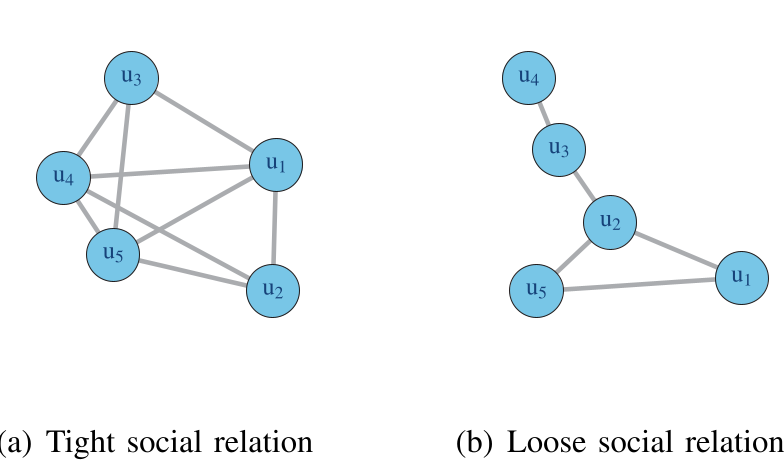 Figure 1: Comparison of social graph structures for different POIs. (a) shows a tight-knit group at a restaurant, while (b) shows a loose group at a music venue.
The signature is then formally defined as a mapping of group sizes to median tightness and closeness values, providing a robust statistical profile of the location.
Experimental Findings
Using real-world data from Brightkite (over 4.4 million check-ins), the study revealed striking patterns:
- The Six Degrees Phenomenon: Even in spontaneous geo-social groups, the graph diameter rarely exceeded 6, confirming that real-world social constraints translate directly into digital check-in data.
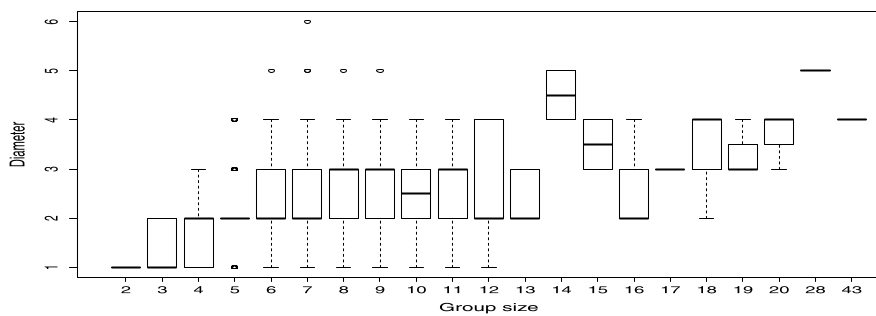 Figure 4: Distribution of social group diameters confirming the "Small World" nature of visiting groups.
- Venue Archetypes:
- High Tightness/Small Scale: Specialty restaurants (e.g., Jax Fish House) attract intimate, well-connected circles.
- Low Tightness: Performance venues (e.g., Florida Grand Opera). People go there as a "social group," but they are often loosely connected—perhaps friends of friends joining for a specific event without dense internal social ties.
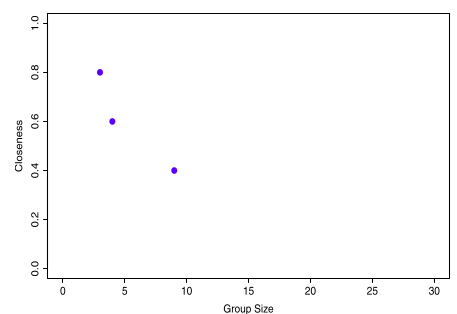 Figure 9: Signatures showing how closeness varies with group size across different types of POIs.
Critical Insight & Future Outlook
The beauty of the POI Signature is its ability to differentiate between locations within the same category. Two "Bars" might have identical ratings, but one's signature might show it is a haven for tight-knit groups of 3-4, while the other is a hub for large, loose social networks.
Limitations: The reliance on explicit "friendship" links in LBSNs might miss "ad-hoc" groups (e.g., business colleagues who aren't friends on social media). Future work could benefit from inferring social ties purely from mobility patterns.
Conclusion: This research provides a crucial building block for the next generation of group-aware recommendation engines. By understanding the social "atmosphere" of a POI, services can better predict not just where you want to go, but where your specific group will feel most at home.