
Nonlinear Polar opinion Dynamics: Why Extremism and Stubbornness Define Social Networks
Polar Opinion Dynamics in Social Networks
The paper introduces a general nonlinear model of polar opinion dynamics on directed social networks. It proposes several specialized susceptibility functions (Stubborn Extremists, Positives, and Neutrals) and leverages nonsmooth analysis and max-min Lyapunov functions to prove stability and convergence to either consensus or persistent disagreement (cleavage).
Executive Summary
TL;DR: This paper moves beyond the classical DeGroot and Friedkin–Johnsen linear models to propose a nonlinear framework where an agent's "malleability" changes based on their current opinion. By applying advanced nonsmooth analysis, the authors prove how networks either harmonize into consensus or fracture into permanent disagreement based on the presence of "stubborn" agents.
Background Positioning: This is a rigorous theoretical contribution that bridges sociopsychological theories (like Cognitive Dissonance and Social Comparison) with Control Theory. It provides the mathematical "teeth" to explain why polarized communities (Democrats vs. Republicans) persist even in well-connected networks.
The Problem: The "Linear" Fallacy of Human Behavior
Most classical models treat humans like simple water pipes: if information flows in, the person's opinion changes by a constant factor. However, social psychology tells us otherwise.
- Prior Work Limitations: Linear models fail to account for ego-involvement. An undecided voter is much easier to flip than a lifelong extremist.
- Structural Challenges: Proving convergence on directed networks is mathematically difficult because standard "smooth" energy functions (Lyapunov functions) often don't exist for these topologies.
Methodology: The State-Dependent Approach
The authors propose the model:
- (The Laplacian): Represents the averaging force—the desire to fit in with neighbors.
- (The Susceptibility): The "brakes" on the system. If is zero, the agent is stubborn.
Three Specialized Flavors of Stubbornness:
- Stubborn Extremists: . Radicalized individuals (at ) stop listening.
- Stubborn Positives: . Only the "positive" pole resists change (e.g., a dominant brand).
- Stubborn Neutrals: . The "silent majority" stays neutral while extremists are volatile.
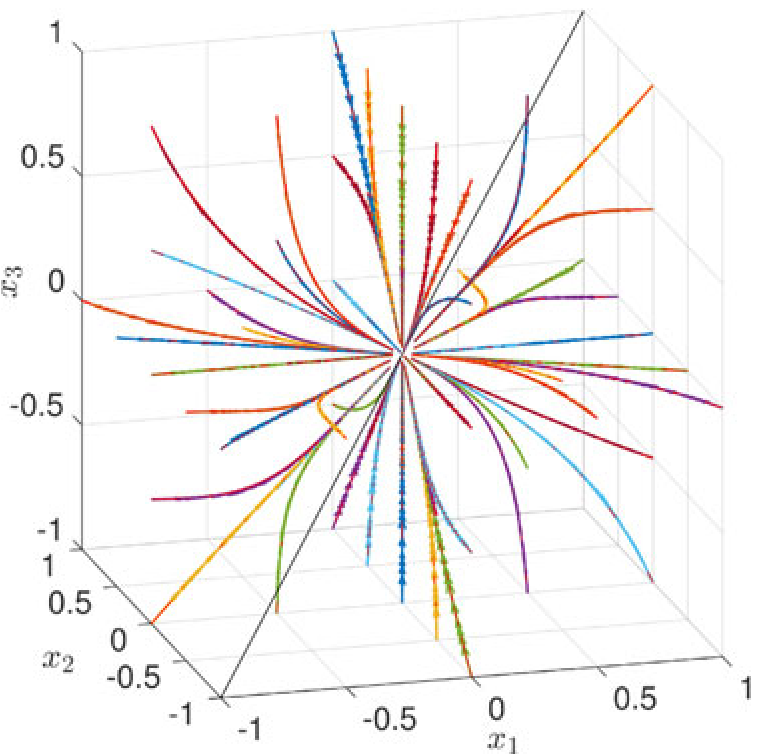 Figure: The phase portrait above illustrates how trajectories in the "Stubborn Extremists" model are pulled toward different equilibria based on initial conditions and the presence of boundary-layer stubborn agents.
Mathematizing the "Agreement vs. Cleavage"
The paper's technical heavy-lifting involves Nonsmooth Max-Min Lyapunov functions. Instead of a smooth curve, they use the "gap" between the maximum and minimum opinions as a measure of system energy.
Key Insights:
- The Consensus Condition: If all stubborn agents agree with each other, the rest of the network will eventually follow.
- The Disagreement Limit: If there are stubborn agents at both poles, the system settles into a state where "open" agents are held in a tug-of-war. The final opinion of these susceptible agents is defined by: This formula shows that the final "moderate" opinion depends entirely on the network's structure () and the positions of the radicals (), not the moderates' initial thoughts.
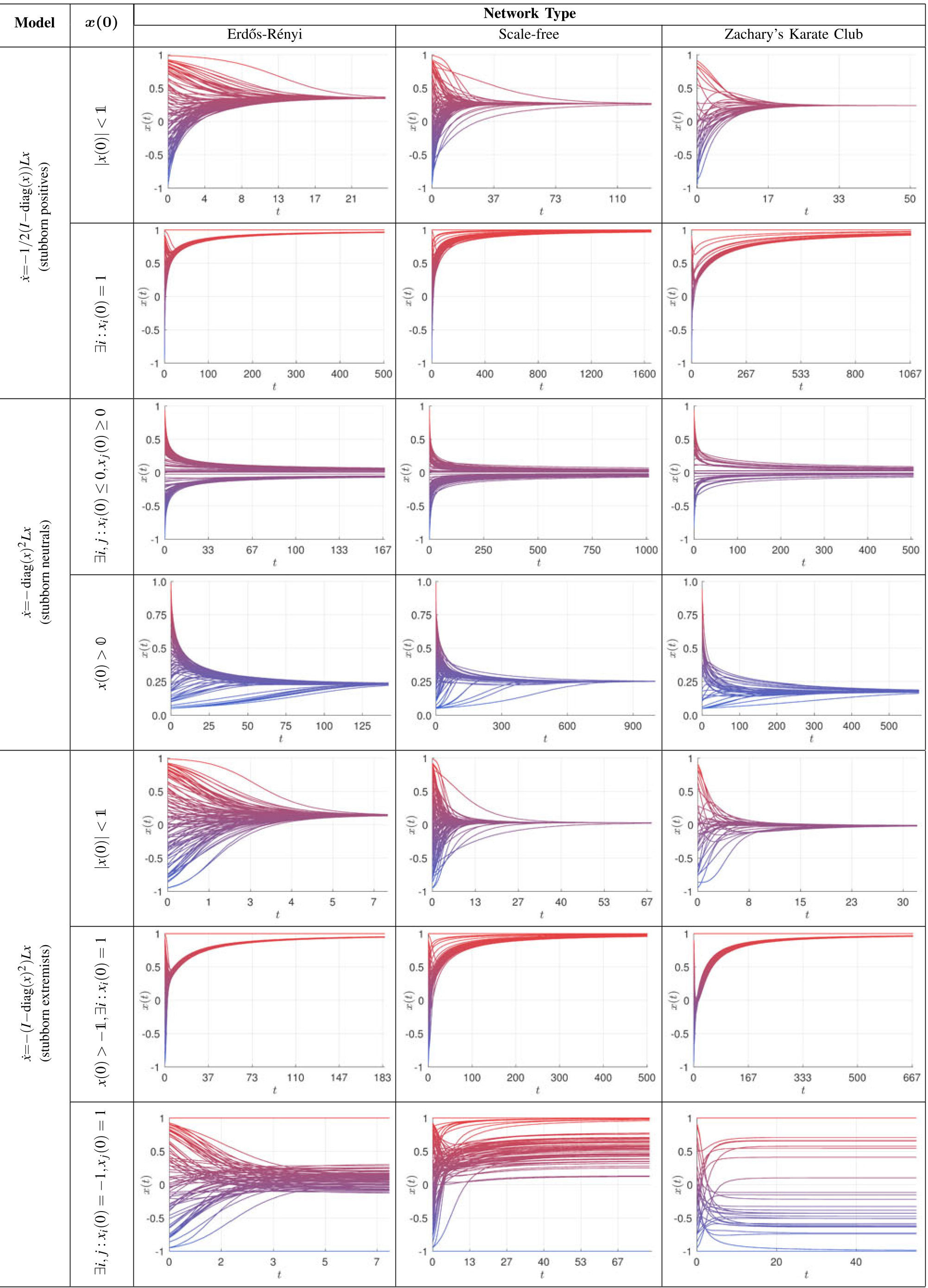 Figure: Simulations on Erdős-Rény and Scale-free networks show that while models like "Stubborn Neutrals" eventually collapse to zero, "Stubborn Extremists" allow for a rich variety of stable disagreement states.
Critical Analysis & Conclusion
Takeaway
The paper confirms that extremism is the ultimate anchor. In a polarized world, the "middle ground" is mathematically coerced by the radical poles. The susceptibility function provides a powerful way to plug different psychological profiles into a unified dynamical system.
Limitations & Future Work
- Fixed Networks: The model assumes the social graph (who talks to whom) never changes. In reality, people cut ties with those they disagree with (Homophily).
- Logic Constraints: The model currently assumes opinions are a single dimension (scalar). Future work could expand this to multi-dimensional belief systems where opinions on one topic (e.g., climate change) affect susceptibility to another (e.g., economic policy).
Final Thought: If you want to change a network's mind, don't target the moderates; you must either wait for the radicals to become "susceptible" or outnumber them with a unified front of stubborn advocates.