
Beyond the Words: Decoding Twitter Polarity via User Emotional Latency
Polarity Classification of Tweets Considering the Poster’s Emotional Change by a Combination of Naive Bayes and LSTM
This paper introduces a hybrid sentiment analysis framework that combines Naive Bayes and Long Short-Term Memory (LSTM) to classify Twitter polarity. By integrating dependency analysis and time-series emotional state prediction, the method achieves a 77.6% accuracy, surpassing traditional baselines and relevant SOTA benchmarks like Uysal.
TL;DR
Language is not just a sequence of tokens; it is a reflection of a persistent emotional state. This paper proposes a hybrid model that combines the statistical efficiency of Naive Bayes with the temporal memory of LSTM to classify tweets. By predicting a user's "emotional flow," the model achieves a significant accuracy boost (reaching 77.6%), proving that context isn't just in the sentence, but in the person.
Problem & Motivation: The "Snapshot" Fallacy
Most sentiment analysis tools treat tweets as independent "snapshots." However, human emotions are fluid. If a user is having a terrible day (a "negative emotional state"), even a seemingly neutral remark might carry a negative undertone.
The authors argue that existing methods focus too much on explicit emotional words while ignoring the implicit emotional state of the poster. To bridge this gap, they propose a system that answers: What was the user feeling before they sent this tweet, and how does that shift the meaning of their current words?
Methodology: The Hybrid Pipeline
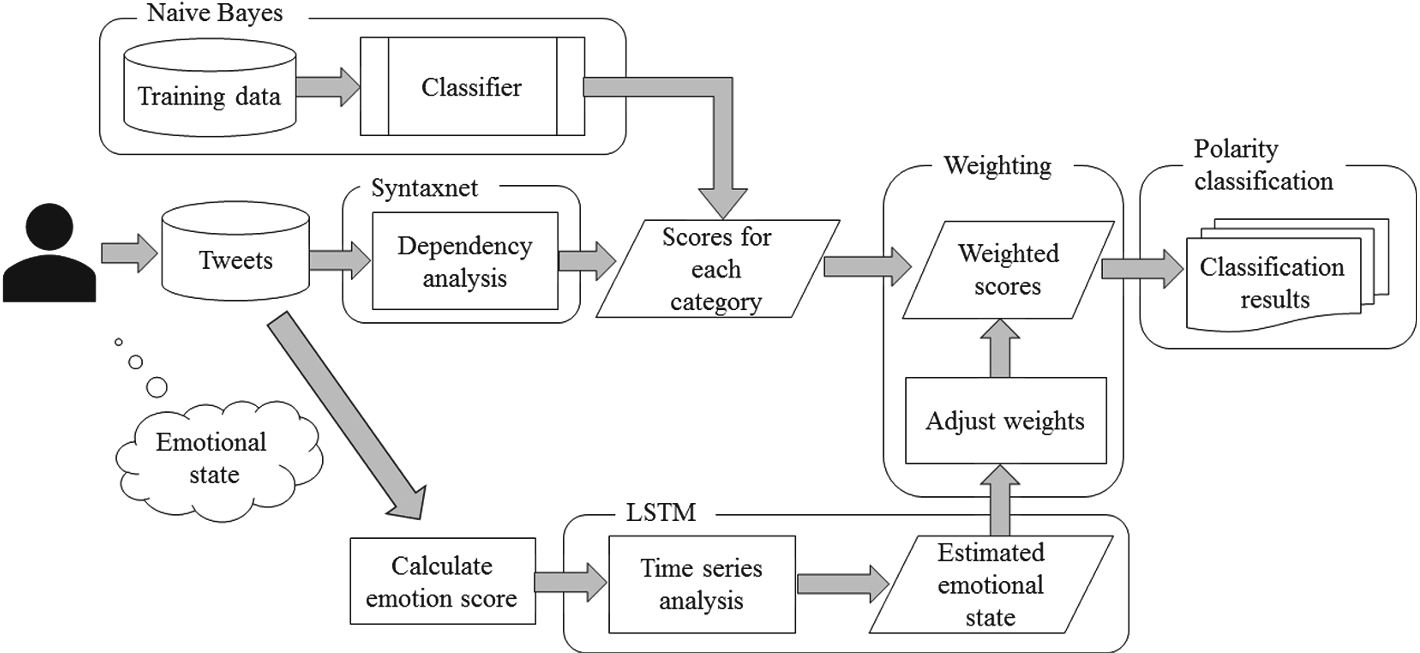
The architecture is a sophisticated multi-stage pipeline designed to blend linguistic structure with temporal dynamics.
1. Linguistic Refinement (SyntaxNet)
Before scoring, the system uses SyntaxNet for dependency analysis. This allows the model to understand that "not happy" is different from "happy" by adjusting scores based on relationship modifiers (intensifiers like "very" or negations like "not").
2. Bayesian Scoring
A Naive Bayes classifier provides the fundamental emotion scores ( for positive and for negative) based on word probabilities derived from 100,000 training samples.
3. Temporal Modeling (LSTM)
This is the core innovation. The model defines an Emotional State (EST) as the ratio of positive scores over time. An LSTM network processes the user's historical EST to predict their current state ().
4. Dynamic Weighting
The predicted emotional state () acts as a "filter." If the LSTM predicts a highly positive state, the positive scores from the Naive Bayes unit are amplified. The authors tested several weighting formulas, with Experiment 3 (scaling both categories based on the deviation from the neutral point) yielding the best results.
Experiments & Results
The study focused on high-volume users from the Sentiment140 dataset to ensure enough historical data for the LSTM.
Key Metrics
The hybrid approach demonstrated a clear advantage over both traditional and modern baselines:
- Baseline (Naive Bayes only): 75.5%
- Uysal (SOTA Feature Selection): 71.5%
- The Proposed Method (Exp 3): 77.6%
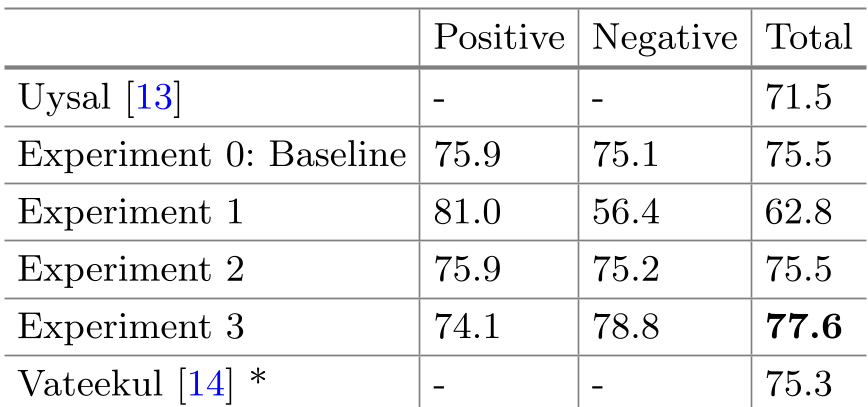
The results illustrate that while basic LSTM models (like Vateekul's 75.3%) are powerful, the explicit combination of statistical scoring and temporal weighting provides a more robust performance.
Critical Analysis & Conclusion
This work successfully demonstrates that user history is a powerful prior for NLP tasks. By moving from "Text Analysis" to "User Analysis," we can resolve ambiguities that plague standard classifiers.
Takeaway
The integration of statistical models (Naive Bayes) for granular features and deep learning (LSTM) for temporal context is a pragmatic and effective strategy for human-centric AI.
Limitations & Future Work
- Data Sparsity: The model requires a history of tweets; it may struggle with "cold-start" users who have few previous posts.
- Neutrality: Currently, the model focuses on a binary (Positive/Negative) classification. The authors suggest that incorporating "Neutral" states is the next logical step.
- Evolution of Architecture: While LSTM was the choice here, future iterations could benefit from Transformers—specifically their self-attention mechanisms—to capture even longer-range emotional dependencies across months of posting history.