
Polarity Detection in Foursquare Tips: Can Lexicons Rival Machine Learning?
Polarity Detection of Foursquare Tips
This paper presents a comparative study of sentiment polarity detection for Foursquare tips using supervised (Naive Bayes, SVM, MaxEnt) and unsupervised (SentiWordNet-based) methods. The study reveals that a lexicon-based unsupervised approach achieves performance comparable to state-of-the-art supervised classifiers without the need for manual labeling.
TL;DR
Researchers from the Universidade Federal de Minas Gerais investigated whether complex supervised machine learning models are actually necessary for sentiment analysis on Foursquare tips. By comparing Naive Bayes, SVM, and Maximum Entropy against a SentiWordNet-based unsupervised method, they found that lexicon-based approaches are surprisingly effective, often matching or exceeding the performance of supervised models without requiring a single manually labeled training example.
Context & Motivation: The "Tip" Problem
Foursquare tips are a unique beast in the NLP world. Unlike long-form movie reviews, tips are:
- Ultra-short: Limited to 200 characters.
- Noisy: Full of slang, "coool!!", and informal grammar.
- Imbalanced: Users tend to post far more positive recommendations than negative complaints.
The authors set out to determine if the "costly" route of manual labeling for supervised learning provides a significant enough ROI compared to "off-the-shelf" lexicons.
Methodology: Rules vs. Labels
The Supervised Contenders
The authors utilized three classic architectures for text classification:
- Multinomial Naive Bayes (NB): Known for its efficiency in text classification.
- Maximum Entropy (ME): A model that avoids independence assumptions.
- Support Vector Machines (SVM): Utilizing a linear kernel to handle high-dimensional TF-IDF vectors.
The Unsupervised Challenger (SentiWordNet)
The lexicon-based approach wasn't just a simple word count. It involved a refined pipeline:
- Dependency Parsing: Identifying negation (e.g., "not good") to flip polarity scores.
- Synset Averaging: Since a word like "bank" has multiple meanings (senses), the method averages scores across all synsets associated with the word's Part-of-Speech.
- Score Aggregation: Final tip sentiment is decided by the delta between average positive and negative scores.
Core Insights from the Results
1. The Death of the "Hybrid" Dream
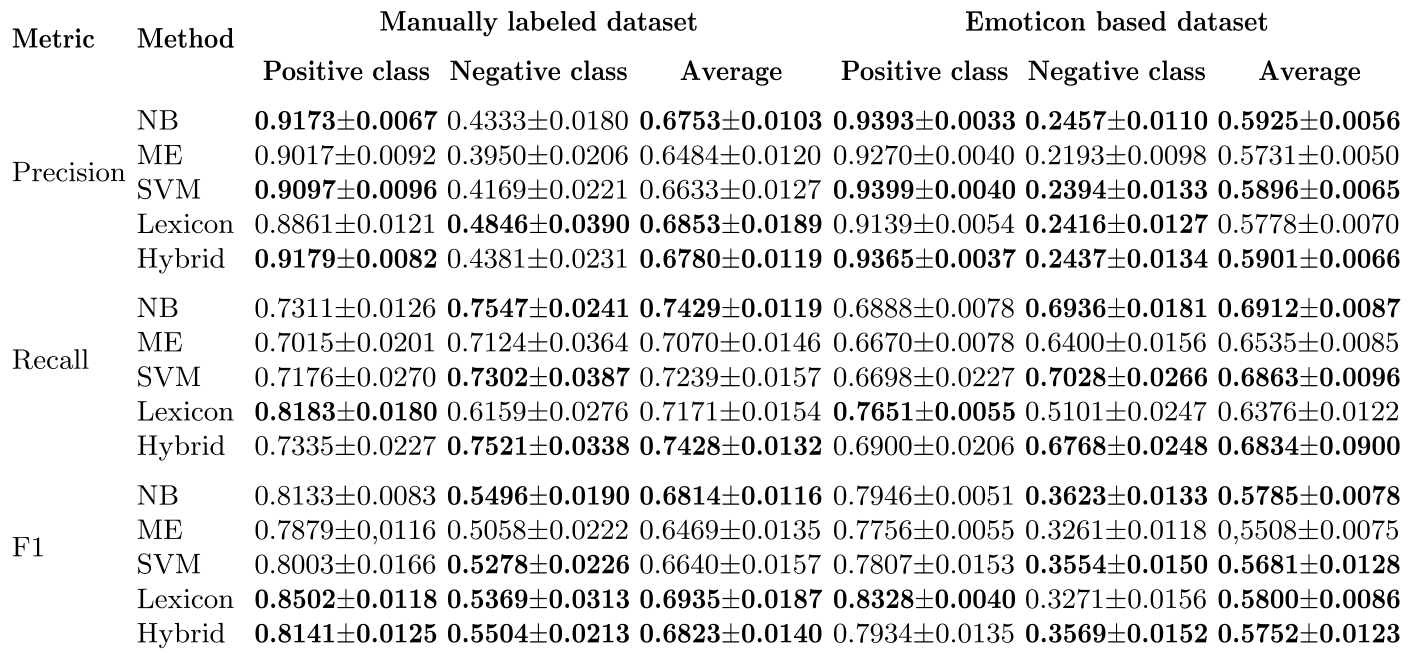
The researchers tested a Stacking approach (a Hybrid model) that combined the predictions of all four methods. Surprisingly, it failed to significantly outperform the best individual method. The reason? High agreement. If NB and the Lexicon already agree on 70% of the tips, there isn't enough variance for the stacker to learn a better combination rule.
2. Positive vs. Negative Specialization
- The Lexicon is a "Positive" Specialist: It achieved the highest F1-scores and Recall for positive tips. If your product goal is to summarize "Why people love this place," the unsupervised method is your best bet.
- ML Wins at Identifying Critics: For negative tips, Naive Bayes and SVM showed massive gains in Recall (up to 36%). This suggests that "negative" language in Foursquare tips is perhaps more nuanced or uses specific markers that a general lexicon like SentiWordNet misses, but a classifier can catch.
3. Noise in Emoticons
The study compared a manually labeled dataset against one labeled via emoticons (e.g., :) = positive). All methods performed worse on the emoticon dataset (~19.5% drop). This highlights the "Sarcasm Gap"—emoticons are noisy proxies for true sentiment.
Critical Analysis & Conclusion
This paper serves as a reality check for the industry. While the current trend pushes toward massive supervised datasets (or LLM fine-tuning), the authors demonstrate that for specific domains like LBSNs, a linguistically-informed unsupervised method is a formidable baseline.
Limitations: The study is constrained to English. Furthermore, 1.6% of tips were "unclassifiable" by the lexicon because they contained no recognizable words from SentiWordNet—a small but persistent problem for dictionary-based methods in evolving social media landscapes.
The Takeaway for Engineers: Don't start by labeling 10,000 samples. Start with a robust lexicon-based pipeline. Use supervised learning only if your use case demands high recall on negative sentiment (e.g., a "complaint alert" system for business owners).