
Decoding Policy: How Affect Lexicons and Dependency Parsing Reveal Political Stance
Determining the Polarity and Source of Opinions Expressed in Political Debates
This paper presents a robust framework for determining political sentiment and its source within American Congressional floor debates. By leveraging multi-source lexicons (affect, opinion, and attitude) and dependency parsing, the authors achieve high-performance polarity classification and identify the speaker's political party with up to 69% accuracy.
TL;DR
Researchers from the University of Alicante have developed a method to navigate the complex rhetoric of US Congressional debates. By moving beyond simple "positive/negative" word counts and using dependency parsing to link emotions to specific legislative targets, they can accurately determine not just the speaker's vote, but also their political party affiliation.
Academic Context: This work bridges the gap between general-purpose sentiment analysis and domain-specific political science, providing a data-independent alternative to heavily trained SVM classifiers.
The Problem: The "Target" Trap in Political Discourse
In a move review, "The acting was terrible" is clearly a negative sentiment toward the movie. In a political debate, a speaker might say, "I strongly disagree with my colleague's pessimistic view of this bill."
- Simple Sentiment: Sees "disagree" and "pessimistic" -> Negative.
- Reality: The speaker is actually supporting the bill by attacking the opposition.
Existing systems often fail because they don't account for the source and the target of the opinion. The authors argue that most "false negatives" occur because the system captures a negative sentiment directed at an opponent rather than the legislation itself.
Methodology: The Three-Pillar Approach
The authors utilize a sophisticated pipeline to ensure the system remains domain-independent yet context-aware.
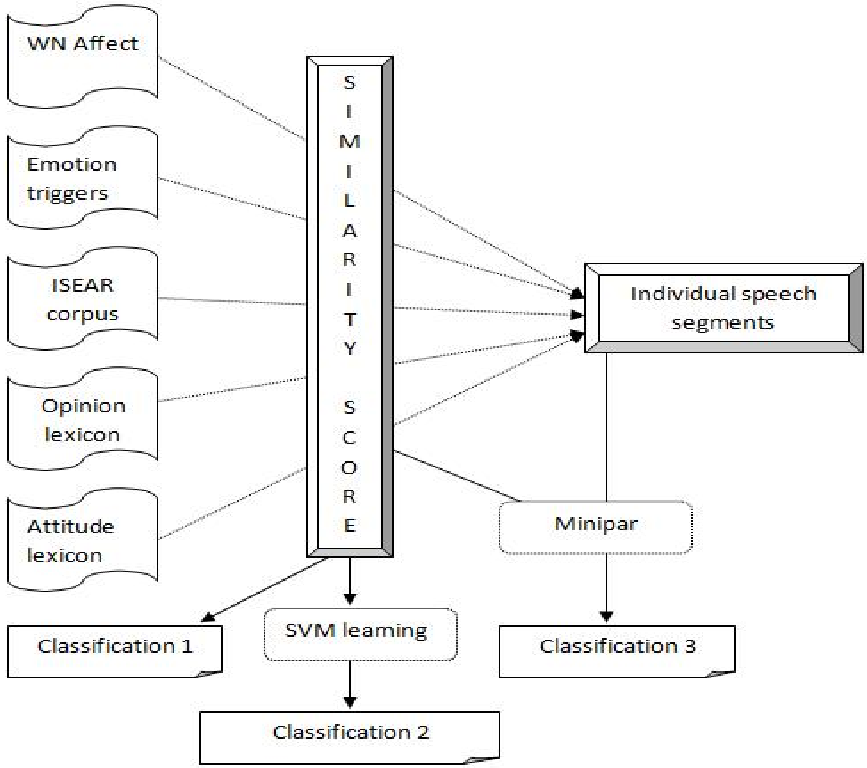
1. Multi-Source Lexicon Integration
Instead of a single list of "good/bad" words, the system uses:
- Affect Lexicon: Categorized emotions (Joy, Anger, Fear).
- Opinion Lexicon: Positive/Negative values expanded via Roget’s Thesaurus.
- Attitude Lexicon: Context-heavy categories like "Justice," "Competence," and "Injustice."
2. Dependency Analysis (The Game Changer)
To solve the "Target Trap," the authors used Minipar to parse sentences. They looked for dependency paths between an attitude word (e.g., "support") and the topic (e.g., "H.R. 3283"). If a sentiment word didn't link to the bill or a speaker, it was discarded.
3. Speaker-Level Aggregation
Recognizing that individual speech segments are often too short for accurate classification, the authors aggregated all segments from a single speaker on a specific topic. This "speaker intervention" level provided a much more stable signal for sentiment.
Experimental Results & Performance
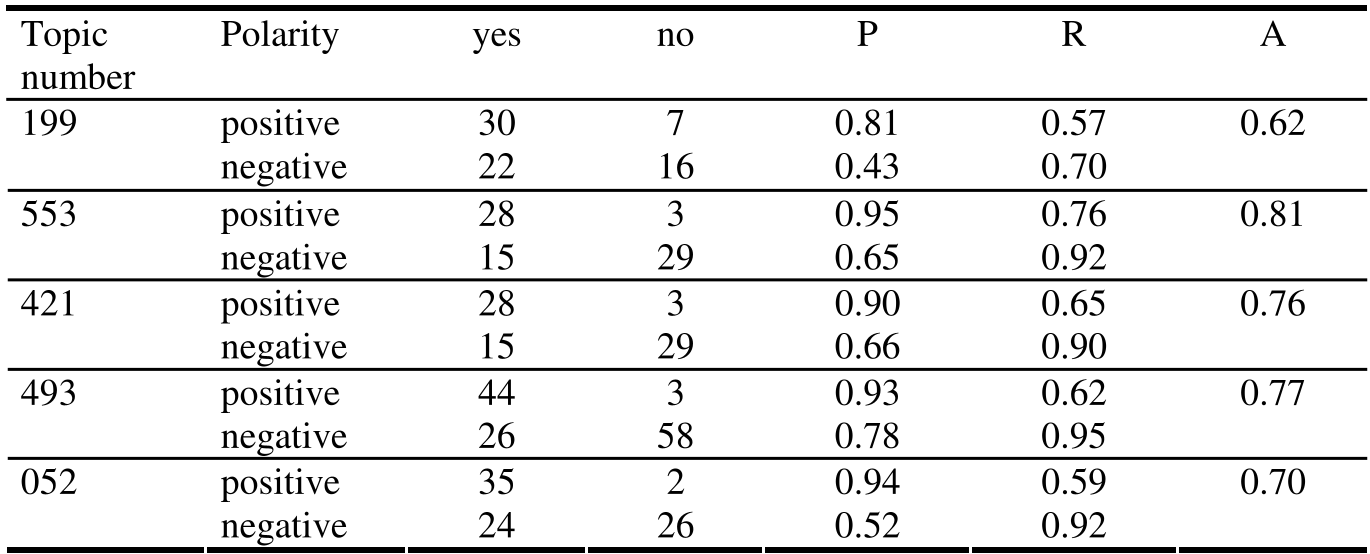
The experiments were conducted on the famous "Congressional Floor Debate" corpus. The introduction of dependency parsing showed a marked improvement in accuracy and a more balanced precision/recall profile compared to basic SVM or similarity measures.
| Method | Accuracy (Test Set) | Precision (Pos) | Recall (Neg) |
|---|---|---|---|
| Base Similarity | 0.73 | 0.70 | 0.87 |
| Dependency Parsing | 0.76 | 0.70 | 0.84 |
| SVM (Trained) | 0.78 | 0.75 | 0.88 |
While SVM achieved a slightly higher accuracy, it was "data-dependent" (needing specific training on those topics), whereas the Dependency Parsing approach remained robust across different discussion topics without retraining.
Furthermore, the system achieved a 69% accuracy in identifying the source party (Democrat vs. Republican), proving that different political sides use distinct affective and argumentative vocabularies.
Critical Insight & Conclusion
This research highlights a vital lesson for the NLP community: Context is structural. High-frequency sentiment analysis often collapses when the "object" of the sentiment shifts. By anchoring affect to specific bill IDs and speaker IDs through dependency trees, the authors turned a noisy classification task into a structured discovery task.
Future Work & Limitations: The authors admit that Anaphora Resolution (e.g., knowing that "it" refers to "the bill") is the next frontier. Many failures occurred because the dependency parser lost the trail when speakers used pronouns to refer to the legislation.
Ultimately, this work proves that a linguistically-informed approach—even without the massive training data required by modern transformers—can achieve high-precision results in highly nuanced domains like political science.