
Deciphering the Political Pulse: Sub-Topic Discovery via Community Detection
Identifying Policy Agenda Sub-Topics in Political Tweets based on Community Detection
The paper introduces a multi-stage framework for identifying specific policy agenda sub-topics from political tweets using a combination of Convolutional Neural Networks (CNN), semantic similarity metrics, and community detection. By analyzing tweets from US state representatives, the method successfully clusters high-level legislative topics (e.g., healthcare, immigration) into granular sub-issues with high Topic and Order Recall.
TL;DR
In the noisy arena of political Twitter, identifying exactly what politicians are debating is a challenge of scale and semantics. This paper presents a sophisticated pipeline that bridges the gap between broad categories (like "Healthcare") and specific debates (like "Affordable Care Act implementation"). By leveraging Convolutional Neural Networks (CNN) for high-level classification and Walktrap Community Detection for granular clustering, the researchers achieved up to 98% recall in identifying policy sub-topics from US state representatives' feeds.
The Motivation: Moving Beyond "Trending"
While "trending topics" are easy to spot, long-term policy shifts are harder to track. Existing methods like LDA (Latent Dirichlet Allocation) often fail on Twitter because its 280-character limit doesn't provide enough word-co-occurrence context. Previous graph-based methods focused on individual tokens, losing the overarching perspective.
The authors' key insight was to inject domain knowledge (the US Policy Agenda Codebook) into the process. By first filtering tweets through a legislative lens, they reduced "noise" before using graph theory to find the "communities" of conversation.
Methodology: The "Classify-then-Cluster" Pipeline
The architecture is a three-stage engine designed to transform raw noise into structured insight.
1. The Neural Filter (CNN)
The team used a CNN to map tweets into 21 major legislative categories (Macroeconomics, Civil Rights, etc.). To solve the "misclassification" problem typical of short texts, they didn't just take the top-1 result. Instead, they used a Gaussian distribution-based selection, keeping all categories in the top quartile of probability to ensure that multi-topic tweets weren't lost.
2. Semantic Graph Construction
This is the heart of the innovation. Instead of simple word overlaps, they built a Tweet-Similarity Graph:
- Semantic Weighting: Using WordNet to calculate contextual similarity (e.g., "Physician" and "Doctor" are treated as similar).
- POS Boosting: Political discourse relies heavily on specific entities. The authors assigned a higher "boosting factor" to proper nouns (1.0) and hashtags (1.3) compared to verbs or adjectives (0.2).
- Hashtag Clustering: Using a UnionFind data structure, they grouped hashtags that frequently appeared together, ensuring that
#POTUSand#Trumpmight be linked even if they didn't share other words.
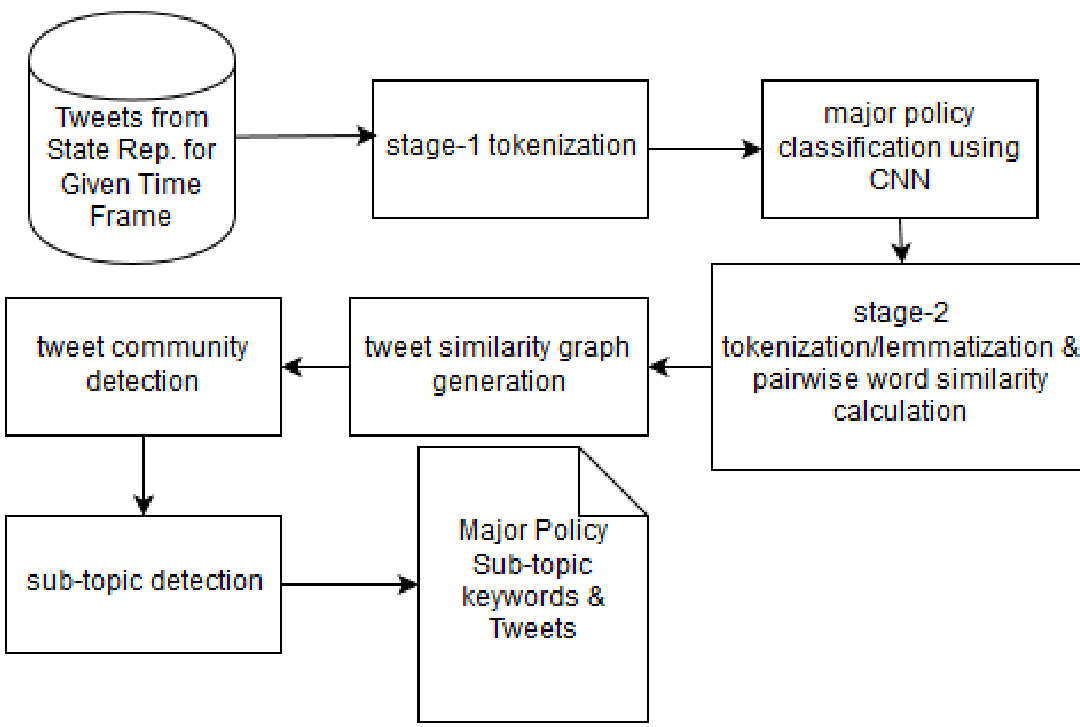 Fig 1: The sequence of stages involved in extracting granular policy sub-topics.
3. Community Detection (Walktrap)
Finally, they applied the Walktrap algorithm. This relies on random walks—trips across the graph that are more likely to stay within a "community" of highly similar tweets. Each detected community represents a distinct sub-topic.
Experimental Results
The researchers tested their model on over 300,000 tweets from US state representatives. To validate the "AI's" findings, they compared them against ground truth annotated by domain experts (Political Science students).
Key Performance Metrics:
- Topic Recall: How many of the human-identified sub-topics did the AI find? Range: 65% - 98%.
- Order Recall: Did the AI correctly rank the sub-topics by popularity? Range: 67% - 97%.
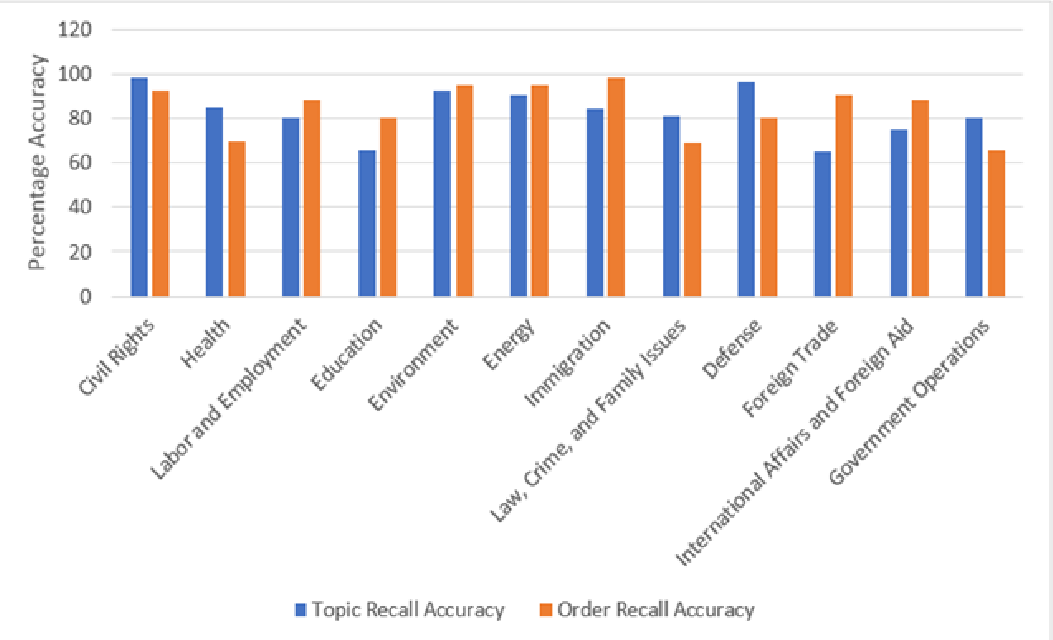 Fig 2: Comparison of Topic Recall and Order Recall across different policy agendas.
The results showed that while performance slightly dipped as the number of tweets increased (due to "masking" of very small sub-topics), the major pillars of the political conversation were captured with remarkable precision.
Critical Analysis & Future Directions
This paper makes a strong case for hybrid models. Deep learning handles the massive scale, while graph algorithms handle the intricate relationships.
Limitations:
- Static vs. Temporal: The model treats all tweets within a window as a single batch. In reality, political topics evolve weekly.
- Influence Neutrality: It treats a tweet from a freshman representative the same as one from a Senate leader.
Future Outlook: The authors suggest that including temporal relations and account influence (follower count) as graph weights could further refine the detection of "emerging" vs. "stagnant" policy shifts. This methodology isn't limited to politics—it could easily be adapted for tracking corporate communications or financial news trends.
Takeaway
By combining the "intuition" of semantic graphs with the "power" of CNNs, we can now map the DNA of political discourse at a level of detail previously reserved for manual human auditing.