
Policy-by-Example: Revolutionizing Privacy Management in Social Networks
Policy-by-example for online social networks
The paper introduces "Policy-by-Example," a dual-approach framework combining Assisted Friend Grouping and Same-As Policy Management to simplify privacy control in Online Social Networks (OSNs). By leveraging CNM clustering and recognition-based UI, the system achieves state-of-the-art efficiency in policy authoring and friend categorization.
TL;DR
Researchers have developed a "Policy-by-Example" framework that slashes the time required to manage social media privacy by over 50%. By using network clustering (CNM) to help group friends and a "Same-As" model that allows users to copy permissions from one representative friend to others, the system makes privacy both easier to manage and more effective.
Context: The Burden of Choice
In the modern social landscape, an average user creates dozens of pieces of content monthly for hundreds of "friends" ranging from family to strangers. While platforms like Facebook offer "Lists" or "Circles," the manual effort to maintain them is immense. This leads to the Privacy Paradox: users claim to care about privacy but leave their profiles wide open because the tools to secure them are too tedious.
The Problem: Cognitive Context Switching
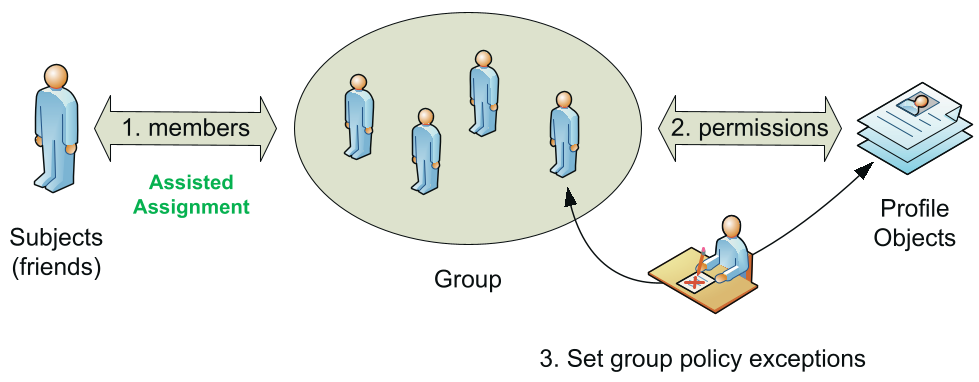
Traditional Group-Based Access Control (GBAC) fails because it fragments the user's mental model into three disconnected stages:
- Categorization: Sorting friends into groups.
- Rule Making: Assigning permissions to those groups.
- Refinement: Creating exceptions for individuals within those groups.
This "What-How-Who" workflow is cognitively expensive. The authors argue that humans are much better at recognition than recollection.
Methodology: Human-Centric Access Control
The researchers introduced two key innovations:
1. Assisted Friend Grouping
Instead of presenting friends in alphabetical or random order, the system uses the Clauset-Newman-Moore (CNM) algorithm to detect natural "communities" in the user's social graph.
- The Intuition: Social clusters (e.g., high school friends, coworkers) usually share the same privacy level.
- The Benefit: By presenting friends in cluster-order, users stay in a specific "mental set," reducing task-switching overhead.
2. Same-As Policy Management
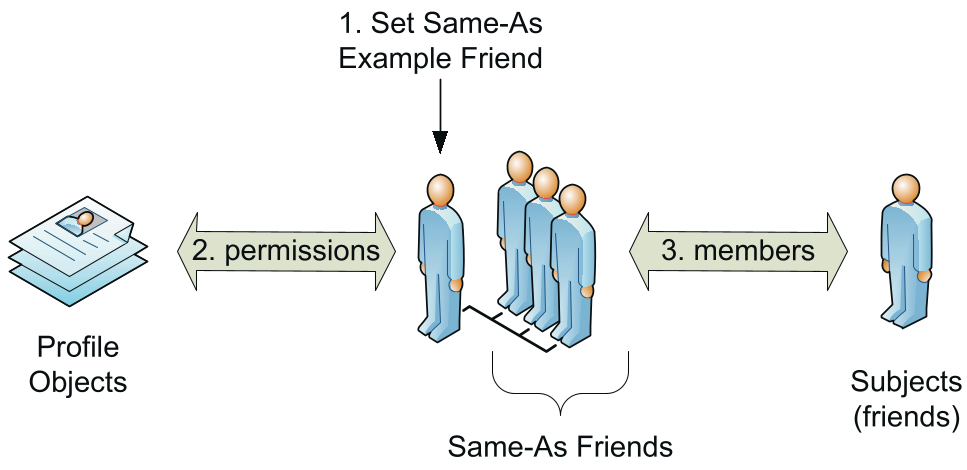
This is the "Example" in Policy-by-Example. Instead of defining a "Work" group, a user thinks: "I want Bob to see what Alice sees."
- Mechanism: The user identifies an "Example Friend," sets their permissions via a visual editor, and then simply tags other similar friends to follow that "example."
Experiments & Real-World Results
The authors tested their prototype (a Facebook app called PolicyMngr) against 101 users. The results were striking:
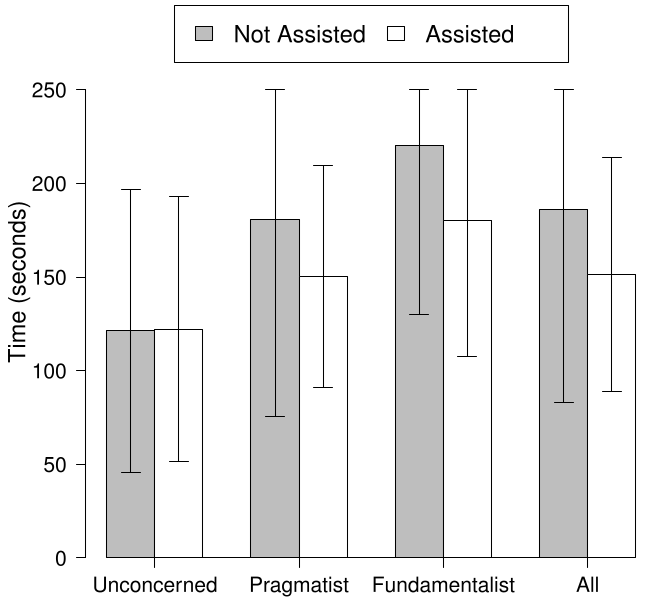
- Speed: Setting up policies with the "Same-As" approach took 179.7 seconds, compared to 401.2 seconds for traditional methods—a 55% improvement.
- Efficiency: Clustering friends using CNM reduced grouping time by 23%.
- Security: Interestingly, users created more conservative (safer) policies when thinking about individual friends (Same-As) rather than abstract groups.
Critical Insight: Why it Works
The "Same-As" model works because it aligns with how our brains naturally store social information. We don't categorize people into rigid database tables; we associate them with archetypes. By allowing users to say "this person is like that person," the interface removes the bridge between social intuition and digital configuration.
Conclusion & Future Outlook
Takeaway: The study proves that "Ease of Use" is not just a UI preference—it is a security requirement. When tools are easier, users write better, stricter policies.
Limitations: The current implementation doesn't easily allow a friend to belong to multiple "example" policies simultaneously (e.g., a cousin who is also a coworker). Future OSN privacy research will likely focus on overlapping community detection to further refine these automated recommendations.