
POPmine: Bridging Social Media Sentiment and Political Reality
POPmine: Tracking Political Opinion on the Web
This paper introduces POPmine, a comprehensive open-source platform designed to track and analyze political opinion across diverse web sources including mainstream news, blogs, and Twitter. It integrates high-performance modules for Named Entity Recognition (NER), entity disambiguation, and sentiment analysis to provide real-time indicators of political discourse.
TL;DR
The digital age has fragmented public opinion across news sites, blogs, and micro-blogging platforms. POPmine is an innovative open-source platform that consolidates these streams into actionable political indicators. By combining advanced Named Entity Disambiguation and a robust sentiment engine that leverages neural word embeddings, it transitions political monitoring from manual coding to automated, real-time intelligence.
Problem & Motivation: The Chaos of Digital Dissemination
Traditional social science relies on manual content analysis, which is slow and unscalable in the era of 24/7 digital cycles. While platforms like Twitter offer a "gold mine" of public sentiment, they are notoriously difficult to mine. The text is informal, devoid of context, and riddled with ambiguity—for instance, does "Cameron" refer to the UK Prime Minister, a filmmaker, or a brand?
The authors identified that existing tools were either proprietary, focused solely on one platform (e.g., Trendminer), or lacked the ability to track specific political actors over long periods with high accuracy. POPmine was designed to fill this gap as a modular, language-independent, and reusable framework.
Methodology: The Architecture of Intelligence
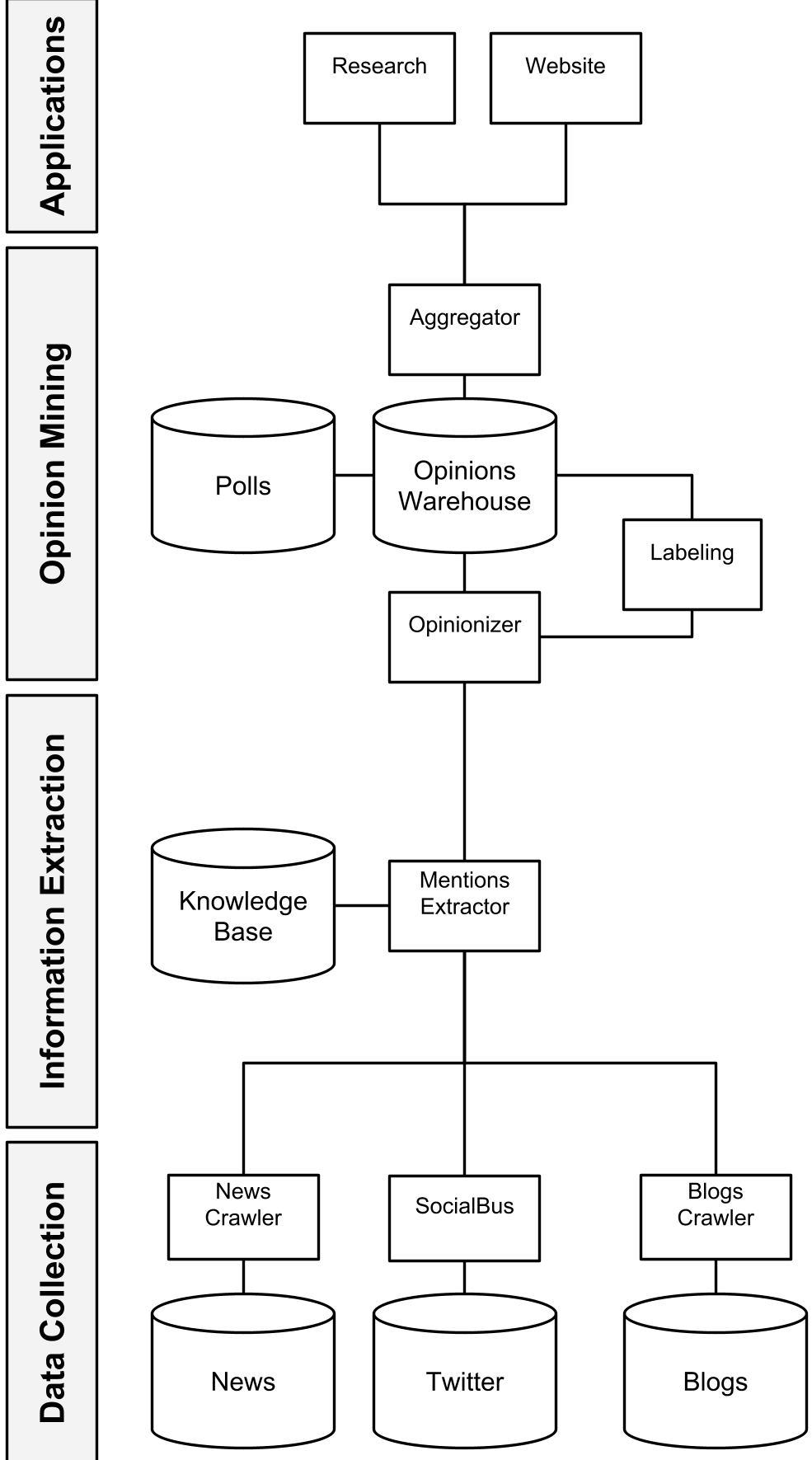
The core of POPmine is its four-stage pipeline: Data Collection, Information Extraction, Opinion Mining, and Application.
1. Robust Information Extraction
To ensure the system tracks the correct politicians, it uses a knowledge base (Verbetes) containing metadata and alternative names. For Twitter, where ambiguity is highest, the authors developed a specialized classifier that uses TF-IDF and SVD (Singular Value Decomposition) to distinguish between "Related" and "Unrelated" tweets.
2. The Sentiment Engine (Opinionizer)
The sentiment analysis module doesn't just look at keywords; it understands context through:
- Neural Word Embeddings: Using Mikolov’s models to capture semantic relationships.
- Hierarchical Clustering: Using Brown clustering to group words with similar distributions.
- Lexical Features: Integrating SentiLex-PT for high-precision polarity detection in Portuguese.
Experiments & Results: Performance at Scale
A key highlight of the study is the system's performance in international benchmarks. Their entity filtering approach won first place at RepLab 2013, proving its effectiveness in cleaning the "noise" of social media.
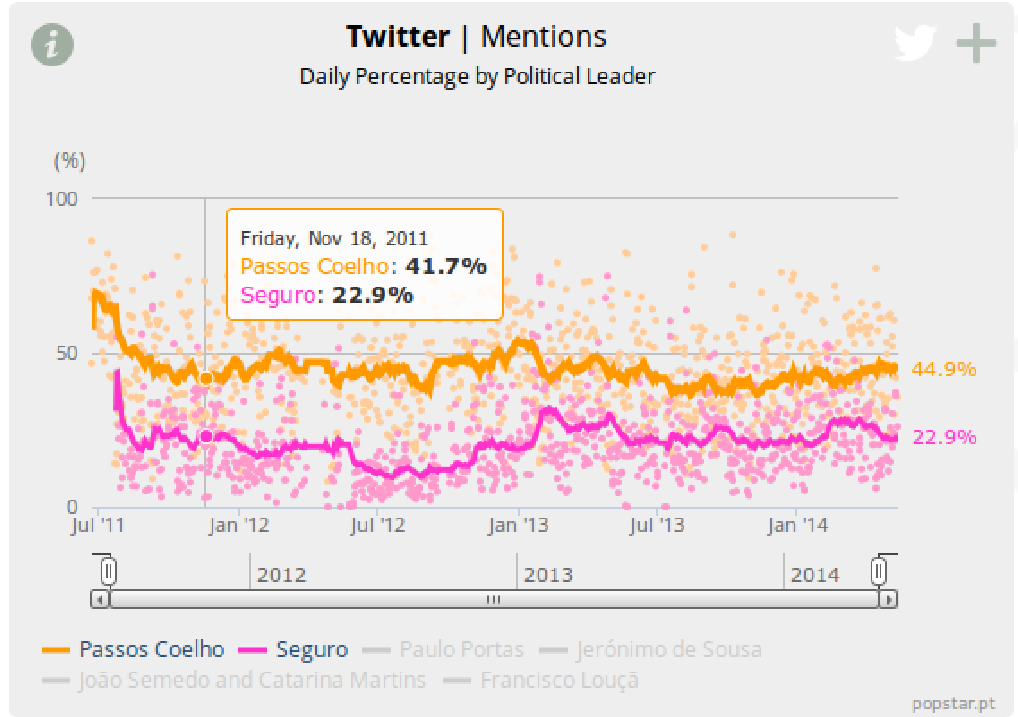
By applying Kalman Filters to the resulting data, POPmine can generate "Buzz" (frequency) and "Polarity" (positive/negative ratio) indicators that are smoothed to remove daily volatility, revealing the underlying trends in public perception.
Critical Analysis & Conclusion
POPmine represents a significant step toward "Computational Social Science." Its Modular and Open Source nature allows researchers to plug in new data sources (like Facebook or YouTube) or focus on different domains (like economy or health).
Takeaways:
- Cross-Media is Key: Analyzing only Twitter provides a skewed view; integrating mainstream news provides a baseline of "media agenda-setting."
- Embeddings Matter: In short-text environments, dense word representations are vital to overcome feature sparsity.
- Disambiguation is the First Step: Sentiment analysis is useless if it's performed on data unrelated to the target entity.
Future Work: The authors aim to integrate "Open Information Extraction" to automatically discover relationships between different political actors and extend the system to broader topical classifications beyond just individual leaders.