
PBCD: Boosting Coordinate Descent with Collective Intelligence and Majority Voting
Population-based coordinate descent algorithm with majority voting
This paper introduces Population-Based Coordinate Descent (PBCD), a novel gradient-free optimization algorithm designed for expensive black-box problems. By integrating collective intelligence via majority voting and space folding, it extends the traditional single-solution Coordinate Descent into a robust population-based framework.
TL;DR
Coordinate Descent (CD) is a classic for high-dimensional optimization, but its single-solution nature often leaves it trapped in local optima. Population-Based Coordinate Descent (PBCD) re-imagines CD by introducing a "democratic" population of solvers. By utilizing Majority Voting and Space Folding, PBCD achieves superior exploration with minimal computational overhead, outperforming traditional CD significantly as problem dimensions grow.
Problem & Motivation: The Exploration-Efficiency Dilemma
In the world of expensive black-box optimization—where every fitness evaluation costs time or money—we face a trade-off. Single-solution methods like Coordinate Descent are "cheap" and exploit local regions well but lack the "vision" to explore. Conversely, population-based methods like Genetic Algorithms explore beautifully but often waste budget on excessive evaluations.
The authors observed that standard CD methods search large spaces using only one thread of thought. Their insight was simple yet powerful: What if a population of CD agents could "vote" on which parts of the search space are most promising?
Methodology: The Three Pillars of PBCD
PBCD transforms the linear search of CD into a collaborative effort through three phases:
- Locating Regions of Interest: Each individual in the population performs a local CD search. For every dimension, it samples a "left," "right," and "center" point.
- Space Folding: Based on the samples, the search space for that individual is "folded" (shrunk) toward the best-performing region. This allows the algorithm to focus its budget on increasingly smaller, high-potential areas.
- Majority Voting (The Consensus Mechanism): This is the core innovation. At the end of an iteration, the top of the population votes on the best interval for each coordinate. The entire population is then re-initialized to the center of these multi-dimensionally "voted" intervals.
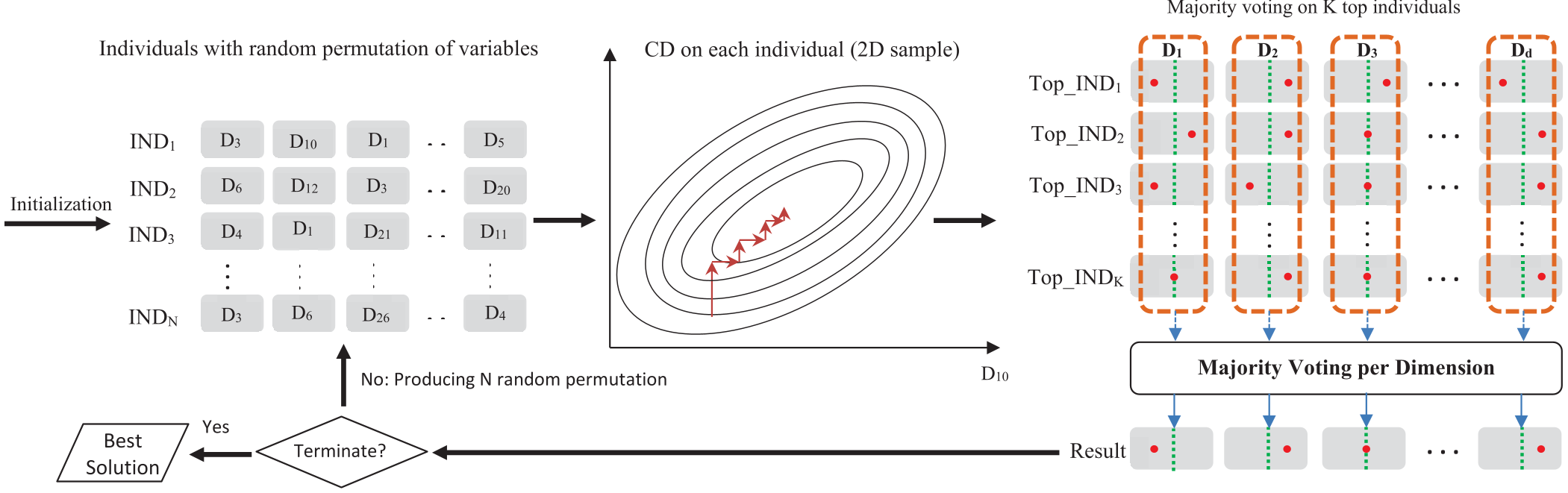 Figure 1: The synergy of local CD exploitation and global majority voting.
Experimental Battleground: CEC-2017 Benchmark
The researchers tested PBCD against standard CD across 29 complex functions with dimensions up to . To ensure a fair fight, both algorithms were given the exact same budget of Function Evaluations (NFE).
Scaling Performance
The results reveal a clear trend: the higher the dimensionality, the better PBCD performs compared to its predecessor.
- At D=30: The race was close (7 wins for PBCD, 7 for CD).
- At D=100: PBCD dominated, winning on 17 functions while CD only managed 4.
The Improved Accuracy Rate (IAR)—a ratio of CD's error to PBCD's error—showed massive gains. For instance, on the uni-modal function F1, PBCD was hundreds of times more accurate.
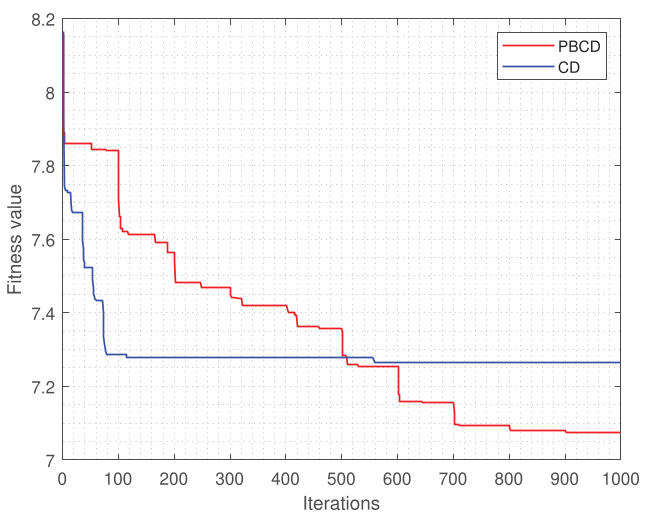 Figure 2: Convergence plots showing PBCD (blue) maintaining a downward trajectory where CD (orange) often plateaus.
Critical Insight: Why Voting Works
Why does voting beat independent runs? In high-dimensional spaces, a single agent is easily deceived by local landscape features. However, when a population of agents—each using a random permutation of coordinates—converges on a similar region, the statistical likelihood that said region contains the global optimum increases. The "Majority Voting" effectively filters out the noise of individual local traps, acting as a robust Inductive Bias for the global search.
Conclusion & Future Look
PBCD is a significant step forward for gradient-free optimization. By adding a communication layer to a local search method, it gains the exploration power of a swarm without the traditional "population tax" on the computational budget.
Future Directions:
- Deep Learning: Applying PBCD to optimize neural network weights or hyperparameters where gradients are noisy or expensive to compute.
- Parallelization: Since each agent performs local CD independently before the voting phase, PBCD is perfectly suited for massive parallelization on modern GPU/CPU clusters.
As we tackle increasingly "expensive" and "large-scale" problems, the hybrid approach of PBCD—combining single-point efficiency with population-level consensus—stands as a compelling architectural blueprint.