
Population Dynamics in IoBNT: Modeling the "Living" Drug Delivery Network
Population Dynamics of Biosensors for Nano-therapeutic Applications in Internet of Bio-Nano Things
This paper introduces a population dynamics model for the Internet of Bio-Nano Things (IoBNT), specifically targeting nano-therapeutic drug delivery. By utilizing a Markov Decision Process (MDP) to simulate the lifecycle of genetically engineered bacterial biosensors, the research achieves a 20-50% increase in information delivery and a 90% enhancement in average biosensor lifetime compared to static models.
TL;DR
Researchers have moved beyond treating nano-biosensors as simple machines by modeling them as living bacterial communities. By applying a Markov Decision Process (MDP) to the lifecycle of these sensors, the study demonstrates that natural biological processes like division and death significantly impact the efficiency of drug delivery, resulting in a 50% increase in information transfer and a 90% improvement in predicted system lifetime.
Establishing the Biological Context
The Internet of Bio-Nano Things (IoBNT) aims to revolutionize healthcare by using engineered bacteria to deliver drugs directly to targets like tumors. However, traditional models often mirror Wireless Sensor Networks (WSN), where nodes are static or have fixed lifespans.
The authors argue that this is fundamentally flawed. In a biological environment, a node (bacterium) doesn't just "exist"—it proliferates via binary fission or succumbs to environmental stressors. Ignoring these Population Dynamics leads to optimized dosages that fail in real-world, dynamic biological "traffic."
Methodology: The MDP Lifecycle
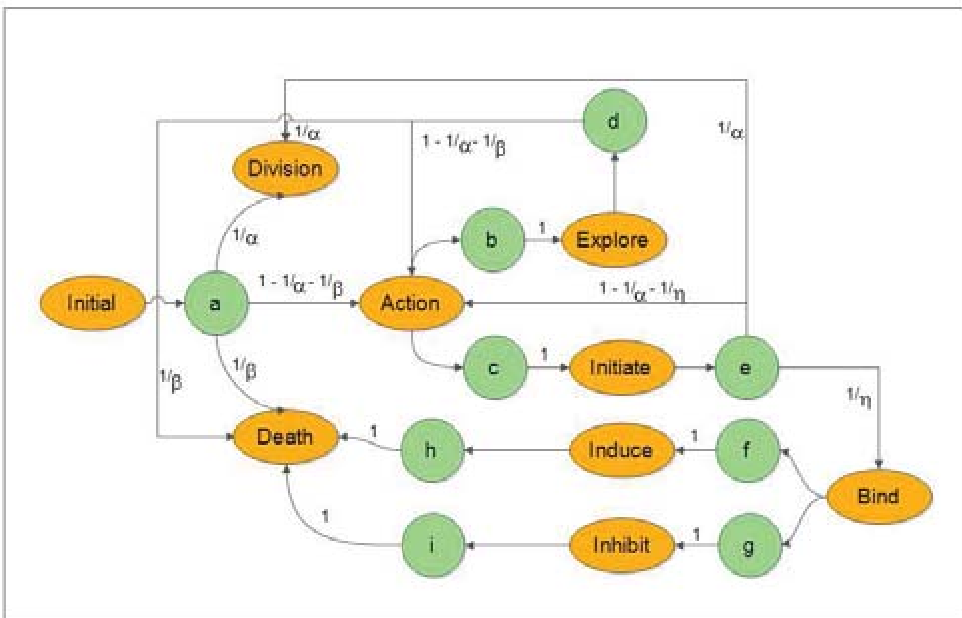
To solve this, the team modeled the biosensor's journey through an MDP. The states transition based on biological triggers:
- S(Division): Governed by rate , representing the birth of a daughter cell.
- S(Death): Governed by rate , representing the removal of a sensor from the network.
- S(Explore/Action): The movement phase using Inducers (to attract) and Inhibitors (to prevent congestion).
The Integrated Framework
The framework connects a macro-scale healthcare provider to the nano-scale domain via a bio-nano interface, as shown in the architecture below:
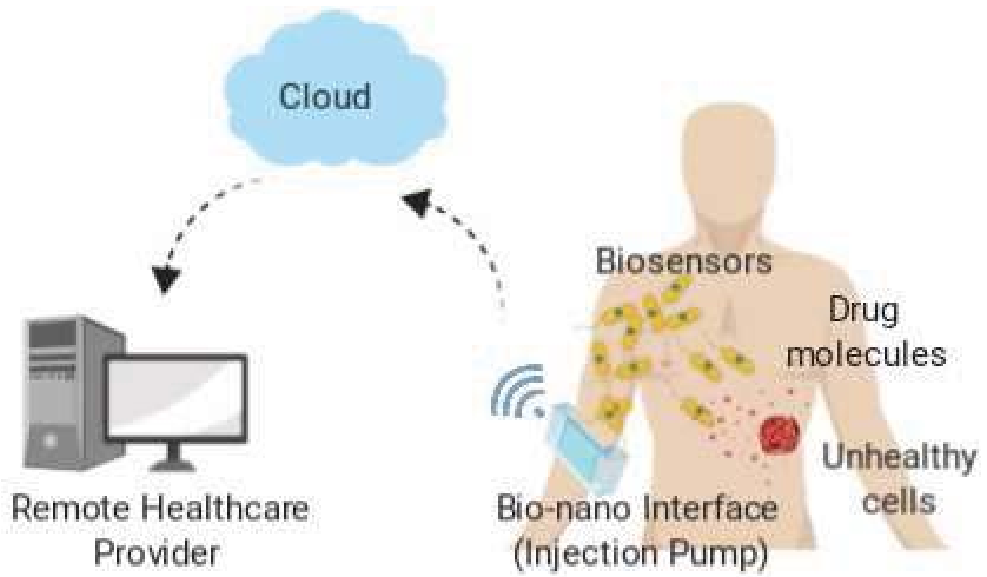
The coordination is driven by Quorum Sensing (QS), a localized decision-making process where bacteria sense chemical concentrations to decide whether to move toward a target or release their payload.
Experimental Analysis: Living vs. Static
The simulation compared a "Basic Model" (no population changes) against the "Proposed Model" (with lifecycle dynamics).
- Throughput & Delivery: The dynamic model saw 20-50% more information molecules delivered to the target. This suggests that the natural proliferation of sensors actually aids in robust target tracking.
- Energy Consumption: A key insight was that while the livelier model is more effective, it is also more "expensive." Energy utilization jumped from 10% in basic models to 50% in the lifecycle-aware model, primarily due to the metabolic costs of division and active exploration.
Critical Insight & Conclusion
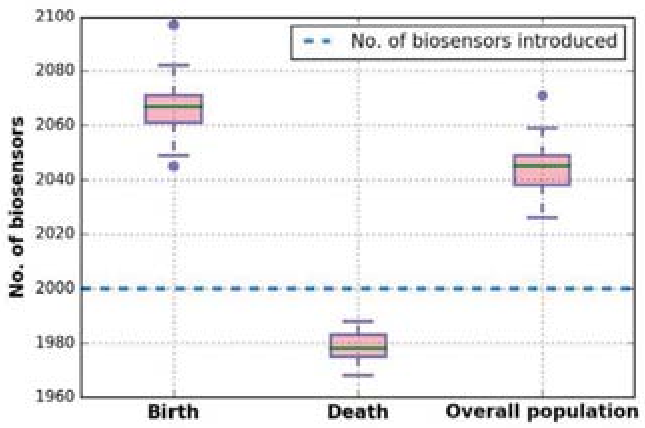
The most striking takeaway is the 90% increase in average biosensor lifetime. When we account for the fact that populations can replenish themselves through division, the "network" effectively becomes much more resilient than a collection of non-replicating robots.
Limitations and Future Work
While the model is a significant step forward, it assumes a fixed drift velocity and does not yet account for the multiplication of the target cells themselves (e.g., a growing tumor). Future iterations will likely need to explore Time-Varying models where both the sensors and the targets are biologically active.
In conclusion, the shift toward populace-aware coordination in IoBNT is not just a theoretical improvement—it is a requirement if we are to design nano-therapeutics that truly mimic the complexity of the human body.