
Decoding the Language of Spikes: Stimulus Recovery with Hodgkin-Huxley Populations
Population Encoding With Hodgkin–Huxley Neurons
The paper investigates stimulus recovery in population encoding using Hodgkin–Huxley (HH) neurons. It proposes a mathematical framework using Input/Output (I/O) equivalence to map complex HH dynamics to simpler Integrate-and-Fire models, achieving State-of-the-Art results in perfect reconstruction of bandlimited signals and optimal spline-based recovery for stochastic stimuli.
TL;DR
This research establishes a rigorous mathematical bridge between high-fidelity biophysical neuron models and signal processing. By proving that complex Hodgkin-Huxley neurons are Input/Output (I/O) equivalent to simpler "Project-Integrate-and-Fire" models, the paper provides the first formal algorithms for perfectly or optimally recovering sensory stimuli from population spike trains.
Problem & Motivation: Beyond the Black Box
In both theoretical neuroscience and information theory, the "Neuron" is often abstracted as a simple aggregator. However, real biological neurons—governed by the Hodgkin-Huxley (HH) equations—are intricate nonlinear dynamical systems.
The challenge has always been: If we only see the spikes (time events), can we mathematically reconstruct the continuous stimulus that caused them? Prior work often relied on "Reverse Correlation," which treats the neuron as a black box. This paper rejects that, instead leveraging the underlying physics of the HH model to build a "Time Decoding Machine" (TDM).
Methodology: The Magic of I/O Equivalence
The core innovation lies in I/O Equivalence. The author demonstrates that under different coupling conditions, an HH neuron acts as a specific type of integrator:
1. Multiplicative Coupling
In this mode, the stimulus essentially changes the "speed" of the neuron's internal clock. The paper proves this is equivalent to an Integrate-and-Fire (IAF) neuron with a variable threshold.
2. Additive Coupling & The Phase Response Curve (PRC)
For additive stimuli, the system moves along a limit cycle. The author introduces the Project-Integrate-and-Fire (PIF) model. Here, the stimulus is projected onto the neuron’s Phase Response Curve (PRC)—a sensitivity map indicating how much an input at a specific phase shifts the next spike.
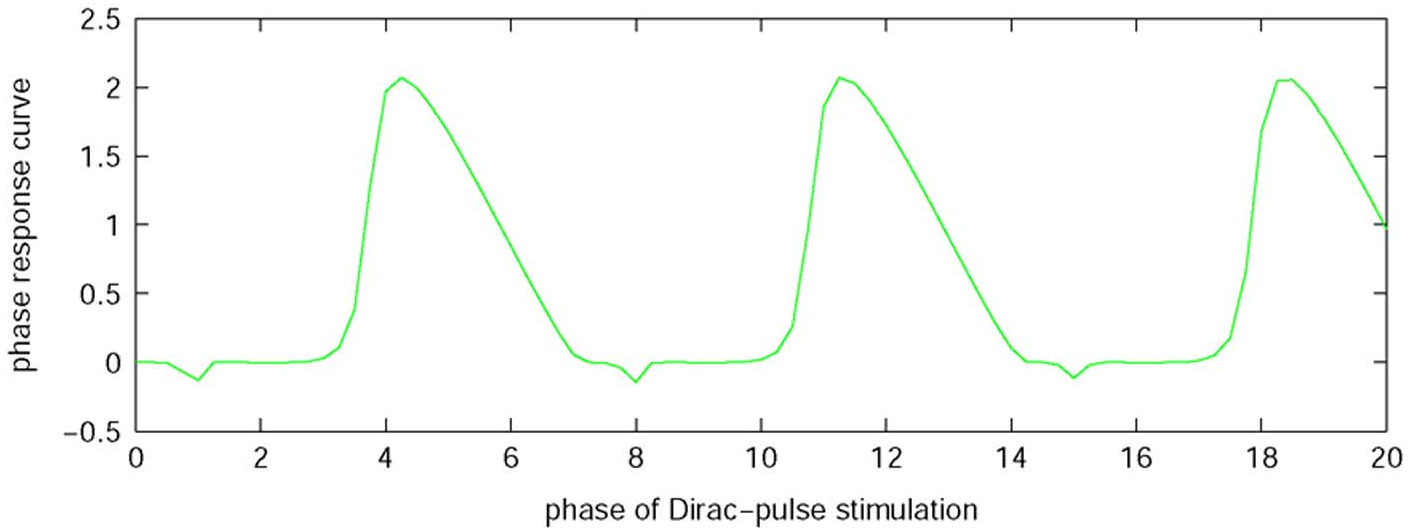 Figure 1: The Phase Response Curve (PRC) identifies the sensitivity of the neuron's cycle to external perturbations.
Mathematics of Reconstruction
Once the neuron is mapped to a PIF model, the spike times become "measurements" of the signal. The stimulus is reconstructed using:
- Interpolation Splines: For deterministic systems, finding the smoothest signal that matches the observed spikes.
- Smoothing Splines in RKHS: For stochastic systems (where conductances have noise), using a regularization parameter to balance data fidelity against signal smoothness.
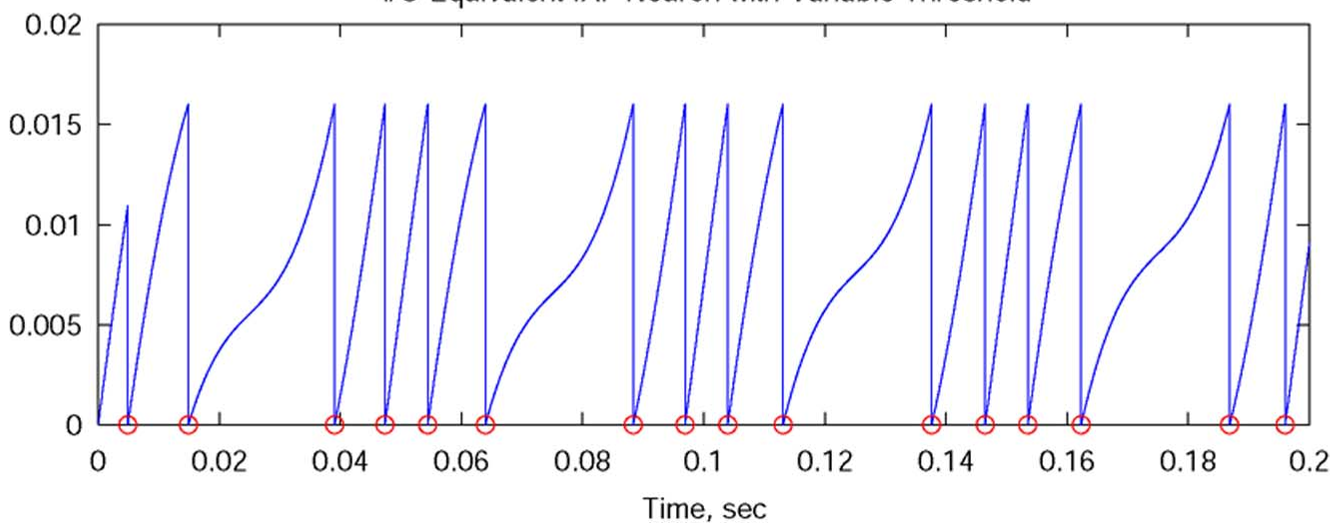 Figure 2: Visualization of the I/O equivalence between an HH neuron and its simplified timing equivalent.
Experiments & Results
The paper provides a theoretical and algorithmic proof-of-concept for population encoding:
- Perfect Recovery: For bandlimited signals, if the neuron population fires fast enough (Nyquist rate), the reconstruction is exact.
- Numerical Stability: By using Reproducing Kernel Hilbert Spaces (RKHS), the reconstruction remains robust even when the neuron gating variables are driven by white noise (Brownian motion).
- Population Scaling: The error in recovery decreases as the number of neurons in the population increases, justifying the massive redundancy found in biological sensory organs.
Critical Analysis & Conclusion
Takeaway
This paper is a cornerstone for Neuromorphic Engineering. It suggests that we can build Analog-to-Digital converters that represent info in the time domain (spikes) rather than the amplitude domain, potentially bypassing the voltage limitations of modern integrated circuits.
Limitations
The "First-Order" I/O equivalence assumes that the stimulus is "weak" enough not to knock the neuron off its limit cycle entirely. In cases of extremely strong or high-frequency stimuli, the phase-reduction model (PRC) might lose accuracy.
Future Work
The author points toward real-time recovery algorithms and the application of these TDMs to complex natural signals like video and speech, potentially revolutionizing how we design neuro-prosthetics.