
Networked Genetic Algorithms: Why Population Structure is the Secret to Avoiding Local Optima
Population network structure impacts genetic algorithm optimisation performance
This paper introduces the Networked Genetic Algorithm (NGA), a novel framework that replaces the standard fully connected population structure with complex network topologies (Erdos-Rényi and Albert-Barabasi). By constraining mating to networked neighbors, the method consistently outperforms standard GAs on benchmark functions like Rastrigin, Sphere, and Ackley.
TL;DR
Standard Genetic Algorithms (GAs) allow any two solutions to "mate," which often leads to the "super-individual" problem—where a single good solution takes over too fast, causing premature convergence. Aymeric Vié’s research introduces Networked Genetic Algorithms (NGA), proving that by restricting mating through specific network topologies (like Random or Scale-Free graphs), we can achieve up to a 53% improvement in optimization performance.
The Problem: The Curse of the "Complete Network"
In the world of Evolutionary Computation, the standard GA is essentially a "panmictic" population—a social structure where everyone can interact with everyone. While this sounds efficient, it creates a massive Inductive Bias toward exploitation over exploration. In complex fitness landscapes (like the Ackley or Rastrigin functions), a "pretty good" solution appearing early on will quickly spread its genes to the entire population, effectively killing the diversity needed to find the true global optimum.
Methodology: Engineering Social Constraints
The core insight of the NGA is to treat the population as a Graph , where individuals are nodes and edges represent mating eligibility.
- Selection: The first parent is chosen via standard fitness-proportionate selection.
- Constrained Mating: The second parent is not chosen from the whole population, but strictly from the neighbors of the first parent in the network.
- Topologies: The author tested two primary structures:
- Erdos-Rényi (ER): Random graphs where connectivity is controlled by probability .
- Albert-Barabasi (AB): Scale-free graphs that mimic real-world social networks with "hubs" (nodes with many connections).
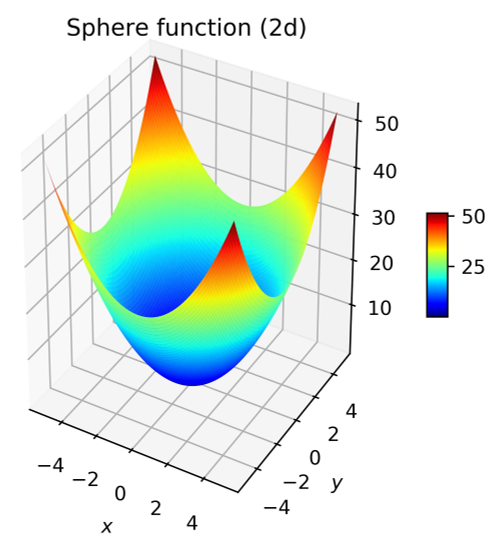 Figure: Various network topologies used to constrain the GA population, from disconnected islands to fully connected grids.
Critical Results: The "Goldilocks" Zone of Connectivity
The research found that optimization performance follows a non-linear path relative to network density.
1. The Threshold of Connectedness
In Erdos-Rényi networks, performance is abysmal until the network reaches the "connectedness threshold" (). Before this, the population is split into isolated islands, and evolution relies almost purely on mutation.
2. Intermediate Density is King
The most striking finding is that fully connected networks (Standard GA) are rarely optimal. The best results occurred at intermediate densities. These structures allow "pockets" of the population to explore different areas of the search space simultaneously, with the low "average shortest path length" ensuring that once a truly superior gene is found, it can still propagate—just not instantaneously.
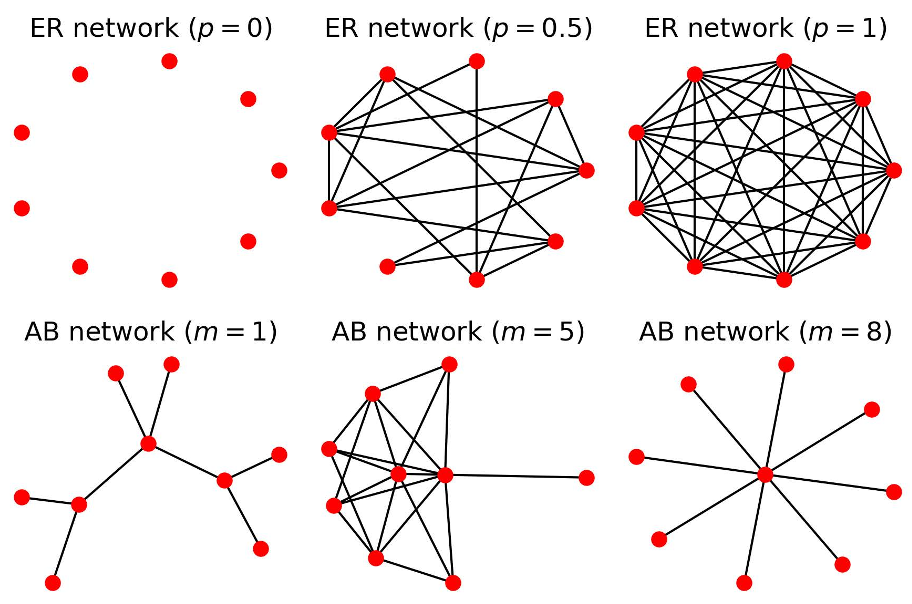 Figure: Average fitness vs. link probability p. Note how intermediate values often outperform the p=1.0 (Standard GA) case.
3. Beating the Baseline
The NGA didn't just marginally improve results; it significantly crushed the standard GA baseline. As shown in the table below, the ER and AB variants consistently achieved much lower fitness values (closer to the 0.0 optimum).
 Table: Quantitative comparison between Standard GA, ER-networked GA, and AB-networked GA.
Academic Insight: Why it Works
The success of the NGA lies in its ability to manage the Exaptation of genetic traits. By slowing down the diffusion of high-fitness genomes, the network acts as a natural "buffer." This is conceptually similar to Distributed GAs or Cellular GAs, but Vié’s work brings it into the rigorous framework of Network Science.
The specific success of scale-free (AB) networks suggests that having a few "hubs" helps aggregate information, while the "periphery" nodes provide the necessary genetic drift to escape local minima.
Conclusion and Future Outlook
This paper serves as a vital reminder that structure matters. Future AI research shouldn't just focus on the operators (mutation/crossover) but also on the topology of the information flow.
Limitations: The study used static networks. The next frontier—Network Control—would involve dynamic networks that change their topology in real-time based on the population's convergence state, potentially starting sparse to encourage exploration and tightening up for a final "burn-in" toward the optimum.