
Population Protocols on Real Social Networks: From Math Theory to Human Reality
Population protocols on real social networks
This paper presents the first experimental evaluation of Population Protocols (PP) on real-world dynamic social networks. By using wearable active RFID tags to capture face-to-face interactions among 120 volunteers, the authors demonstrate that PPs for Threshold, Modulo, and Comparison predicates successfully converge on realistic topologies, despite the sparsity and non-uniformity of human mobility.
Executive Summary
TL;DR: This study bridges the gap between the theoretical model of Population Protocols (PP)—designed for agents with near-zero memory and no infrastructure—and the messy, unpredictable reality of human movement. Using RFID-captured social traces, the authors prove that these decentralized algorithms actually work on real-world topologies, though "contact density" is the primary bottleneck for convergence speed.
In the academic landscape, this paper represents a shift from purely analytical proofs to empirical validation, using high-resolution spatial data to challenge the assumptions of traditional distributed computing models.
Problem & Motivation: The "Fairness" Myth
Traditional Population Protocols assume a "fair adversary" or a uniform random scheduler. In plain English, the math assumes everyone talks to everyone else eventually, and with equal probability.
The Reality Check: Human interaction is neither fair nor random. It is:
- Sparse: You only interact with a fraction of the population.
- Clustered: Students stay with students; museum-goers stay near specific art pieces.
- Dynamic: Contacts are fleeting and depend on physical proximity.
The authors' intuition was simple: If we can't assume a complete graph, can these tiny "finite state machine" agents still reach a global consensus using only opportunistic encounters?
Methodology: Capturing Human "Edge" Data
The authors deployed two infrastructures using SocioPatterns active RFID tags. These aren't your typical long-range sensors; they record a contact only when two people are face-to-face within 1 meter.
1. Data Collection Scenarios
- DIIAG (Departmental setting): Long-term (1 week), stable social groups, lower density.
- MACRO (Art Museum): Short-term (3 hours), high-density interactions in a shared space.
2. Implementation in NetLogo
The agents in the simulation weren't moving randomly. They followed the literal "footsteps" (interaction timestamps) of the volunteers.
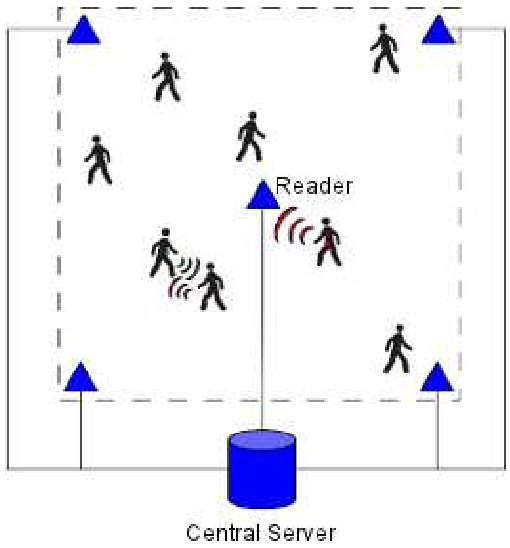 Figure 1: The reference architecture for capturing physical interactions and translating them into a simulation graph.
The Core Challenge: The Comparison Predicate
While simple tasks like Threshold (is #a > T?) were easy, the Comparison Predicate (is #a > #b?) proved difficult. In sparse networks, agents with "a" might never find agents with "b" to perform the necessary "cancellation" step if they are in different social clusters.
To solve this, the authors utilized State Swapping:
- When two agents meet, even if they don't change states based on the protocol, they might swap their internal states.
- This acts as a "virtual mobility" mechanism, allowing information to jump between social clusters even when the physical individuals don't move between groups.
Experimental Results: Density is King
The team tested three types of predicates: Threshold, Modulo, and Comparison.
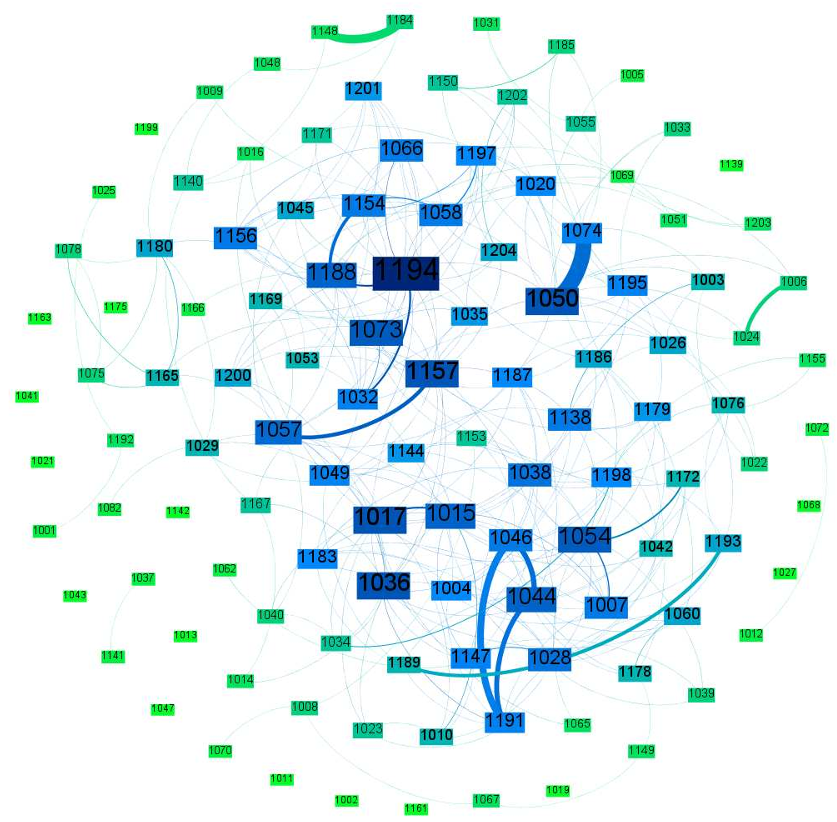 Figure 2: Contrast between DIIAG (top) and MACRO (bottom) interaction graphs. The MACRO graph shows higher contact density.
Key Findings:
- The 80% Rule: In all real-world traces, the majority of the population (≈80%) reaches the correct conclusion very quickly. The "long tail" of convergence is caused by isolated nodes or low-degree nodes who rarely interact.
- Macro vs. DIIAG: The MACRO installation converged 10x faster than DIIAG. Why? Because the "contact density" (contacts per timestamp) was significantly higher in the museum hall than in the spread-out university department.
- Swapping works: Without State Swapping, Comparison Predicates in sparse networks often failed to stabilize. Increasing the swap probability directly improved convergence speed on real social topologies.
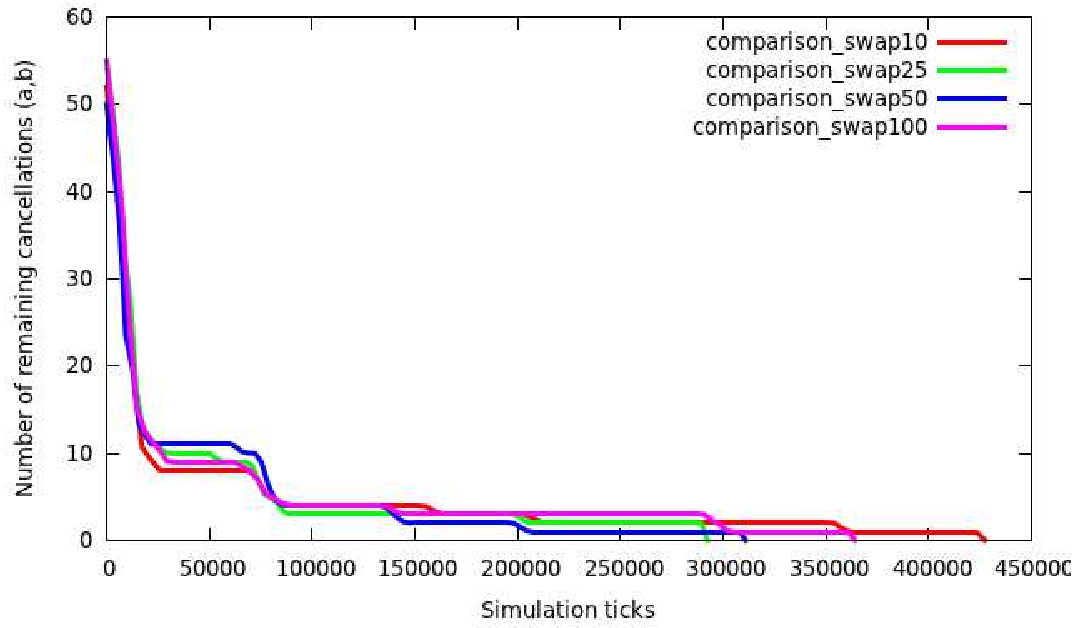 Figure 3: Comparison Predicate convergence. Note how different swapping probabilities (0.1 to 1.0) accelerate the reduction of remaining pairs.
Critical Analysis & Conclusion
Takeaway: Population Protocols are viable for real-world ad-hoc social networks. The study proves that decentralization doesn't require a perfectly connected graph—just enough "churn" to keep information moving.
Limitations:
- Isolated Nodes: The paper had to remove nodes that never interacted. In a real system, these nodes would remain "ignorant" of the global state.
- Energy Cost: While PPs are computationally cheap, frequent RFID polling to detect proximity is the real energy drain—a factor not fully explored in the simulation.
Future Outlook: This research paves the way for "infrastructure-less" social apps—systems where a group of people can vote, reach a consensus, or share a reputation score during a conference or emergency, relying solely on the phones in their pockets and the people they walk past.