
Population Protocols: Do Decentralized Algorithms Work on Real Social Networks?
Population protocols on real social networks
This paper presents the first experimental evaluation of Population Protocols (PP)—a decentralized computational model for resource-constrained agents—on real-world dynamic social networks. Using active RFID tags to capture face-to-face interactions among volunteers, the authors demonstrate that while real-world social topologies delay absolute convergence compared to theoretical random graphs, PPs remain functional and effective for basic distributed tasks.
TL;DR
Population Protocols (PP) are designed for environments where tiny, "dumb" sensors need to compute global information through local interactions. This study moves PP out of the classroom and into the real world, using RFID data from social events to prove that while real-world "friendship circles" and "physical barriers" slow down the math, the algorithms still reach the right answer.
Background Positioning
In the hierarchy of distributed computing, Population Protocols represent the "minimalist" extreme—no IDs, very limited memory, and unpredictable connections. While mathematically beautiful, they are usually analyzed under "uniform random" conditions. This work is a SOTA empirical validation, bridging the gap between theoretical distributed systems and real-world Human-Computer Interaction (HCI).
Problem & Motivation: The "Fairness" Myth
The core of PP theory relies on a "fair" scheduler: the idea that every agent will eventually meet every other agent. In reality, humans don't move like gas molecules in a jar. We stay in rooms, talk to the same three friends, and avoid strangers.
The authors identified a critical gap: Does the social structure of our movements break the logic of these protocols? If a sensor in a student's pocket only ever "talks" to sensors in the same lab, can the entire building ever agree on a global count (threshold) or a vote (comparison)?
Methodology - The Core
The team deployed active RFID tags (SocioPatterns) that only record a contact when two people are within 1 meter and facing each other. This is a much higher fidelity signal than Bluetooth or GPS.
The Testbeds:
- DIIAG: A 1-week deployment in a university department (stable social groups, lower contact density).
- MACRO: A 3-hour art opening (dynamic, high contact density, transient interactions).
The Algorithms:
They tested three "semilinear" predicates:
- Threshold: Is the count of property X T?
- Modulo: Is the count of X j (mod k)?
- Comparison: Are there more A's than B's? (This is the hardest, requiring a "cancellation" logic).
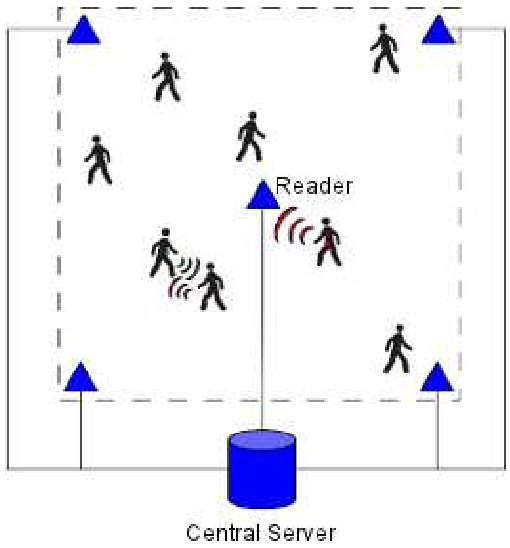 Above: The architecture used to collect face-to-face interactions via RFID tags and readers.
Experiments & Results
The researchers used NetLogo to replay these "social traces" and run the protocols on top of them.
1. The Speed Gap
On a Random Topology, nodes converge almost instantly in a smooth curve. On the DIIAG Social Topology, the curve has a long "tail." While 80% of the department knows the answer quickly, the last 20% (the "loners" or people in isolated offices) take a massive amount of time to get the update.
2. The Comparison Challenge
The "Comparison" predicate proved to be the most sensitive. If you want to know if there are more "Type A" people than "Type B," the two types must physically meet to "cancel each other out." In a sparse social network, a Type A and Type B person might never meet!
To fix this, the authors implemented State Swapping: when two people meet, even if they aren't the right "types" to cancel, they swap their internal status. This effectively allows data to "jump" across the network, simulating the movement that the humans themselves aren't making.
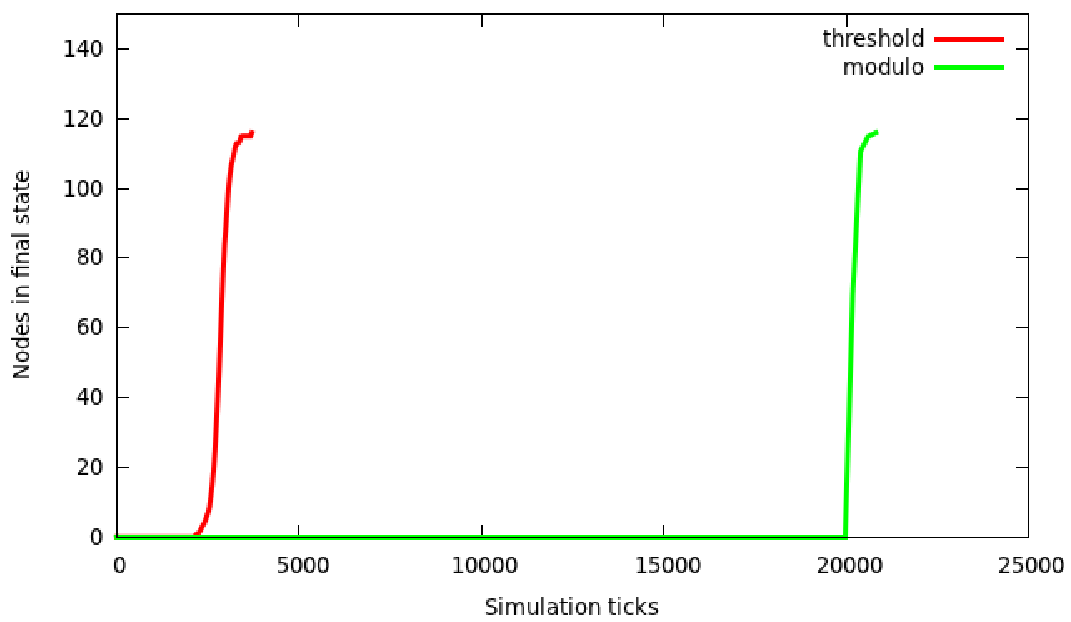 Above: Comparison of convergence rates between Random, DIIAG, and MACRO topologies. Note the steeper descent in the MACRO setup due to higher contact density.
Critical Analysis & Conclusion
Takeaway
The study confirms that population protocols are robust. Even with the "skewed" fairness of real human movement, the network stabilizes. The MACRO exhibition results show that high physical density can actually rival random models in efficiency.
Limitations
- Scaling: The study used ~120 nodes. In a city-wide deployment of millions of sensors, the "isolated community" problem might be insurmountable without persistent state swapping.
- External Observers: For the Comparison predicate, the researchers had to use an "external observer" to define termination, which isn't possible in a truly decentralized system.
Future Outlook
This work lays the foundation for "Socially-Aware Distributed Systems." Future protocols might need to intentionally identify "social bridges" (popular people) and use them as high-priority data carriers to speed up convergence in sparse networks.