
AOMF: Maximizing Positive Sentiment in a World of Mistrust and Signed Networks
Positive opinion maximization in signed social networks
The paper introduces the Activated Opinion Maximization Framework (AOMF) to address the Positive Opinion Maximization problem in signed social networks. It combines a Multi-stage Linear Threshold (MLT) model for node activation with a dynamic DeGroot model for opinion evolution, outperforming traditional Influence Maximization (IM) methods on six real-world datasets.
TL;DR
Researchers have developed the Activated Opinion Maximization Framework (AOMF), a novel approach to social network marketing that doesn't just look for "popular" people, but specifically targets those who can flip negative sentiments into positive ones. By modeling both the threshold of influence and the dynamic flow of opinions in networks with enemies and friends (signed networks), they achieved over 14% better sentiment outcomes than previous state-of-the-art methods.
Background: Why "Influence" Isn't Enough
For a decade, the gold standard in social media strategy was Influence Maximization (IM)—the art of picking users to trigger a viral cascade. However, IM has a fatal flaw: it assumes every "infected" user becomes a brand advocate. In reality, a user might see an ad, become "activated," and then post a scathing negative review.
The transition from IM to Opinion Maximization (OM) is crucial. OM recognizes that opinions exist on a spectrum (from -1 to +1) and that negative relationships (the "minus" signs in a network) can actively destroy value.
The Problem: The Complexity of Signed Dynamics
The authors identify three missing links in current research:
- Static vs. Dynamic: Most models assume an opinion is fixed once a user is influenced.
- Unsigned vs. Signed: Most models ignore "enemy" links, which are common in platforms like Slashdot or Bitcoin markets.
- Activation Paradox: An activated individual might not actually share the desired opinion.
The authors prove that solving this in a signed network is NP-hard and, mathematically, the objective function is non-submodular. This means the "diminishing returns" rule doesn't apply, making the optimization extremely tricky.
Methodology: The AOMF Framework
To solve this, the authors proposed a three-stage pipeline:
1. Heuristic Candidate Selection
Instead of checking every node, a heuristic rule selects candidates based on their initial opinion, their neighbors' opinions, and the weights of their outgoing trust/distrust links.
2. Activated Opinion Model
This is the "heart" of the paper. It combines two mathematical foundations:
- MLT (Multi-stage Linear Threshold): Determines when a node wakes up and starts caring about the topic.
- DeGroot Model: Simulates the "tug-of-war" of opinions. A node's opinion at time is a weighted average of its internal belief and the expressed opinions of its neighbors (adjusted by trust/distrust).
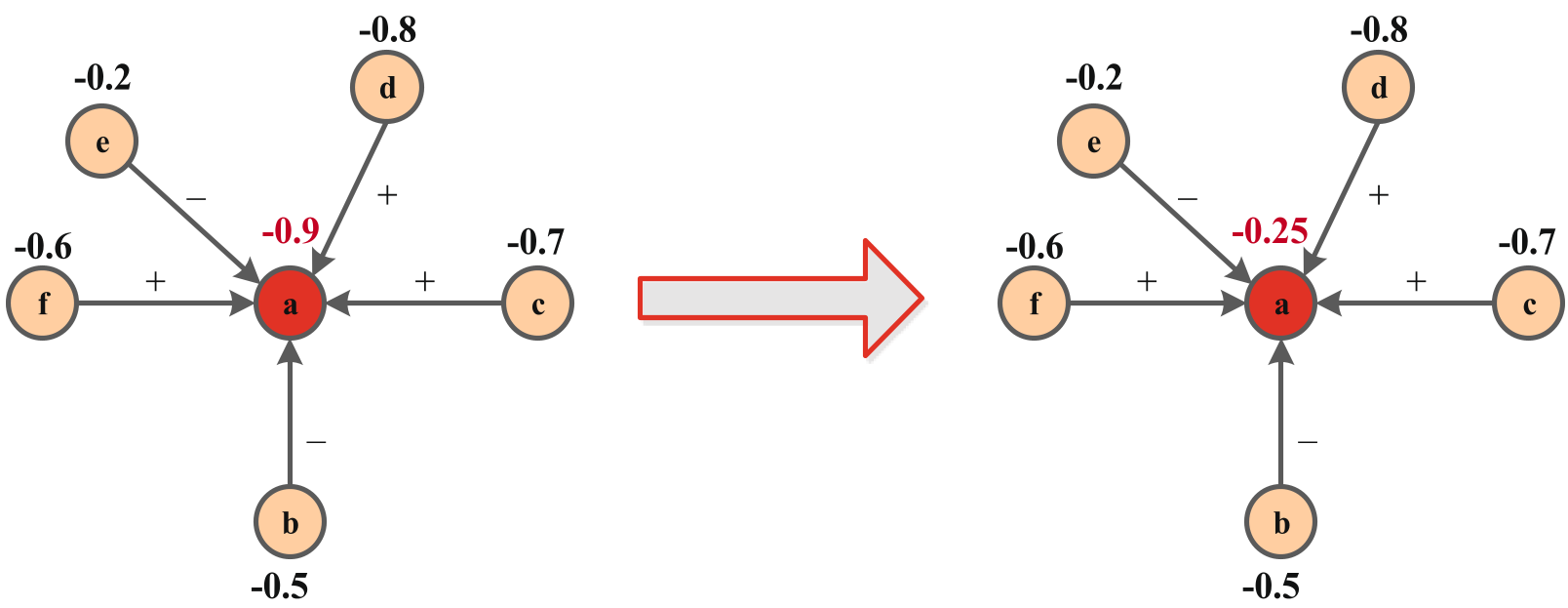 Fig 1: Illustrating how a node's positive orientation can flip to negative based on the consensus of its distrusted neighbors.
3. Iterative Determination
The seeds are chosen in stages. This allows the model to "see" how the network is reacting and adjust the next batch of influencers accordingly.
Experimental Proof: Better Sentiment, Faster Results
The framework was tested on six major datasets, including Bitcoin OTC and Wikipedia Elections.
- Performance: AOMF consistently reached higher "Potential Opinion" (the net sum of positive minus negative sentiment) compared to the RISNIM algorithm and degree-centrality baselines.
- Positive Ratio: On the Bitcoin Alpha dataset, AOMF increased the ratio of positive users by 32.8% compared to the initial state.
- Efficiency: While a standard Greedy algorithm might take hours to converge on large graphs (like Epinions), AOMF provides a near-identical result in a fraction of the time by leveraging its heuristic candidate pool.
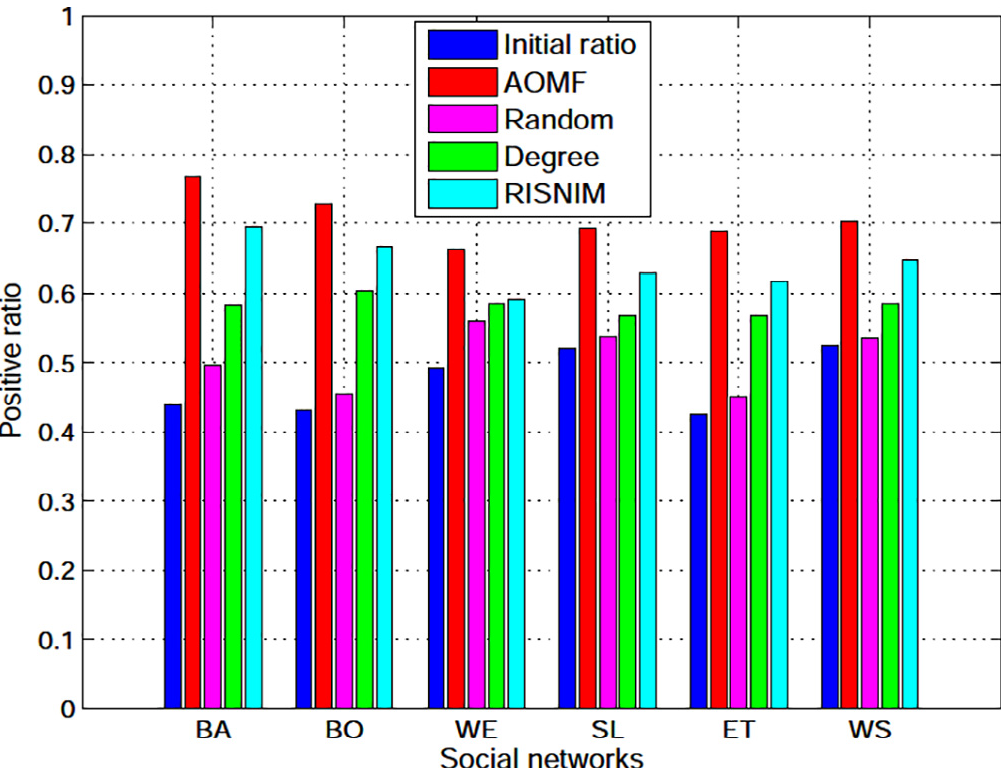 Fig 2: Positive ratio comparisons across six network datasets, showing AOMF's consistent lead.
Critical Insight: The "Enemy of My Enemy" Logic
What makes this work so fascinating is its respect for Signed Social Networks. In a signed network, a negative weight means "I disagree with or distrust this person." Most algorithms break down here. AOMF uses these negative weights to predict when an influencer might actually repel people, allowing for a selection strategy that avoids triggering a backlash.
Conclusion & Future Work
The AOMF proves that in modern social media, who you trust matters as much as who you follow. For product promotion, this means targeting users who aren't just "connected," but are "trusted" within specific clusters.
Limitations: The model assumes initial opinions are known, which requires sentiment analysis in practice. The authors suggest their next step is exploring competitive scenarios—where two brands are fighting for the same "opinion space" simultaneously.