
POSN: Reclaiming Privacy via Decentralized Hybrid Cloud-Mobile Social Networking
POSN: A Personal Online Social Network
The paper introduces POSN (Personal Online Social Network), a privacy-preserving decentralized OSN platform that eliminates central servers. It combines a phone-to-phone (P2P) architecture for direct interaction with free cloud storage for hosting encrypted content, achieving both high availability and user data sovereignty.
TL;DR
The dominance of centralized Online Social Networks (OSNs) like Facebook has turned personal data into a commodity. POSN (Personal Online Social Network) presents a paradigm shift by decentralizing the ecosystem. It replaces central servers with a clever hybrid: Mobile devices for direct interaction and Free Storage Clouds for encrypted data availability. The result is a system that mimics real-world privacy—ensuring your data stays between you and your friends.
Context: The Privacy-Availability Paradox
In the world of decentralized systems, researchers have long faced a trade-off. Peer-to-Peer (P2P) systems offer great privacy but suffer from high churn: if your friend's phone is offline, you can't see their updates. Conversely, centralized clouds offer 100% availability but zero privacy.
The authors of POSN recognize that "free" cloud storage (Dropbox, Google Drive) is an underutilized resource. They ask: Can we use these clouds as "dumb" storage lockers for encrypted data, while the "intelligence" stays on our phones?
Methodology: The Hybrid Architecture
POSN’s architecture is built on three pillars:
- Encrypted Storage: Users upload content to their personal cloud folders. Everything is encrypted before it leaves the phone. The cloud never sees plaintext.
- Group-Based Key Management: Since encrypting a post individually for every friend is inefficient, POSN uses symmetric group keys. These keys are shared via public-key infrastructure during "Friendship Establishment."
- Peer-to-Peer Signaling: When two friends are simultaneously online, their phones connect directly (Phone-to-Phone) to exchange real-time updates and push notifications, bypassing the cloud for low-latency interactions.
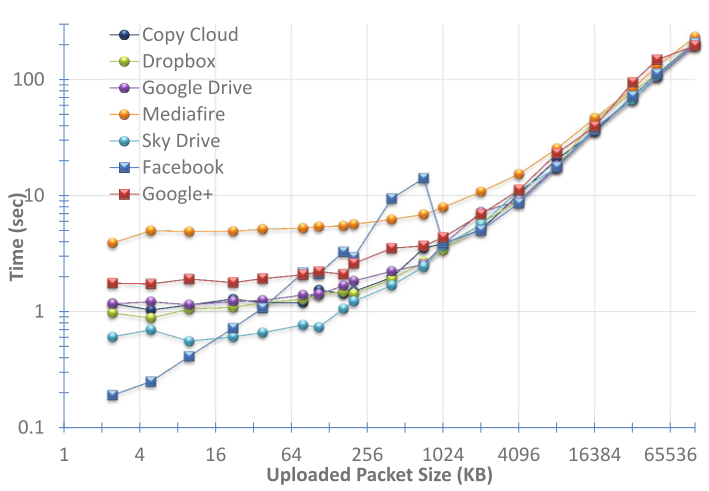 Figure 1: The dual-layer approach of POSN combining Cloud Storage and Direct P2P interaction.
Solving the "Social" in Decentralized
A major contribution of this work is how it handles traditional OSN features that usually require a database:
- Commenting: Instead of a central "Comment Thread," POSN uses distributed comment files. Friends write to their own cloud folders, and the content owner aggregates these pointers to display the thread.
- Search: To avoid downloading every friend's entire history, POSN builds a Search Index on the client-side. The phone preemptively fetches small index files from friends to make local searching instantaneous.
- Optimization via Social Intuition: By prioritizing connections with friends who have the "most common friends" or "highest online duration," POSN reduces the network overhead of checking for updates by over 50%.
Performance vs. The Giants
One might assume that jumping through cloud APIs would be slow. However, the study's benchmarks tell a different story.
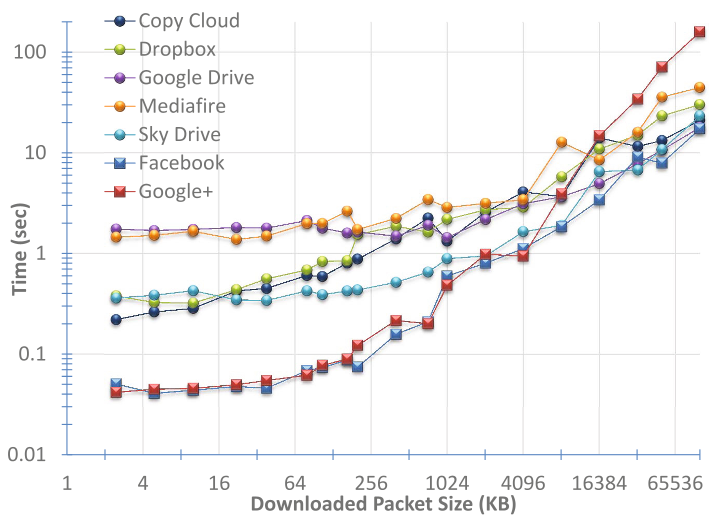 Figure 2: Upload/Download latency of various cloud providers vs. Facebook and Google+.
The data shows that for files larger than 1MB (like photos and videos), cloud storage performance is essentially indistinguishable from Facebook. While encryption adds a ~22% latency penalty, the authors argue this sub-second delay is a negligible price for total data sovereignty.
Critical Insight: Why This Matters
The "Web3" and "Decentralized" hype often focuses on blockchains, which are expensive and slow for storing gigabytes of social media. POSN offers a more pragmatic path: Social Overlay Networks.
By treating the cloud as a commodity utility rather than a service provider, POSN effectively "blinds" the infrastructure. Even if a cloud provider tracks IP addresses, they cannot see the social graph or the content content.
Limitations & Future Outlook
While POSN is robust against service providers, it still relies on SMS/Email for initial trust—points of failure if those accounts are compromised. Furthermore, while it handles "unfriending" via key rotation, the metadata of who communicates with whom (traffic analysis) remains a challenge.
In conclusion, POSN demonstrates that we don't need a "Social Media Giant" to have a rich social experience. All we need is the storage we already have and a smarter way for our devices to talk to each other.
Summary Takeaway
- Scalability: Leverages existing cloud infra for free.
- Privacy: End-to-end encryption with user-managed keys.
- Innovation: Decentralized commenting and search index structures for mobile.