
Evolutionary Game Theory in MSNs: Can Cooperation Survive Without Rewards?
Poster: Towards Opportunistic Resource Sharing in Mobile Social Networks -an Evolutionary Game Theoretic Approach
This paper explores the emergence of cooperation in Mobile Social Networks (MSN) using Evolutionary Game Theory (EGT). It introduces a modified Small World In Motion (SWIM) mobility model and applies the Moran death-birth process to simulate how opportunistic resource sharing can become a self-sustaining behavior without external incentive schemes.
Executive Summary
TL;DR: This research investigates whether mobile users can spontaneously cooperate to share resources (like data or storage) without needing "points" or "reputation" systems. By applying Evolutionary Game Theory (EGT) to a refined mobility model, the authors prove that when movements are localized and social structures emerge, cooperation can actually defeat the "selfish" Nash Equilibrium.
Positioning: This work bridges the gap between theoretical sociology (Evolutionary Games) and network engineering (Mobile Ad Hoc Networks), providing a theoretical justification for decentralized, zero-incentive cooperation in MSNs.
Problem & Motivation: The "Free-Rider" Dilemma
In any opportunistic network, sharing costs something—battery, bandwidth, or storage. Basic game theory suggests that a rational actor should always "defect" (take resources but never give), leading to a network collapse where no one shares.
To combat this, engineers usually build complex incentive layers (credits, tokens, or reputation scores). However, the authors leverage a different Insight: In the real world, people don't move randomly; they stay in "locales" and interact with the same groups. Does this structural clustering change the game?
Methodology: EGT Meets Realistic Mobility
1. The Refined SWIM Model
The authors found that standard mobility models were too "dispersive." They introduced a moving range constraint () to ensure users stay within realistic boundaries.
This creates a network that looks less like a random mesh and more like a social cluster.
2. The Game Architecture
The system uses a Moran death-birth process. Every round:
- Users interact and calculate Fitness: .
- A user is chosen to "die" (strategy update).
- They adopt a neighbor's strategy with a probability proportional to that neighbor's fitness.
 Figure 1: Conceptual overview of the opportunistic contact and game evolution process.
Experiments & Results: The Power of Heterogeneity
The most striking finding is the role of Mobility Heterogeneity. When some users move a lot and others stay local (following a power-law distribution), the cooperation rate () sustains much better than in a uniform environment.
Key Findings:
- Cost () is the Threshold: Cooperation only peaks when the cost of sharing is low.
- The Clustering Effect: A limited moving range (around ) acts as a "buffer" that allows clusters of cooperators to survive against defectors.
- Small-World Advantage: As the social structure becomes more clustered, the "Overall Benefits" of cooperation outweigh the risks of being exploited by a few defectors.
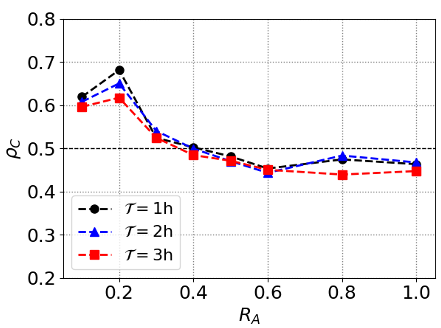 Figure 2: (a) Cooperation rate vs Cost. Note how Heterogeneous mobility (Red) outperforms Homogeneous mobility (Blue) in sustaining cooperation.
Critical Analysis & Conclusion
Takeaway
This paper provides a mathematical "green light" for decentralized MSNs. It suggests that if we design networks to favor local interactions, we might not need the heavy architectural burden of reputation systems.
Limitations
- Convergence Time: The model requires up to 1,000 simulated hours for strategies to stabilize, which may be unrealistic for highly dynamic or short-lived networks.
- Binary Strategies: Real users might use "tit-for-tat" or probabilistic cooperation rather than pure C or D.
Future Work
The next step for this research involves moving from synthetic mobility (SWIM) to real-world datasets (like San Francisco taxi traces) to see if these "cooperation islands" naturally form in urban environments.