
Unmasking the Ghost Networks: A Postmortem of 2016 Election Suspensions on Twitter
A postmortem of suspended Twitter accounts in the 2016 U.S. presidential election
This paper presents a comprehensive postmortem analysis of approximately one million Twitter accounts involved in the 2016 U.S. presidential election that were subsequently suspended. Utilizing the Louvain community detection algorithm on retweet and mention networks, the authors identify coordinated malicious behaviors and evaluate the effectiveness of Twitter's updated countermeasures.
TL;DR
Researchers at the University of Iowa performed a massive "autopsy" on nearly 1 million Twitter accounts suspended after the 2016 U.S. election. By grouping these accounts into communities, they discovered that malicious actors aren't just lone wolves; they operate in highly coordinated clusters. The study reveals that 90% of accounts caught in later "purges" were already connected to previously banned groups, suggesting that central "hub" accounts are the key to platform manipulation.
Background: Beyond the Russian "Troll Farms"
Most accounts of the 2016 election interference focus on a few thousand Russian IRA (Internet Research Agency) accounts. However, this paper argues that the scale of manipulation was far broader. By analyzing a dataset of nearly 10 million users, the authors found that roughly 9.5% were eventually suspended. This "postmortem" approach allows us to see what Twitter's automated systems eventually caught, providing a ground-truth map of the "dark side" of the social network.
The "Synchronized" Fingerprint
Why were these accounts suspended? The authors suggest that individual signals (like how often an account tweets) are easy to fake, but coordinated behavior at the community level is much harder to hide. They looked at five critical dimensions:
- Dominant Poster: A single account doing all the talking for a group.
- Dominant Content Producer: Everyone in the group retweeting a single "master" account.
- Burstiness: Sudden, unnatural spikes in activity.
- Dominant Domain: Pushing a specific website (e.g., eBay for merch, or propaganda sites).
- Dominant Hashtag: Flooding the zone with specific political slogans.
Methodology: Mapping the Web of Influence
The researchers built a Retweet and Mention Network to see who was interacting with whom. Unlike "follower" counts, which are passive, retweets and mentions represent active engagement.
Using the Louvain Algorithm, they clustered these accounts into 9,554 distinct communities.
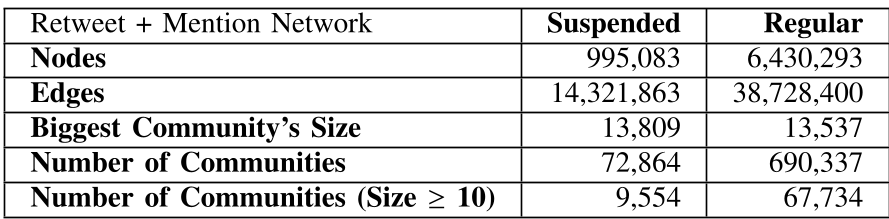 Table 1: The sheer scale of the network analysis, comparing suspended vs. regular communities.
Key Findings: The Anatomy of Suspended Communities
The results were striking. In regular communities, conversation is distributed. In suspended communities, it is often a "dictatorship."
- The Power of One: 38.3% of suspended communities had a single "Dominant Poster" responsible for over half the content. In regular communities, this happened only 3% of the time.
- Heterogeneity: Not all suspended accounts were "Russian Trolls." The authors found communities dedicated to:
- Political Merchandise: Selling "Chicken Trump" or "Hillary Love" stickers via eBay.
- Niche Causes: Support for LGBTQ+ rights (which were still suspended for automated spamming).
- Pornographic Spam: Using political hashtags like #MakeAmericaGreatAgain to drive traffic to adult sites.
 Figure 2: Example of "Burstiness" in the Vote!BlackLivesMatter community, showing unnatural spikes in activity.
The "Purge" and the Future of Moderation
One of the most valuable parts of this study is the longitudinal check. In 2018, the authors identified the first wave of suspended accounts. In 2019, they checked again and found 192,000 more accounts had been banned in a massive "purge."
The Smoking Gun: Over 90% of these newly suspended accounts were directly connected to the communities identified a year earlier. Furthermore, 72% were retweeting the exact same "dominant content producers" from the old suspended groups.
This proves that Twitter’s "new" countermeasures are essentially following the breadcrumbs of network connections. If you hang out with suspended accounts and retweet the same masters, you are eventually going to be purged.
Critical Insight & Conclusion
This paper shifts the focus from who the actors are (Russian, Iranian, or commercial) to how they behave. The core takeaway is that Network Inductive Bias is a powerful tool for platforms. By targeting the "hubs" of these communities—the dominant retweet producers—Twitter can effectively collapse the entire coordinated network.
However, the study also highlights a limitation: 25% of suspended accounts did not fall into these highly coordinated clusters. This suggests that while "coordinated behavior" detection is effective, there is still a significant amount of "stealthy" manipulation that evades community-level analysis.
For researchers and developers, the lesson is clear: individual account features are no longer enough. To secure a platform, you must look at the graph.