
Marketing 4.0: Data-Driven and Mobile Strategies Outshine the AI Hype
Potential Benefits of New Online Marketing Approaches
This study investigates the impact of emerging digital marketing trends—including AI, Data-driven Marketing, and Programmatic Advertising—on overall marketing potential. Using Structural Equation Modeling (SEM) through SmartPLS on expert survey data (n=102), the research identifies Data-driven and Mobile Marketing as the primary drivers of modern online marketing success.
TL;DR
In the rapidly evolving landscape of digital marketing, not all shiny new tools are created equal. This study quantitatively proves that Data-driven Marketing and Mobile Marketing are the true drivers of modern business potential, while hyped technologies like AI and Programmatic Advertising failed to show significant positive influence among experts.
The Problem: The Complexity of the "Marketing 4.0" Era
The days when a single expert could handle all online marketing are long gone. Today, the field is a fragmented ecosystem of SEO, SEA, and social media. Enterprises are overwhelmed by choices: should they invest in AI bots, dynamic pricing engines, or programmatic ads? The lack of empirical evidence regarding which of these actually moves the needle leads to wasted budgets and strategic paralysis.
Methodology: Testing the Hype
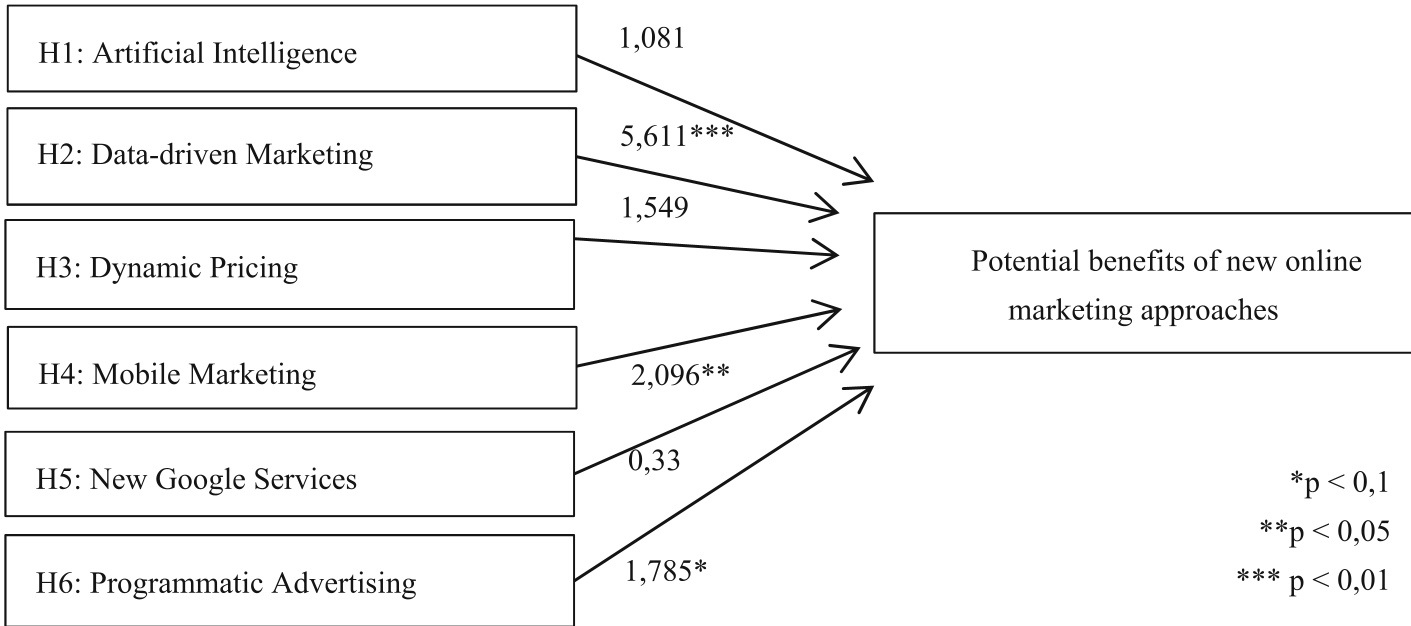
The research team from Aalen University focused on six core determinants of modern marketing. They surveyed 102 marketing experts and applied Structural Equation Modeling (SEM)—a sophisticated statistical method that visualizes and measures the strength of causal relationships between variables.
Key Results: Reality Check for AI
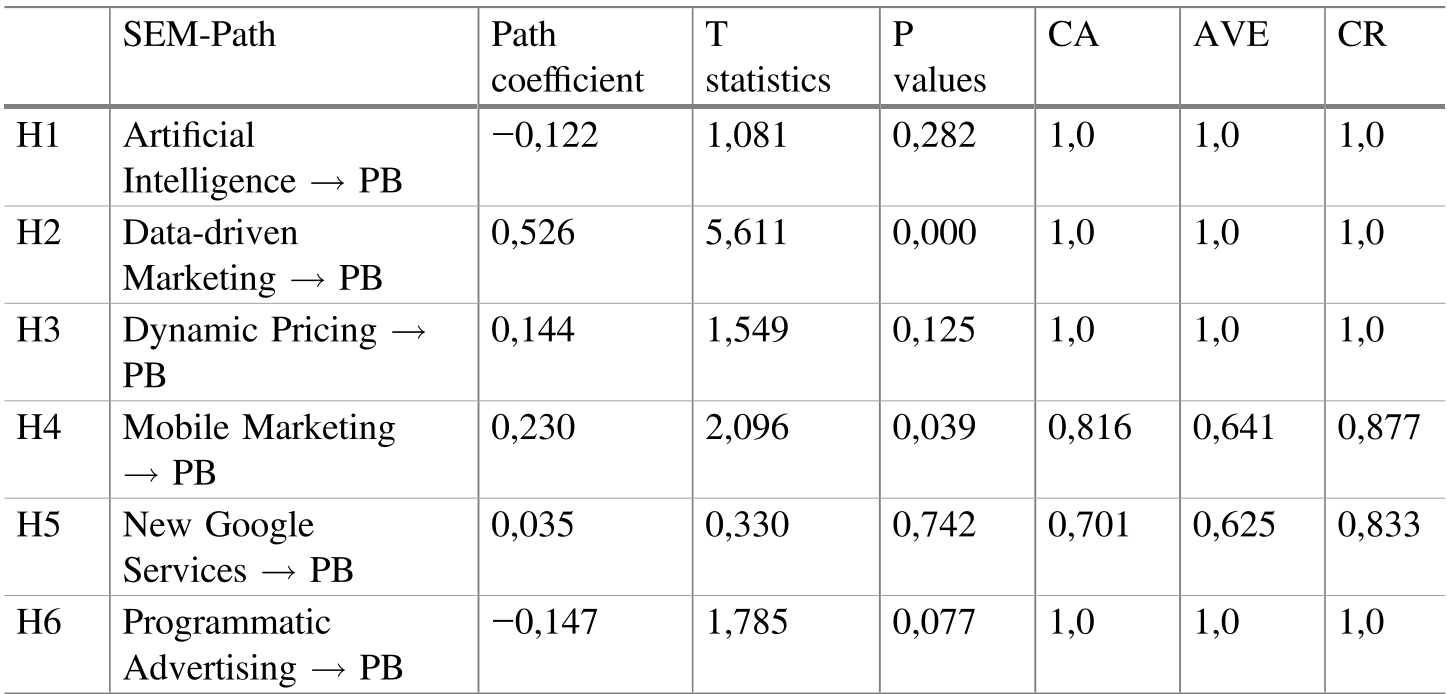
The results from the SmartPLS analysis (shown in the table below) provide a stark contrast to typical industry buzz:
- The Gold Mine: Data-driven Marketing: With a path coefficient of 0.526, it is the single most dominant factor. Using web analytics to replace "gut feelings" significantly boosts campaign performance and sales.
- The Essential: Mobile Marketing: Significant at 0.230, proving that time- and space-independent usability is no longer optional—it's a core benefit driver.
- The Great Disappointment: AI & Programmatic Advertising: Both showed negative path coefficients and lacked statistical significance. For experts, AI is currently suffering from a "meaningful deployment gap," where the perceived value hasn't yet translated into quantifiable marketing potential.
- The Risk: Dynamic Pricing: While it has a slight positive trend, its lack of significance suggests that the risk of damaging customer trust (the "price fairness" issue) often outweighs the margin gains.
Deep Insight: Why Data Beats Intuition
The findings suggest a fundamental shift in the role of the marketer. Data-driven marketing strengthens the marketer's position within a company because success becomes provable. When marketing is no longer based on intuition but on tracked performance, it transforms from a "cost center" to a "growth engine."
The failure of AI to show significance likely stems from its complexity. While Amazon Echo or Siri represent the "future," for the average enterprise, these tools are not yet practical avenues for daily customer acquisition compared to the reliable ROI of localized Google services or mobile optimization.
Conclusion and Takeaways
This study serves as a strategic roadmap for enterprises:
- Stop Chasing Hype: Don't invest in AI just because it's a buzzword. Focus on your data infrastructure first.
- Go Mobile-First: Leverage viral effects and pre-purchase information via mobile apps to simplify the customer journey.
- Data over Gut: Transition your decision-making processes to rely on Web-Analytics. Personalized, data-backed campaigns are the only way to increase Customer Lifetime Value effectively in the "Marketing 4.0" world.
Limitations: The study was conducted primarily in German-speaking countries. Future research should explore if these "Anti-AI" sentiments persist in more tech-aggressive markets like the US or China.