
SIoT-Enhanced Crowdsensing: Leveraging Social Objects for Sustainable Task Allocation
Power consumption due to node i's functioning. s i Speed of node i. X k Set of nodes that can contribute to task k. τ i Lifetime for node i. CS-ME CrowdSensing micro engine. MCS Mobile crowdsensing. ME Micro engine
This paper introduces a framework that integrates the Social Internet of Things (SIoT) with Mobile Crowdsensing (MCS) to assign geolocated sensing tasks. By leveraging social relationships between objects, it implements a fair resource allocation algorithm that optimizes task distribution based on real-time energy profiles and mobility.
TL;DR
In the era of pervasive IoT, your smartphone is more than just a tool; it's a "social object." This paper proposes a breakthrough in Mobile Crowdsensing (MCS) by utilizing the Social Internet of Things (SIoT) to balance sensing workloads. By treating devices as members of a social network, the system can FAIRLY distribute tasks, extending network lifetime by 40% while maintaining high data accuracy.
The Motivation: Why Your Sensors are "Anti-Social"
Current Mobile Crowdsensing (MCS) models treat devices as isolated data silos. When a central server needs temperature data from a geofenced area, it either broadcasts to everyone (wasting energy) or picks nodes randomly (ignoring battery health).
The authors identify a critical gap: Trust and Resource Awareness. Without a social context, we can't easily:
- Discover the most reliable nodes.
- Share energy profiles (to avoid redundant power-hungry characterization).
- Coordinate fairly to ensure no single device "dies" first.
Methodology: The Socialized Micro-Engine
The core of this work is the CS-ME (Crowdsensing Micro-Engine), built upon the Lysis platform. It operates through a 4-layer structure: Real-World Objects, Social Virtual Objects (SVOs), Aggregation, and Application.
1. Social Relationship Exploitation
The system uses specific social links to optimize the network:
- POR (Parental Object Relationship): Devices of the same model share their energy profiles so a "new" device doesn't have to waste battery learning its own consumption rates.
- CLOR (Co-location): Used to identify clusters of devices within the target geofence.
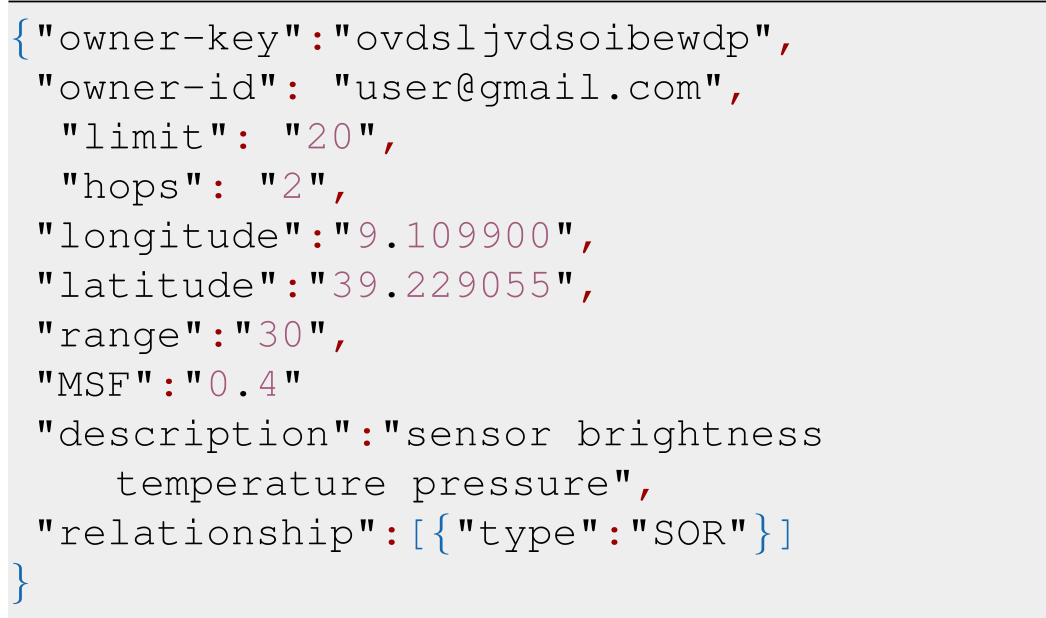
- SOR (Social Relationship): Based on frequent encounters to evaluate the trustworthiness of a node.
2. The Lifetime-Equalization Algorithm
The authors define system lifetime () as the time until the first node fails. To maximize this, they derived a frequency for each node :

This ensures that nodes with more residual energy or more efficient sensors take on a higher frequency, while "fast-moving" nodes (likely to leave the geofence) or low-battery nodes are filtered out.
Experimental Evidence: Success in the Campus
Using a testbed of 20 Android devices at the University of Cagliari, the authors generated synthetic mobility traces and real energy profiles for 6 different smartphone models.
Key Results:
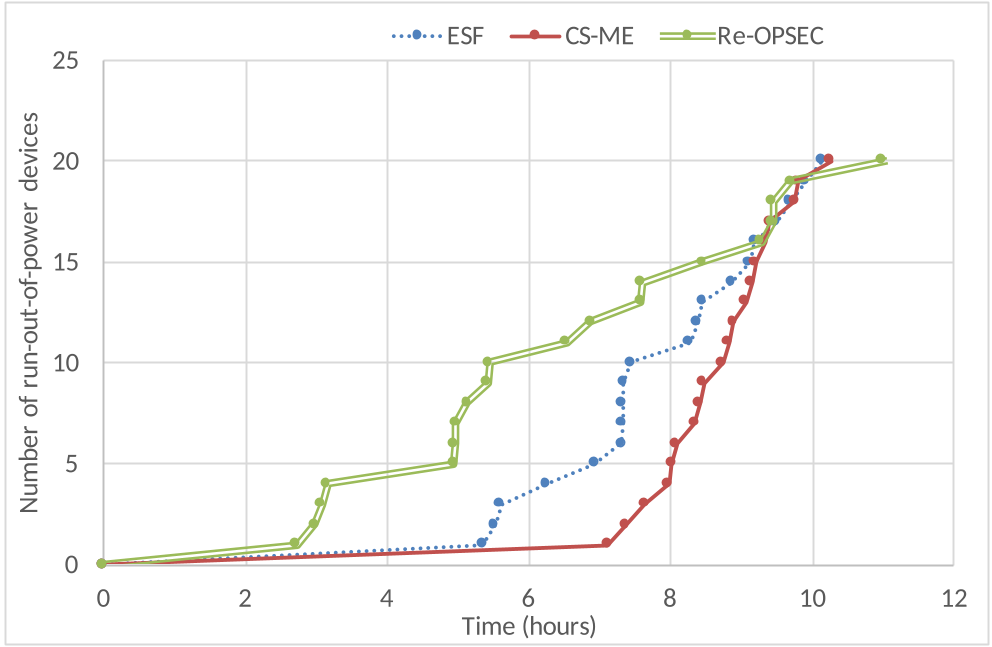
- Battery Gains: The CS-ME approach outperformed established baselines like Re-OPSEC and ESF (Equal Sampling Frequency). By extending the first-node death-time by 40%+, it allows the sensing campaign to persist much longer.
- Accuracy: Even as devices enter and leave the geofence, the CS-ME keeps the sampling error below 3%.
- Energy Efficiency: The "middle-path" policy of CS-ME balances between being "Smartphone Friendly" (saving battery) and "Collector Friendly" (ensuring data density).
Critical Analysis & Future Outlook
The beauty of this work lies in the Physical-Social Intuition. By recognizing that devices belonging to the same owner or produced by the same manufacturer "know" things about each other, we can reduce the overhead of management.
Limitations:
- The current model relies on the Lysis cloud platform; moving this to a fully decentralized edge-based architecture would further reduce latency.
- The mobility rules ( parameter) assume linear movement; unpredictable human behavior in dense urban areas might require more complex Markovian models.
Future Work: The authors suggest extending this to actuators (e.g., smart vehicles, drones), where the "social relationship" could dictate complex collaborative physical actions, not just passive sensing.
Senior Editor's Note: This paper is a significant SOTA milestone for SIoT, proving that social metaphors are mathematically sound tools for solving the Hard-IoT problem of resource scarcity.