
PPDCA: Bridging the Gap Between Crowdsourcing Utility and Local Differential Privacy
PPDCA: Privacy-Preserving Crowdsourcing Data Collection and Analysis With Randomized Response
The paper introduces PPDCA, a novel Privacy-Preserving Crowdsourcing Data Collection and Analysis framework. It combines a Complementary Randomized Response (C-RR) mechanism with a Deep Learning-based decoding model to achieve Local Differential Privacy (LDP) while significantly improving data reconstruction accuracy for heavy-hitter estimation.
TL;DR
PPDCA (Privacy-Preserving Crowdsourcing Data Collection and Analysis) is a breakthrough framework that addresses the notorious "accuracy-privacy" trade-off in crowdsourcing. By introducing a Complementary Randomized Response (C-RR) mechanism and a TensorFlow-based neural decoder, it achieves significantly higher accuracy in heavy-hitter estimation than Google's RAPPOR, all while satisfying the rigorous requirements of Local Differential Privacy (LDP).
The Core Dilemma: Plausible Deniability vs. Accurate Insights
In the era of IoT and smart devices, companies need to collect user data (like browsing history or app usage) to improve services. However, users demand privacy.
Traditional Differential Privacy often requires a "trusted curator," but in the real world, curators are often "honest-but-curious" or vulnerable to hacks. Local Differential Privacy (LDP) solves this by perturbing data on the client-side before it is sent. The problem? Existing LDP methods like RAPPOR are often too "noisy," making it difficult for analysts to reconstruct the true population distribution or identify "heavy hitters" (the most frequent items) accurately.
Methodology: The PPDCA Innovation
The authors tackle this issue from two angles: smarter perturbation and smarter decoding.
1. Complementary Randomized Response (C-RR)
Instead of a simple coin flip, C-RR uses a complex six-round randomization process.
- PRR & COP: These rounds ensure "plausible deniability" while trying to keep the randomized bit as close to the original Bloom filter bit as possible.
- IRR & COI: These provide protection against tracking attacks while retaining the mathematical features needed for the subsequent machine learning phase.
2. Neural Network as a Decoder
The most significant departure from prior work is the use of a Multilayer Perceptron (MLP). While earlier methods used linear regression or simple statistical counting, PPDCA treats data reconstruction as a non-linear multi-classification problem.
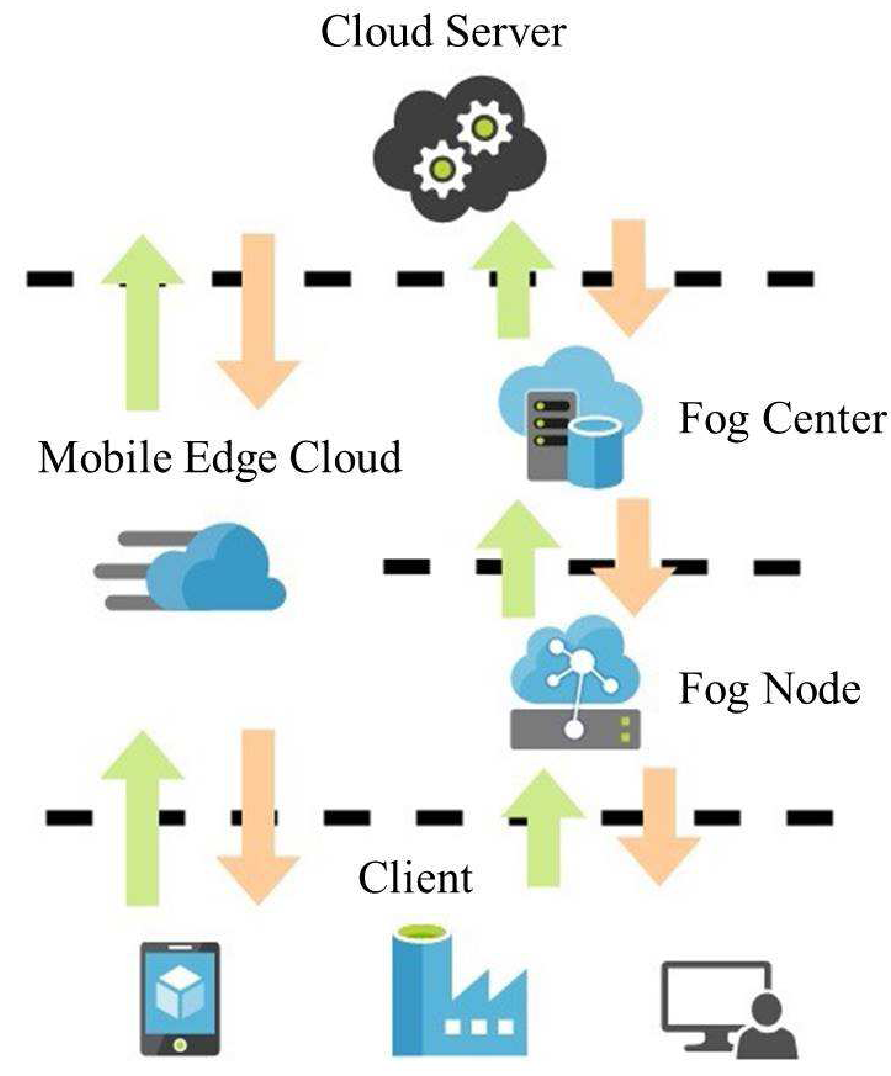 Figure 1: The PPDCA System Model, utilizing a Fog/Edge computing architecture to distribute the learning load.
The network is trained using Softmax activation and Categorical Cross-entropy loss to map the noisy -bit vectors back to their most likely original strings.
Experimental Evidence: SOTA Performance
The researchers tested PPDCA against RAPPOR and MLDP using the Kosarak (web clickstream) and MHEALTH (sensor signals) datasets.
Key Findings:
- Accuracy Gains: PPDCA improved prediction accuracy by up to 30% over RAPPOR.
- Privacy Budget (): Even with a small privacy budget (strong privacy), PPDCA's ability to preserve features allowed it to maintain higher utility than competitors.
- Optimization: The study found that Stochastic Gradient Descent (SGD) with two hidden layers provided the best convergence for reconstructing randomized data.
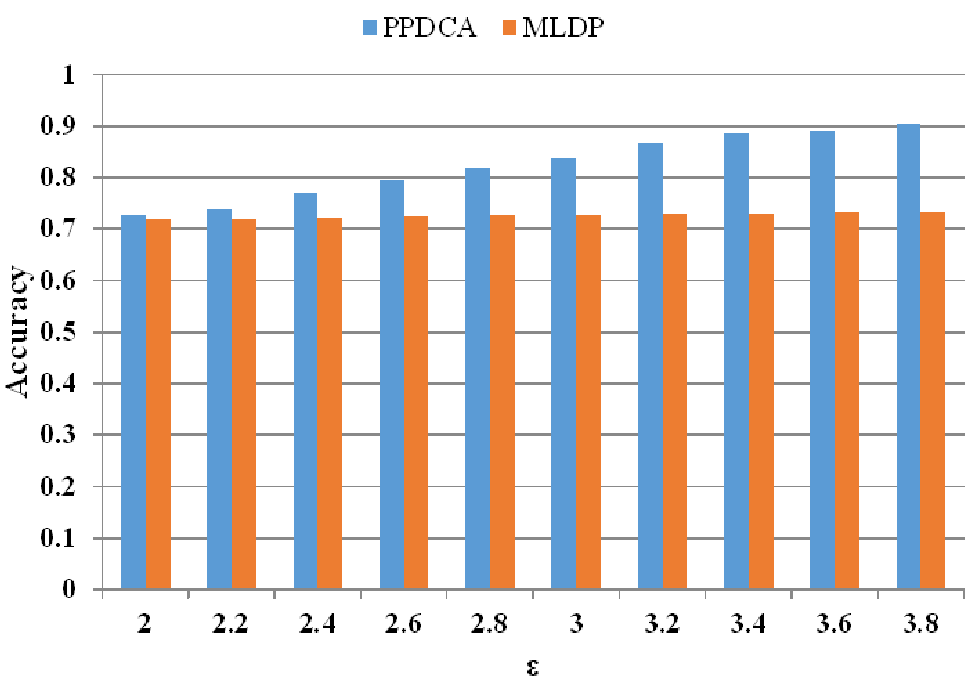 Figure 2: Accuracy of PPDCA vs. MLDP across different privacy budgets (). As increases, PPDCA's advantage becomes more pronounced.
Deep Insight & Conclusion
PPDCA proves that we don't have to settle for "good enough" statistics in privacy-preserving systems. The shift from statistical estimation to Deep Learning-driven reconstruction allows us to extract far more signal from the noise.
Limitations & Future Work: While PPDCA is robust, its performance is tied to the Bloom filter size and the quality of the training data. Future research could explore adaptive randomization where the parameters () adjust dynamically based on the sensitivity of the specific data point, or applying this to more complex, unstructured data types like audio or images.
In conclusion, PPDCA is a powerful demonstration of how Fog Computing and Machine Learning can modernize classical privacy techniques for the scale of modern crowdsourcing.