
PRINGL: Rewiring Motivation in Socio-Technical Systems via Domain-Specific Languages
PRINGL – A domain-specific language for incentive management in crowdsourcing
This paper introduces PRINGL, a Domain-Specific Language (DSL) designed for programming and managing complex incentive strategies in crowdsourcing and socio-technical systems. It enables the creation of portable, modular, and reusable incentive logic decoupled from specific platform implementations.
TL;DR
The paper introduces PRINGL, a Domain-Specific Language (DSL) that shifts incentive management from "hard-coded scripts" to a modular, visual programming paradigm. By decoupling the "Why" and "How" of rewards from the underlying platform, PRINGL allows for complex social strategies—like tournament-style promotions and peer-voted bonuses—to be portable and reusable across different crowdsourcing ecosystems.
The Problem: The "Hard-Coded" Ceiling of Crowdsourcing
Traditional crowdsourcing platforms excel at simple micro-tasks (e.g., image tagging) using basic "pay-per-task" models. However, when tasks require expert collaboration and long-term engagement, money alone isn't enough.
The current research landscape faces a major hurdle: Incentive Silos. Because incentive logic is usually baked directly into the platform's core code, it is impossible to:
- Transfer Reputation: A high-performer on one platform has no "proof of work" on another.
- Reuse Logic: A successful "Team-Bonding Bonus" strategy in one company cannot be easily ported to another without a complete rewrite.
- Iterate Rapidly: Changing a strategy requires a developer rather than a domain expert (psychologist or manager).
The PRINGL Architecture: Abstraction is Key
The core innovation of PRINGL lies in its Abstraction Interlayer. It doesn't talk directly to the database; instead, it operates on a standardized model of "Workers," "Metrics," and "Relations."

The system distinguishes between two users:
- Incentive Designer: A multidisciplinary expert who writes the core logic snippets.
- Incentive Operator: A manager who uses a GUI to tweak parameters (e.g., changing a "10% bonus" to "15%") without touching code.
Methodology: Composable Motivation
PRINGL breaks down an incentive scheme into a hierarchy of complex elements:
- Worker Filters: Who deserves the reward? (e.g., "Top 10% by effort who haven't been rewarded this month").
- Rewarding Actions: What do they get? (e.g., a badge, a salary bump, or a promotion).
- Incentive Logic: The "brain" containing the actual mathematical or conditional predicates.
The "Rotating Presidency" Case Study
One of the most compelling examples provided is the Rotating Presidency. In this model, the best worker in a team iteration becomes the manager for the next iteration—but they can't hold the seat for more than k times in a row.
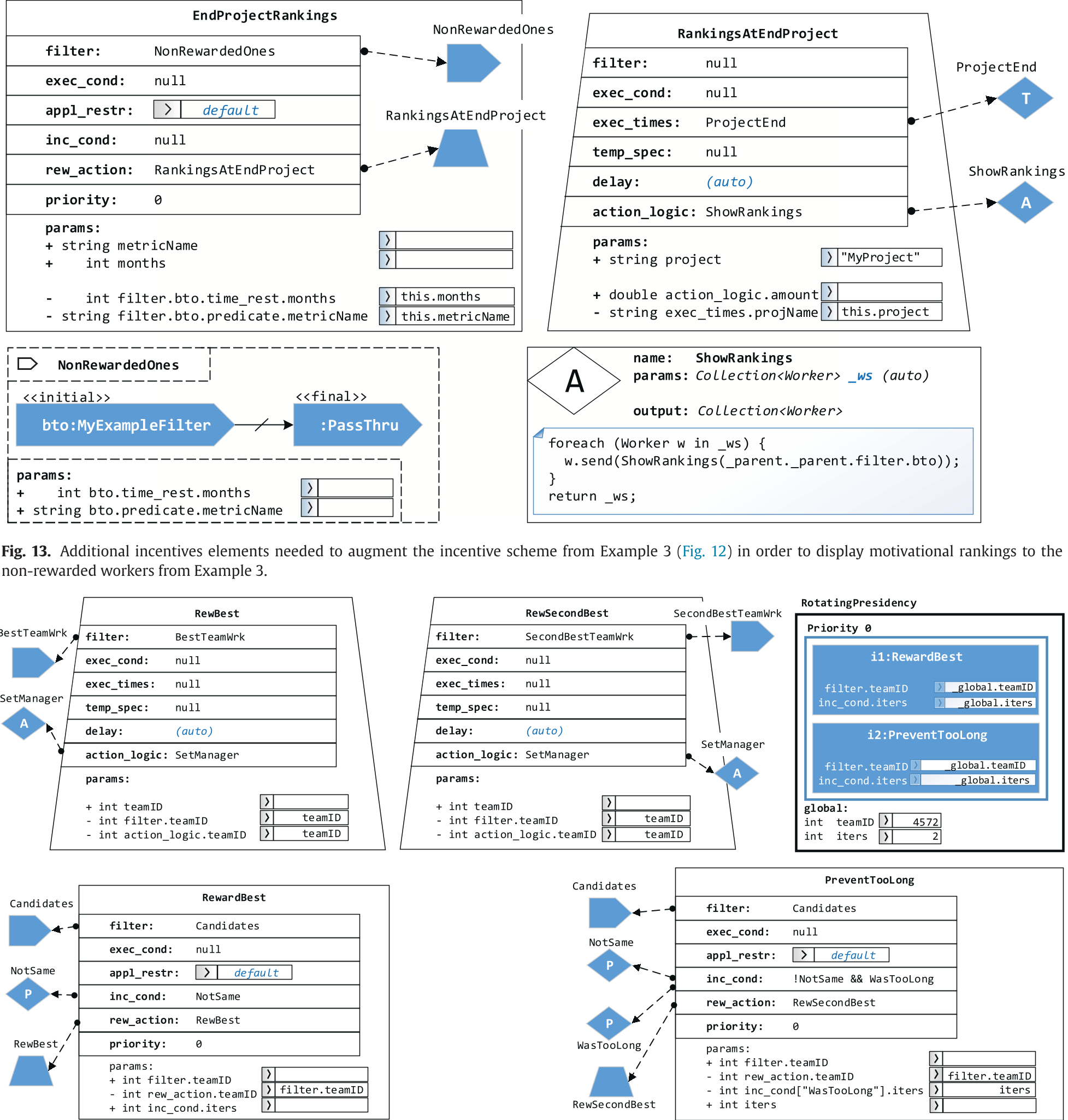
This involves Structural Changes (re-chaining the ManagedBy relations in a graph). PRINGL handles this by allowing the designer to define a SecondBestTeamWrk filter to replace a manager who has overstayed their limit, ensuring fresh leadership while maintaining high performance.
Experiments and Results: Proving Expressiveness
The authors evaluated PRINGL qualitatively by implementing a suite of five complex real-world scenarios that general-purpose platforms struggle to handle.
| Scenario | Incentive Category | Evaluation Method | Key Result |
|---|---|---|---|
| Ex 1: Referral | Deferred Compensation | Event-based | Successfully tracks 12-month performance before payout. |
| Ex 2: Peer Voting | Team-based | Human-in-the-loop | Integrates subjective feedback into reward triggers. |
| Ex 5: Rotating Leadership | Promotion / Structural | Graph Transformation | Automates team hierarchy changes based on performance. |
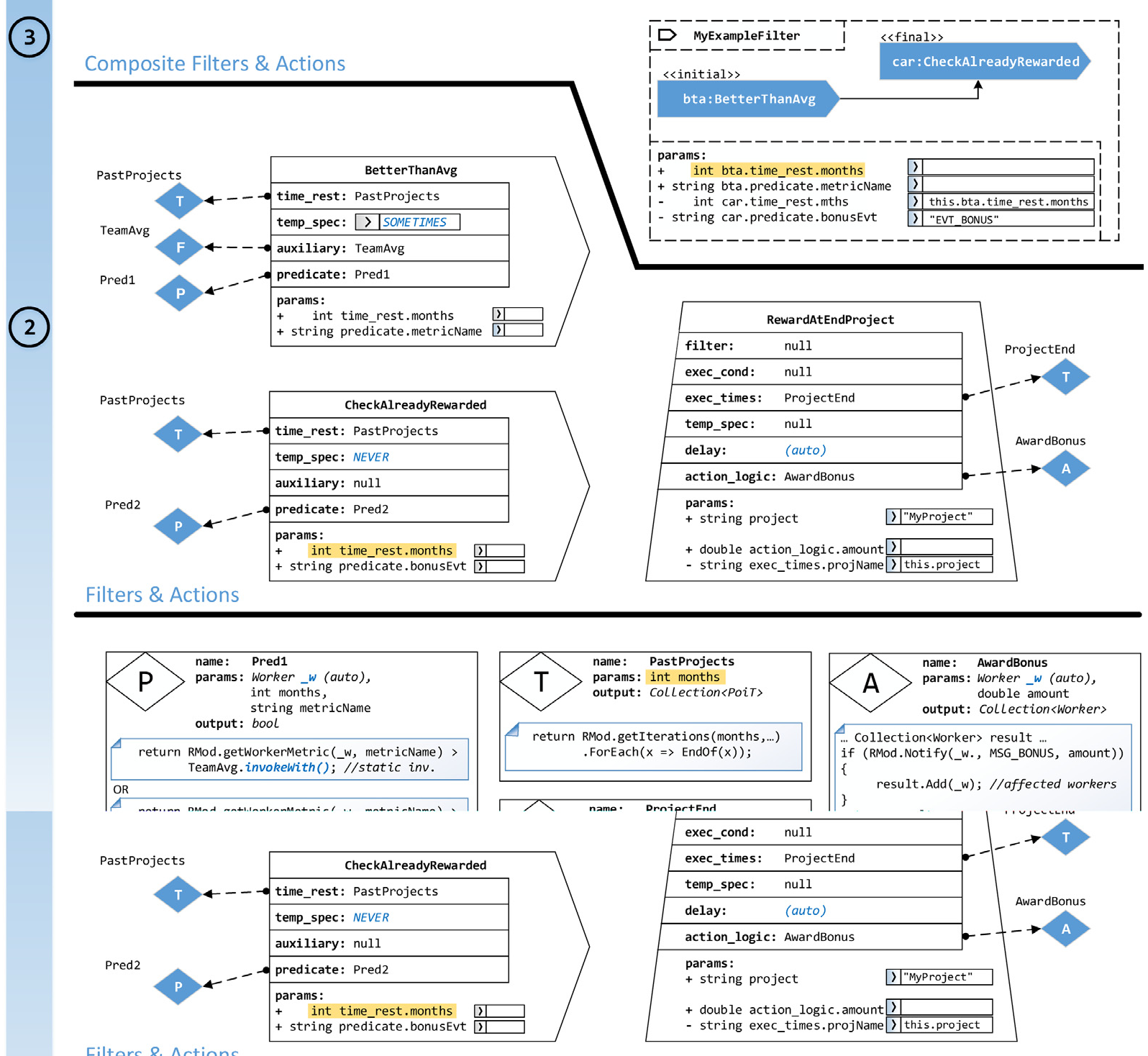 Fig: The parameter propagation feature allows low-level logic (PastProjects) to bubble up its settings to the high-level Incentive Mechanism.
Critical Insight: Beyond the Paycheck
PRINGL's true value is its recognition of Socio-Technical needs. By supporting "Psychological Actions" and "Structural Changes," it acknowledges that for high-level experts, status, autonomy, and peer recognition are often more powerful than a flat $5 microtask payment.
Limitations & Future Work
While PRINGL is highly expressive, it currently relies on the PRINC interlayer, which must be implemented for a platform before PRINGL can run. The authors are moving toward integrating this into the "SmartSociety" platform to test these incentives on real human collectives at scale.
Conclusion
PRINGL represents a significant step toward the standardization of human motivation in digital systems. By turning "incentive design" into a modular engineering discipline, it paves the way for a more transparent, portable, and effective virtual labor market.