
Unifying the "Water" in Wireless: Practical Algorithms for Multi-Level Waterfilling
Practical algorithms for a family of waterfilling solutions
This paper presents a unified algorithmic framework for solving a wide family of "waterfilling" optimization problems in communication systems. It introduces a generalized algorithm capable of handling multiple waterlevels and multiple constraints with proven linear worst-case complexity (), achieving exact numerical solutions for MIMO transceiver design and power allocation.
TL;DR
Optimization problems in wireless communications often result in a "waterfilling" solution, where power is poured into "valleys" of channel noise. While simple cases are easy, complex MIMO designs with multiple constraints previously required custom, high-effort algorithms. This paper provides a universal, linear-complexity () algorithm that solves almost all known waterfilling variants in one unified framework.
Background: Beyond the Classical Pour
Since Gallager's seminal work, "waterfilling" has been the go-to intuition for maximizing channel capacity. The logic is simple: give more power to better subchannels. Visually, you're pouring a fixed volume of water (Power) over a rugged terrain (Inverse Channel Gains).
However, as we moved from simple SISO to complex MIMO and multicarrier systems, the "terrain" became multi-dimensional. Modern objectives—like ensuring fairness (Min-Max MSE) or specific QoS requirements—resulted in solutions with multiple waterlevels. For years, engineers had to derive new algorithms for every new objective function. This paper ends that "painstaking" cycle.
The Problem Statement
The core bottleneck in previous research was the lack of a generalized structure. A standard single-level waterfilling is easy because you only have one variable (the waterlevel ) to find. In a multi-level system:
- Multiple Levels: Different groups of subchannels might have different "ceilings" or waterlevels.
- Interlinked Constraints: Adjusting power in one subchannel group affects the constraints of another.
- Complexity: A naive search for which subchannels should be "on" or "off" (Active Set) leads to combinations—an exponential nightmare for real-time systems.
Methodology: The Unified Hypothesis Algorithm
The authors propose a general model where subchannel power is defined as . The breakthrough is the Ordered Hypothesis Testing.
1. The Monotonic Insight
The authors observed that as long as the constraint functions and are monotonic, the waterlevels are coupled in a predictable way. By sorting subchannel gains initially, the search space for "active" subchannels becomes structured.
2. Systematic Deactivation
Instead of checking all combinations, the algorithm starts with the "all subchannels active" hypothesis. It then checks the feasibility of the waterlevel bounds. If the constraints aren't met, it identifies the specific subchannel group that must be reduced, effectively "deactivating" the weakest subchannels one by one.
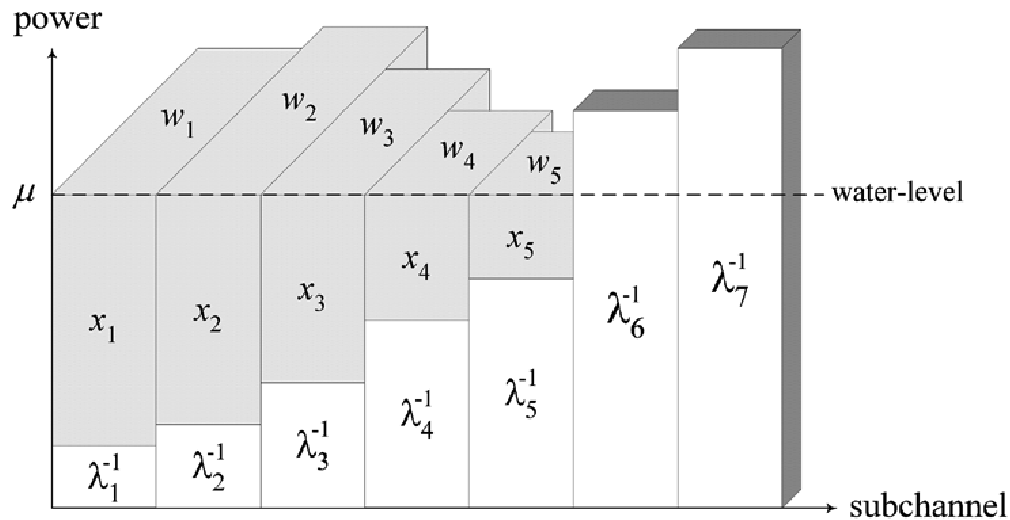 Fig 1: The visual interpretation of weighted waterfilling where 'width' represents subchannel weights.
Experiments and Applications
The paper demonstrates the algorithm's power by applying it to several SOTA problems:
- Min-Max MSE: Guarantees the quality of the worst subchannel.
- Harmonic Mean of SINR: Optimizes the collective robustness of the link.
- Average BER: Targets the ultimate digital performance metric.
For each case, the authors show that simply "plugging in" the specific objective functions into their Algorithm 1 yields an exact solution.
 Fig 2: Mathematical partitioning of waterlevels used to prove the algorithm's convergence.
Critical Insight & Conclusion
The real value of this work isn't just a faster algorithm; it's the theoretical bridge. It proves that a vast family of communication optimization problems share a fundamental underlying geometry.
Key Takeaways:
- Linear Complexity: Complexity scales with (number of subchannels), not . This makes it viable for massive MIMO or high-density OFDM.
- Generality: It covers everything from 1960s pulse amplitude modulation to 2000s MIMO joint transceiver design.
- Limitation: The algorithm requires monotonic constraints. While this covers most physical-layer problems, highly non-linear or non-convex QoS constraints (like those involving discrete bit-loading) might still require heuristic extensions.
This paper remains a cornerstone for anyone building physical layer resource allocators, providing a robust mathematical tool for the "waterfilling" toolbox.