
Business Ethnography in Japan: Adapting Academic Rigor to Corporate Speed
Practices and Issues of Corporate Ethnographers: A Case Study of a Corporate Laboratory of a Japanese Telecommunications Service Provider
This paper examines the implementation of "Business Ethnography" within a Japanese telecommunications laboratory (KDDI Research). It identifies how traditional anthropological methods are adapted into a team-based, short-term framework to fit corporate constraints, utilizing external partnerships and technology.
TL;DR
Can a multi-year academic methodology survive in a corporate world governed by quarterly reports? This case study of a major Japanese telecommunications laboratory (KDDI Research) reveals how ethnography is being "re-engineered" from a solo academic pursuit into a team-based, technology-enhanced, and highly outsourced business process.
Background Positioning: The Context of Japanese Corporate Research
Unlike Silicon Valley firms that often hire PhD anthropologists for specific design roles ("job-based employment"), Japanese corporations traditionally favor "membership-based" hiriing—recruiting generalists and training them internally. This creates a unique friction point when trying to implement ethnography, a method that captures latent user needs through deep cultural immersion.
Problem & Motivation: The Time-Cost Dilemma
The authors identify two fundamental conflicts between academic and business ethnography:
- Temporal Conflict: Academia demands years; business demands three months (linked to hanki or half-year reporting).
- Specialization Conflict: While the US government and tech sectors hire experts, Japanese firms often rely on non-specialist engineers to conduct qualitative research.
The motivation for this study was to discover how Japanese firms bridge this gap without sacrificing the "human understanding" that makes ethnography valuable.
Methodology: The Team-Based "Multiple Eyes" Approach
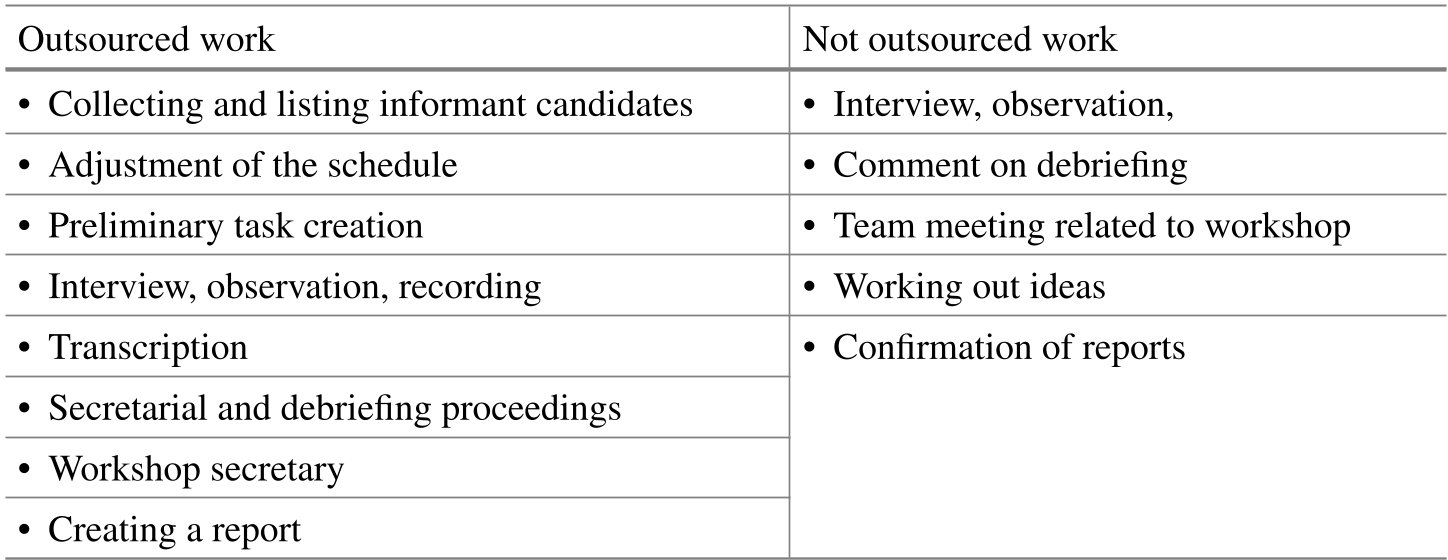
The core insight of the KDDI model is the Division of Labor. Rather than expecting one researcher to be a "hero-anthropologist," the work is split between the lab and external research agencies.
The Collaborative Model
- External Agencies: Handle the "heavy lifting"—listing informants, scheduling, transcription, and initial report drafting.
- In-house Researchers: Focus on high-level decision-making, attending field visits, and "working out ideas."
Technology as an Equalizer
To solve the issue of "non-expert" observation, the lab employs 360-degree cameras and VR goggles. This allows researchers who weren't physically present at a field site to virtually "visit" it, ensuring that the entire team shares the same visual context. This "multiple eyes" approach attempts to replicate the holistic intuition of an expert anthropologist through collective processing.
Experiments & Results: Holistic vs. Partial Scope
The study highlights a significant shift in the scope of research. While academic ethnography is holistic (understanding a whole culture), business ethnography is partial (understanding specific interactions).
Key findings include:
- Cultural Familiarity: In domestic markets, researchers leverage shared cultural background to skip the "learning the language" phase required in traditional anthropology.
- Efficiency Gains: Using "Affinity Diagrams" (K-J Method) and collective workshops allows teams to synthesize data faster than a solo researcher could.
- Outcome over Process: The "leadership of the research company" allows the lab researchers to act as project managers rather than field workers.
Critical Analysis & Conclusion: The "Membership" Paradox
Takeaway
The adaptation of ethnography in Japan is a story of pragmatism. By transforming a subjective, individualistic craft into a structured team workflow, Japanese firms have found a way to inject "User Experience" (UX) insights into product development cycles.
Limitations
The study honestly notes that this "partial scope" approach may miss deeper cultural shifts. Relying on external agencies also means that deep ethnographic "muscle memory" or tacit knowledge is rarely built within the laboratory itself; it remains a purchased commodity rather than an internal capability.
Future Outlook
As technological gadgets like AR/VR become more sophisticated, the line between "being there" and "watching a recording" will blur. The future of corporate ethnography likely lies in this hybrid space—where AI and immersive tech allow generalist employees to perform specialist-level cultural analysis.