
PRADO: Engineering App Success by Deciphering the DNA of User Behavior
PRADO: Predicting App Adoption by Learning the Correlation between Developer-Controllable Properties and User Behaviors
The paper introduces PRADO, a predictive framework designed to estimate Android app adoption using 108 developer-controllable features. By leveraging large-scale behavioral data from 12.57 million users, it achieves state-of-the-art accuracy in predicting uninstallation ratios, user ratings, and download counts.
TL;DR
Is it possible to predict if your app will be a "Killer App" or a "Zombie App" before it even hits the store? PRADO (Predicting App Adoption) says yes. By analyzing 108 technical properties—from code complexity to UI layout—across 9,824 apps and 12.57 million users, researchers have built a model that predicts downloads, ratings, and even uninstallation rates with high accuracy.
The "Success" Blindspot in App Development
For most developers, the "Why" behind an app's failure is a post-mortem mystery. While tools like AppAnnie track downloads, they don't tell you if your Weighted Methods per Class (WMC) or your Target SDK choice caused that spike in uninstalls.
The authors identify three major gaps in current research:
- Metric Superficiality: Downloads can be faked; ratings are often sparse.
- Lack of Actionability: Knowing "users hate the app" is useless if you don't know which technical lever to pull.
- Privacy Barriers: Highly valuable data, like uninstallation rates, is usually locked away by store operators.
Methodology: The Taxonomy of Control
PRADO’s core innovation lies in its Developer-Controllable Feature Taxonomy. It categorizes 108 features into 9 dimensions:
- D1-D3 (Code): Size, Complexity (CK Metrics), and Quality (Exception handling/ANR issues).
- D4-D6 (System): Library dependencies, SDK requirements, and Energy drain.
- D7-D9 (Market/UI): GUI complexity, Marketing descriptions, and "Official" status.
The Workflow
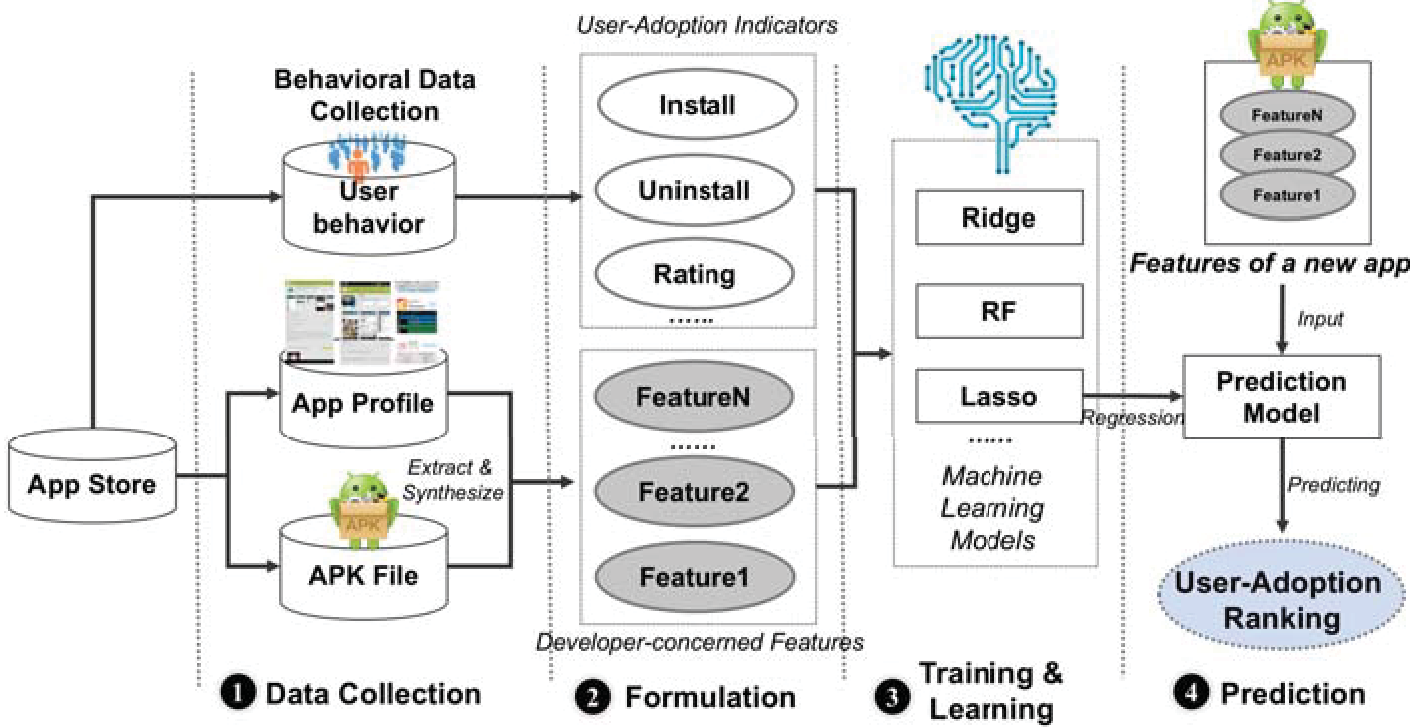
The researchers used Random Forest (RF) to capture non-linear relationships, Lasso for feature selection, and Ridge to handle collinearity among technical metrics.
Key Insights: What Actually Matters?
The results from the Random Forest importance analysis (%IncMSE) yielded some counter-intuitive and highly actionable insights.
1. The Power of "Official" Status
Being marked as an Official version (D9) is the #1 predictor for high downloads and low uninstalls. In a market riddled with repackaged, ad-heavy clones, trust is the ultimate currency.
2. UI Complexity vs. User Confusion
Higher UI Layout Complexity (num_layout) was positively correlated with both Download Percentile and Like Ratio. This suggests that users perceive "richer" interfaces as more functional, contrary to the "minimalist" obsession in some design circles.
3. The "Try-Catch" Trap
Apps with high num_noAction (empty try-catch blocks) showed a significant correlation with lower user adoption. Passive exception handling—the "silent fail"—effectively kills user trust through perceived "ghost" bugs.
Experimental Evidence
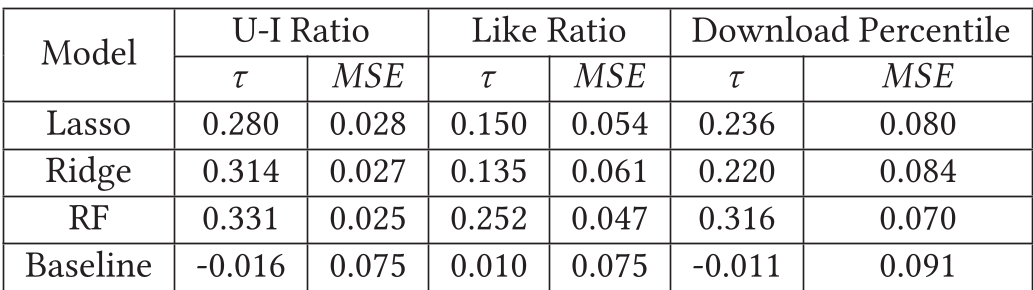 Table 1: PRADO performance across different indicators. Note that Random Forest (RF) consistently yields the highest Kendall’s Tau (τ), proving the non-linear nature of app adoption.
Case Study: The Game Domain
When narrowing the focus to 2,658 Game apps, the importance of Execution Path Complexity (num_exePath) and In-app Ads (num_adLib) skyrocketed. Specifically, for gamers, ad density was a primary driver of uninstallation, whereas general utility users were more tolerant if the functionality was unique.
Critical Analysis & Future Outlook
Takeaway: PRADO proves that your code is your marketing. The architecture of your classes and the cleanliness of your exception handling directly manifest as user behavioral signals.
Limitations:
- Correlation vs. Causality: While the model predicts success, it doesn't guarantee that reducing WMC will immediately boost ratings (though it likely helps).
- Static Analysis Bias: The study relies on static metrics; dynamic runtime performance (actual FPS or network latency) is not fully captured.
The Future: As app stores become more saturated, PRADO-like systems could be integrated into CI/CD pipelines. Imagine a GitHub Action that says: "Your latest commit increased Predicted Uninstallation Ratio by 5% due to excessive UI thread Disk I/O." That is the future of data-driven software engineering.
Author Bios: This research was a collaboration between Peking University, UIUC, and the University of Michigan, utilizing a massive dataset from the Wandoujia app store.