
The Power of Noise: Rethinking Pre-processing in Twitter Sentiment Analysis
The Role of Pre-processing in Twitter Sentiment Analysis
This paper investigates the critical impact of various pre-processing techniques on Twitter sentiment analysis using a linear classifier (Liblinear). The authors propose a optimized pipeline incorporating URL reservation, negation transformation, and repeated letter normalization, ultimately achieving a SOTA accuracy of 85.5% on the Stanford Twitter Sentiment Dataset.
TL;DR
While many data scientists treat pre-processing as a "solved" checklist, this paper proves that for Twitter, the wrong choices can destroy model accuracy. By specifically handling negations, repeated letters, and URLs, and avoiding standard techniques like stemming, the authors achieved a 85.5% accuracy on the Stanford Twitter Sentiment Dataset, outperforming previous benchmarks with fewer features.
Background: Why Tweets are a "Different Beast"
Twitter sentiment analysis is essentially a high-stakes classification problem—results can predict stock market shifts or election outcomes. However, a tweet isn't a mini-essay; it's a 140-character burst of noise. Traditional NLP tools were built for the "King's English," not for someone tweeting "This is coooooold!!!! #winter :(."
The authors identify a critical gap: while pre-processing is used for dimensionality reduction, its role in elevation of performance—knowing what to keep versus what to kill—is underexplored.
Methodology: The Anatomy of a Clean Tweet
The researchers broke down their approach into a multi-stage pipeline:
1. Denoising & Feature Reservation
While usernames (@User) and hashtags (#Topic) were removed to generalize the model, the authors made a counter-intuitive choice: Keep the URLs. They hypothesized that URLs often point to content that aligns with the tweet's sentiment, acting as a latent feature.
2. The Negation Paradox
How you handle "don't" matters. The authors tested four versions:
- Expansion: "don't" → "do not"
- Concatenation: "don't" → "donot"
- Stripping: "don't" → "dont"
They found that UN3/UN4 (Concatenation/Stripping) worked best for unigram models because they represent a single "negative" concept, whereas expanding to two words ("do" and "not") can dilute the sentiment signal.
3. Repeated Letters Normalization
People type "cooooold" to convey intensity. The authors used a lexicon-based approach:
- If a letter repeats >3 times, reduce it to 2.
- Check if that word exists in WordNet.
- If not, reduce it to 1. This preserves the "feeling" while mapping variations of the same word to a single feature.
 The Information Gain formula used to select the most impactful bigrams.
Experiments: What Works and What Fails?
Using Liblinear (a fast linear classifier optimized for sparse text data), the authors conducted "Safe-launch" experiments—adding one technique at a time.
The "Stemming" Trap
One of the paper's most significant findings is the failure of Stemming and Lemmatization. In formal NLP, turning "stemming" into "stem" helps. In Twitter sentiment, it actually decreased accuracy. Why? Because in short-form text, the specific conjugation used by the author often carries emotional weight or context that is lost when reduced to a root form.
Performance Comparison
| Method | Accuracy |
|---|---|
| Baseline (No Pre-proc) | 81.62% |
| Go et al. (2009) | 83.00% |
| This Paper (Optimized) | 85.50% |
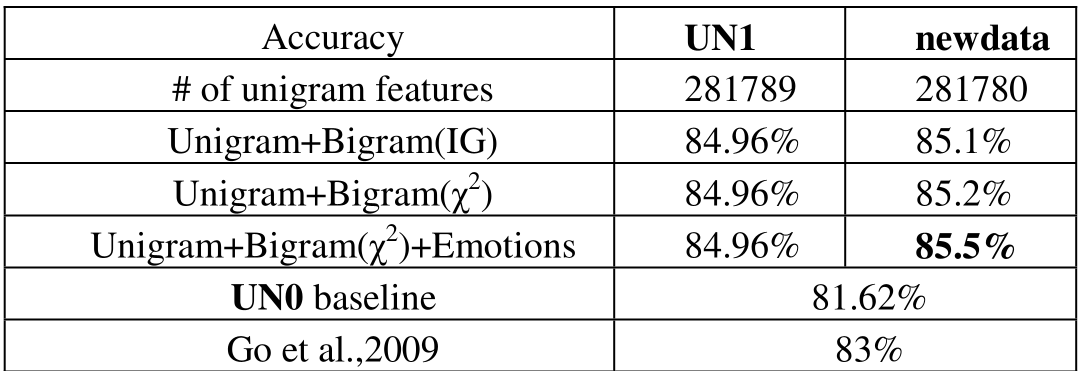 Final accuracy comparison showing the consistent climb in performance.
Deep Insight: Beyond Unigrams
The authors didn't just stop at individual words. They found that augmenting the space with 300 high-impact bigrams (selected via Information Gain or ) and explicit emotion features (mapping ":)" to a binary "Positive" flag) provided the final nudge needed to reach 85.5%.
Interestingly, they noted that bigrams are most effective when negations are expanded into two words, highlighting the "Conjecture 1" in the paper: different pre-processing choices require different feature architectures to succeed.
Conclusion
This study serves as a masterclass in "data-centric" AI before the term was trendy. It proves that for microblogs:
- URLs are signals, not just noise.
- Negation handling must be intentional.
- Standard normalization (Stemming) can be harmful.
Future Outlook: As we move toward LLMs and Transformers, the lessons here remain relevant: the "structural noise" of social media is often where the sentiment actually lives.