
From Orchards to Algorithms: Mastering Date Classification with Transfer Learning
Employment of Pre-trained Deep Learning Models for Date Classification: A Comparative Study
This paper presents a comparative study on date fruit classification within unstructured orchard environments using fine-tuned pre-trained deep learning models. By leveraging transfer learning with architectures like ResNet-50, the authors achieved a SOTA accuracy of 97.37% on a multi-class dataset of five date varieties.
TL;DR
Automating the harvest of dates is a high-stakes challenge due to the harsh, unstructured nature of orchards. This paper evaluates four heavy-weight deep learning models—ResNet-50, DenseNet, AlexNet, and GoogleNet—to see which can best identify date varieties under real-world conditions. The winner? ResNet-50, which achieved a staggering 97.37% accuracy, proving that deep residual networks can "see" through the clutter of a palm grove.
Problem & Motivation: The "In-the-Wild" Challenge
Manual date harvesting is dangerous, labor-intensive, and increasingly expensive, raising production costs by over 45%. While robotic harvesting is the future, the "eyes" of these robots face a nightmare scenario:
- Visual Complexity: Bagged vs. un-bagged bunches, variable lighting, and harsh shadows.
- Similarity: Different date types like Sullaj and Khalas look nearly identical to the untrained eye (and many algorithms).
- Data Scarcity: Unlike general objects, high-quality labeled datasets for dates in the field are rare.
Most prior work used "lab-condition" photos—single dates against clean backgrounds. This study throws the models into the "wild" orchard environment.
Methodology: Why Transfer Learning?
The authors chose Transfer Learning as their primary weapon. Training a deep CNN from scratch requires millions of images; however, by using models pre-trained on ImageNet, the models already understand fundamental visual concepts like edges, textures, and shapes.
The Contenders
- AlexNet: The 2012 pioneer that started the deep learning revolution.
- GoogleNet: Introduced "Inception" modules to capture multi-scale information.
- DenseNet: Connects every layer to every other layer to alleviate vanishing gradients.
- ResNet-50: Uses "Skip Connections" to allow training of very deep networks without performance degradation.
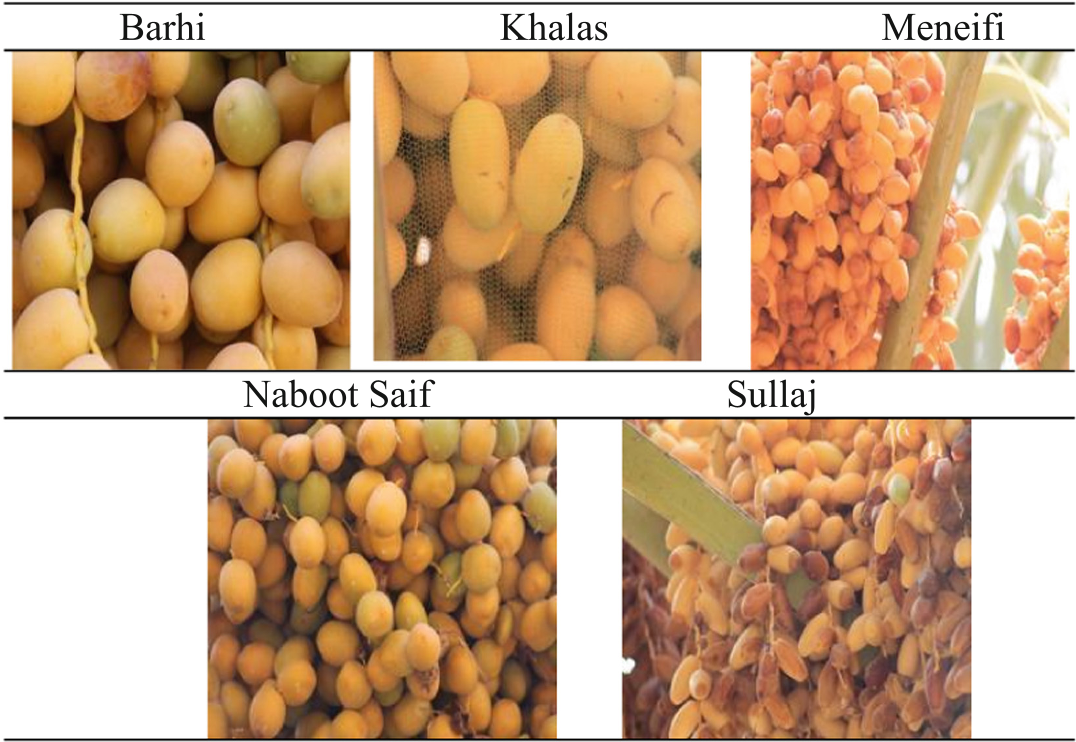 Figure 1: Samples of the five date varieties (Sullaj, Meneifi, Barhi, Khalas, Naboot Saif) showing the slight variations in color and texture.
Experiments & SOTA Results
The models were tested on a dataset of 8,000+ images. The results confirm a clear hierarchy in architectural effectiveness for agricultural tasks.
| Model | Accuracy | F1-Score |
|---|---|---|
| ResNet-50 | 97.37% | 98.14% |
| DenseNet | 91.30% | 92.32% |
| AlexNet | 85.71% | 85.33% |
| GoogleNet | 83.23% | 84.36% |
Performance Analysis
ResNet-50's superiority (reaching 97.37% accuracy) stems from its Residual Blocks. In an orchard environment where features might be "distorted" by nets or leaves, the skip connections allow the network to preserve essential identity information through the layers, preventing the loss of fine-grained details necessary to distinguish Naboot Saif from Sullaj.
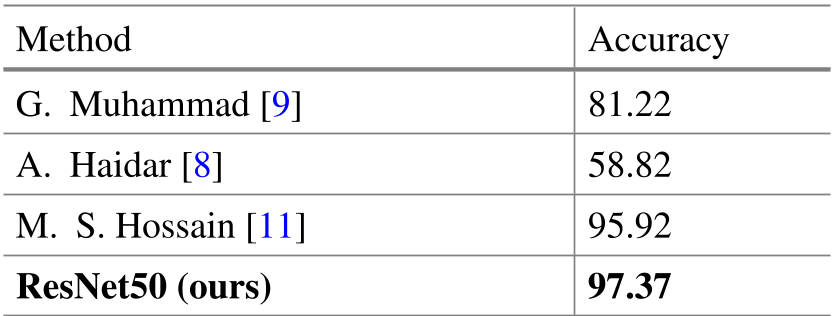 Figure 2: ResNet-50 vs. Previous Methods. The jump from 81.22% (Texture Descriptors) to 97.37% (ResNet-50) highlights the shift from handcrafted features to deep learning.
Critical Analysis & Conclusion
The takeaway is clear: Architecture matters more than just "going deep." While GoogleNet is sophisticated, its multi-scale approach was less effective here than ResNet’s ability to optimize deep mappings.
Limitations & Future Work
- Real-time Optimization: While ResNet-50 is accurate, a harvesting robot needs high FPS. Future research should look at Lightweight models (MobileNetV3) or FPGA acceleration.
- Beyond Classification: The next step is Detection and Disease Diagnosis, moving from "what type of date is this?" to "where is the date and is it healthy?"
By outperforming previous benchmarks by nearly 2% to 16%, this study provides a robust backbone for the next generation of autonomous agricultural robots.
Takeaway: If you are building vision systems for complex, natural environments, ResNet-50 with Transfer Learning remains the gold standard for balancing complexity and feature representation.