
Beyond the Budget: Harnessing Social Media Sentiments to Predict Movie Success
Using Crowd-Source Based Features from Social Media and Conventional Features to Predict the Movies Popularity
This paper presents a machine learning framework for predicting movie popularity (Ratings and Gross Income) by integrating conventional metadata with crowd-sourced social media features. By leveraging sentiment analysis on Twitter and engagement metrics from YouTube, the study achieves a peak accuracy of 77% for Rating prediction and 61% for Income classification using the J48 Decision Tree algorithm.
TL;DR
Predicting whether a movie will be a "Blockbuster" or a "Flop" has traditionally been a game of looking at budgets and genres. However, this paper demonstrates that social media features (Twitter sentiments and YouTube engagement) actually outperform conventional industry data in predicting both audience ratings and box office income. Using a J48 Decision Tree, the researchers achieved up to 77% accuracy in rating prediction, proving that the digital "crowd" knows better than the historical spreadsheet.
Background: The Shift from Metadata to Social Pulse
In the film industry, stakeholders have long relied on "Conventional Features" (CF) such as production house prestige, budget, and MPAA ratings. While these provide an Inductive Bias for success, they ignore the volatility of public opinion. This study positions itself as a corrective to previous works that dismissed social media as "noisy," arguing that with proper feature engineering—like aggregating cast followers and measuring sentiment magnitude—social data becomes the most discriminating factor in predictive modeling.
The Methodology: Data Collection & Feature Engineering
The authors developed a robust methodology that bridges the gap between static databases (IMDB) and dynamic social platforms.
1. Feature Extraction Innovation
Instead of just looking at the "Top Star," the authors introduced Aggregate Actor Followers, summing the Twitter reach of the top three cast members. This solves the "zero-count" problem where specific leads might not have a social presence.
2. The Sentiment Engine
By assigning signed integer values to tweets (positive, negative, or neutral) and aggregating them, they created a Sentiment Score that reflects the magnitude of public anticipation.
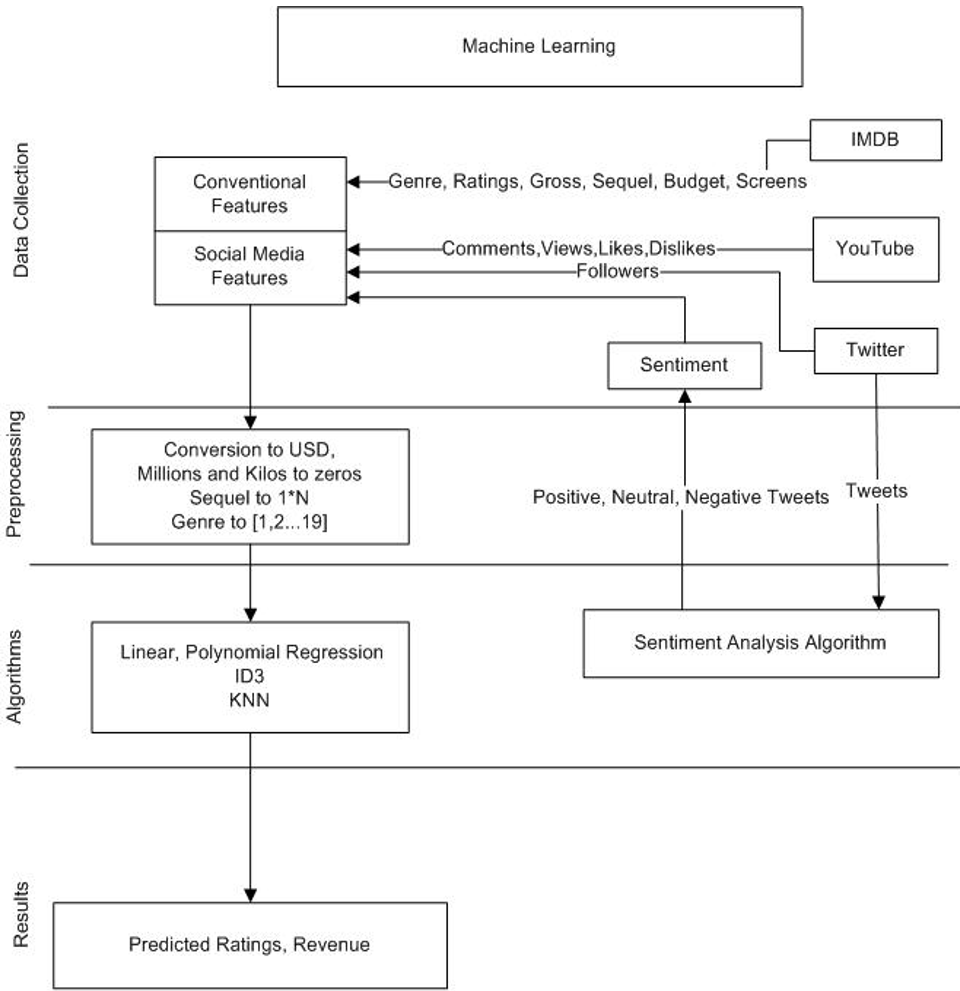 Figure 1: The proposed system model integrating Data Collection from IMDB, Twitter, and YouTube into a Predictive Engine.
Experiments and Key Findings
The researchers split their experiments into two primary targets: Ratings (Audience Reception) and Income (Commercial Success).
Predicting Ratings (The "Good" vs. "Poor" Band)
Using Linear Regression and J48 Decision Trees, the study found that social media features provided a clearer signal for audience perception.
- Accuracy 1 (Exact): 43% for Social Media vs. 36.4% for Conventional.
- Accuracy 2 (Range of ±1): A staggering 95% accuracy when predicting ratings within a 1-point margin.
Predicting Income (The "Blockbuster" Test)
Income prediction is notoriously difficult due to extreme variance. By categorizing income into four ordinal bands (Flop, Average, Success, Blockbuster), the authors saw a significant jump in performance when switching to social data.
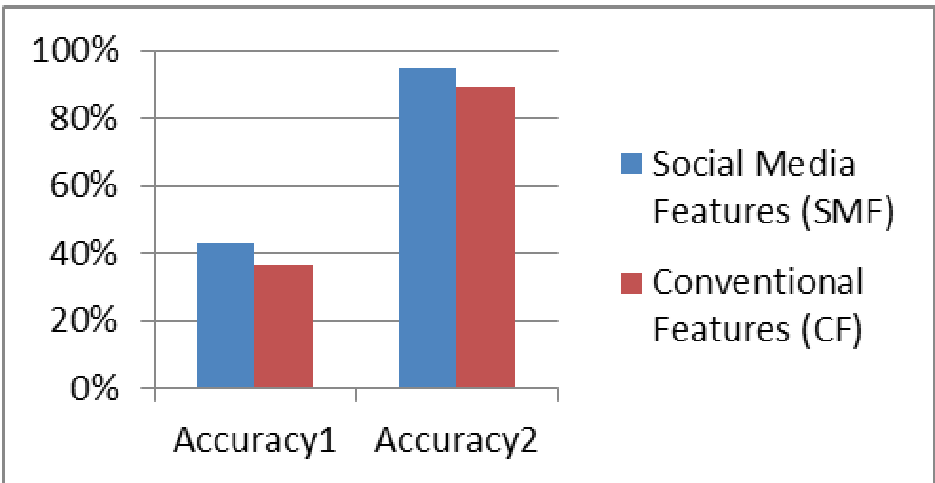 Table 6: Comparison showing Selected Social Media Features (61%) significantly outperforming Conventional Features (52%) in Income prediction.
Critical Insight: Why Does This Work?
The core "Why" behind these results lies in Feature Selection. Through Principal Component Analysis (PCA), the authors discovered that:
- Sentiment Score was the most vital social feature.
- Number of Screens remained the strongest conventional feature (reflecting the industry's "push" power).
- YouTube Likes/Dislikes were surprisingly weak indicators compared to Comment Counts and Views, suggesting that active engagement (writing a comment) is a better proxy for intent-to-buy than a simple "like" click.
Challenges and Future Outlook
While the results are promising, the study acknowledges the inherent noise in Twitter data. The reliance on older sentiment analysis libraries (prior to the LLM era) suggests that there is even more performance "left on the table."
Future research could benefit from:
- Temporal Sentiment Tracking: Analyzing how sentiment shifts from the first teaser trailer to the premiere.
- Cross-Platform Fusion: Integrating data from TikTok (short-form virality) and Instagram (visual engagement).
Conclusion
This paper serves as a strong validation for the "Wisdom of the Crowds." In the modern era, a movie's fate is dictated less by its budget and more by the digital footprint it creates months before its release. For investors and production houses, monitoring the Sentiment Score is no longer optional—it is a core metric of financial risk management.