
CRMP: Predicting Cross-Network Migration via Connector and Recursive Meta-Paths
Predicting anchor links between heterogeneous social networks
This paper introduces CRMP (Connector and Recursive Meta-Paths), a framework for predicting anchor links—the future formation of accounts by the same user across heterogeneous social networks. Evaluated on Twitter and Foursquare datasets, CRMP achieves significant performance gains, outperforming the CICF baseline by over 40% in Accuracy and 60% in AUC.
TL;DR
Predicting which users will join a new social network is a vital task for targeted marketing and churn prevention. This paper proposes CRMP, a meta-path-based approach that models the social "pull" of a target network. By analyzing how a user's friends cluster on a new platform and using heterogeneous data (location, time, text), CRMP achieves a massive 60% AUC improvement over previous state-of-the-art cross-domain learning methods.
Problem & Motivation: The Missing Target Node
In traditional link prediction (e.g., "People You May Know"), both users exist in the system. In Anchor Link Prediction, the target node does not exist yet; it is created the moment the user joins the new network.
The authors identify three primary challenges:
- Feature Scarcity: How do we describe a relationship between a node and a network it haven't joined yet?
- Missing Endpoints: Traditional adjacency-matrix completion fails when one dimension is undefined.
- Network Heterogeneity: Twitter (Source) and Foursquare (Target) have different structures, making direct feature mapping difficult.
The guiding Insight here is "Peer Influence": A user is likely to join a new platform if their existing friends are already there and, crucially, if those friends are interacting with each other on the new platform.
Methodology: The Power of Meta-Paths
The core of the paper lies in the construction of two distinct types of meta-paths that bridge the source () and target () networks.
1. Connector Meta-Paths ()
These paths connect a source user to potential target network entry points. They use Similarity Extension—instead of just looking at direct followees, they look at users who are spatially or textually similar.
- Logic: If people similar to you are joining Foursquare, the platform's utility likely matches your preferences.
2. Recursive Meta-Paths ()
This is the most innovative part of the methodology. These paths form "loops" that start at a source user, travel to the target network through anchor links, navigate the target social structure, and return to the source user.
- Formula:
- Logic: These paths measure the "intimacy" of your social circle on the new platform. If your Twitter friends are also "similar" to each other on Foursquare, the social cluster is robust, making your migration highly probable.
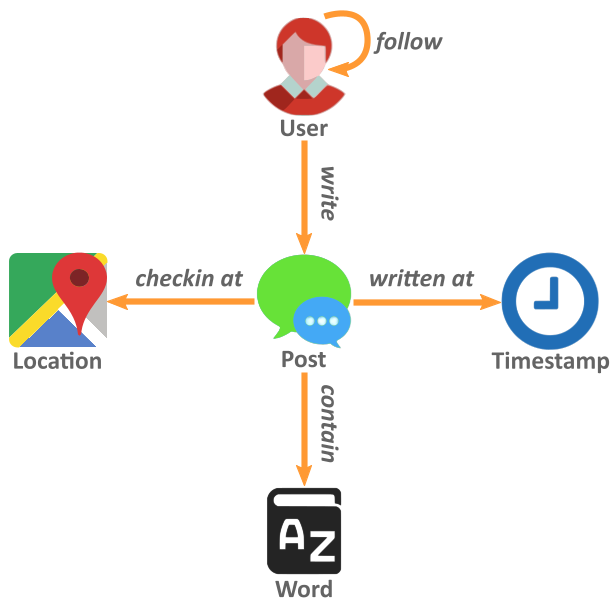 Figure 1: The Heterogeneous Network Schema capturing Users, Posts, Locations, and Words.
Experiments & Results
The authors tested CRMP using Twitter as the source and Foursquare as the target. Key findings include:
- Heterogeneous Superiority: Incorporating spatial (locations) and textual (words) data alongside social links provided the highest accuracy.
- Robustness to Sparsity: Even when the target network had 90% of its data removed (), CRMP maintained high performance, proving that the "Recursive" logic works even with limited signal.
- Ablation Study: Removing the "Recursive" part of the model (using only CMP) significantly degraded performance, highlighting that cross-network "intimacy" is the strongest predictor of user migration.
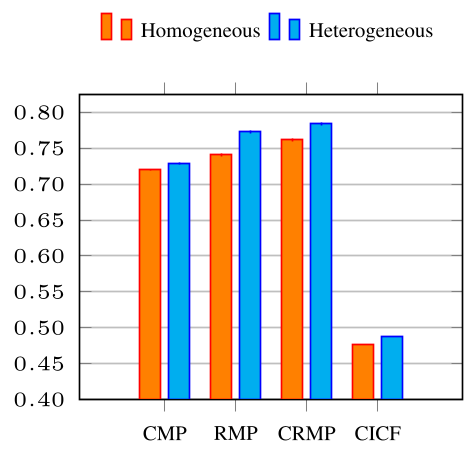 Figure 2: Performance comparison showing CRMP outperforming the CICF baseline across Accuracy and AUC.
Critical Insight & Conclusion
The success of CRMP demonstrates that anchor link formation is a collective social phenomenon, not an individual profile-matching task. High-accuracy prediction requires looking beyond the "user-to-user" link and considering the "community-to-community" mapping.
Takeaway: If you are building a new platform, don't just target "influencers"; target "tight-knit clusters" of users from existing platforms.
Limitations: The model assumes a degree of structural similarity (Network Schema) between networks. Future work could investigate how to apply this when networks are radically different (e.g., migrating from a text-based network like Twitter to a video-based one like TikTok).