
Predicting Silent Risk: Using SVM to Forecast Type-2 Diabetes 7 Years in Advance
Predicting Diabetes in Healthy Population through Machine Learning
This paper presents a machine learning approach using Support Vector Machines (SVM) to predict Type-2 Diabetes (T2D) in healthy populations based on the San Antonio Heart Study (SAHS). By analyzing 10 key socio-demographic and physiological features from Oral Glucose Tolerance Tests (OGTT), the model achieves a validation accuracy of 84.1% and a recall rate of 81.1% for predicting disease onset over a 7.5-year horizon.
TL;DR
Researchers have leveraged Machine Learning and clinical data from the San Antonio Heart Study to predict the onset of Type-2 Diabetes (T2D) years before diagnosis. By focusing on the recall rate—the ability to catch every potential case—and utilizing features from Oral Glucose Tolerance Tests (OGTT), the study achieved over 84% accuracy, highlighting that glucose response curves are a "smoking gun" for future metabolic failure.
Background: The Global Health Time Bomb
With diabetes prevalence nearly doubling in recent decades, the strain on healthcare systems is reaching a breaking point. The challenge isn't just treating the disease, but identifying "pre-diabetic" individuals who are invisible to standard screenings. Current methods often fail because the body's glucose response is non-linear; some people appear healthy during fasting but have underlying insulin resistance that only shows during a "stress test" like the OGTT.
The "Unbalanced" Data Challenge
In epidemiological studies, the number of healthy participants far outweighs those who develop the disease. In this dataset, the ratio was 1:8.
- The Problem: If a model simply predicts "Everyone is Healthy," it would achieve 87.5% accuracy but would be completely useless for medicine.
- The Solution: The authors used under-sampling to balance the classes during training and prioritized Recall (Sensitivity) over simple Accuracy. This ensures the model is "looking" for the red flags of diabetes even if they are rare.
Methodology: The Power of Four Features
While the researchers tracked 10 variables, including the complex Matsuda Index and BMI, they discovered a "sweet spot" for prediction.
Architecture & Feature Selection
The study utilized a Linear Support Vector Machine (SVM). Unlike complex deep networks, SVMs are highly effective on smaller, tabular datasets and provide a clear decision boundary.
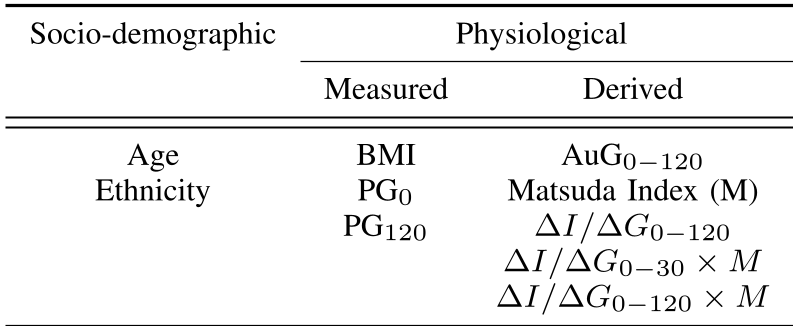
The most powerful combination turned out to be just four features:
- AuG 0-120: The total area under the glucose curve (how much sugar stays in the blood over 2 hours).
- PG 120: Blood sugar levels exactly 2 hours after ingestion.
- Age.
- Ethnicity.
Results: Performance that Matters
The results confirm that the "richness" of the OGTT curve is the best predictor of metabolic trajectory.
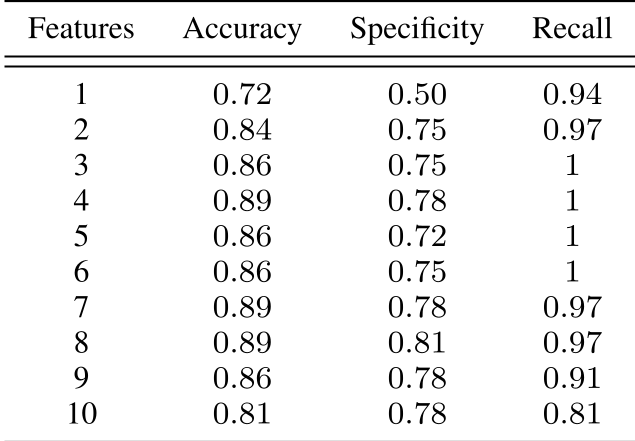
As shown in Table III, as the number of features increased to four, the Recall reached a perfect 1.0 (100%) in the training phase, with accuracy peaking at 89%. Interestingly, adding more than 7 features actually decreased performance, a classic sign of feature redundancy and the "curse of dimensionality."
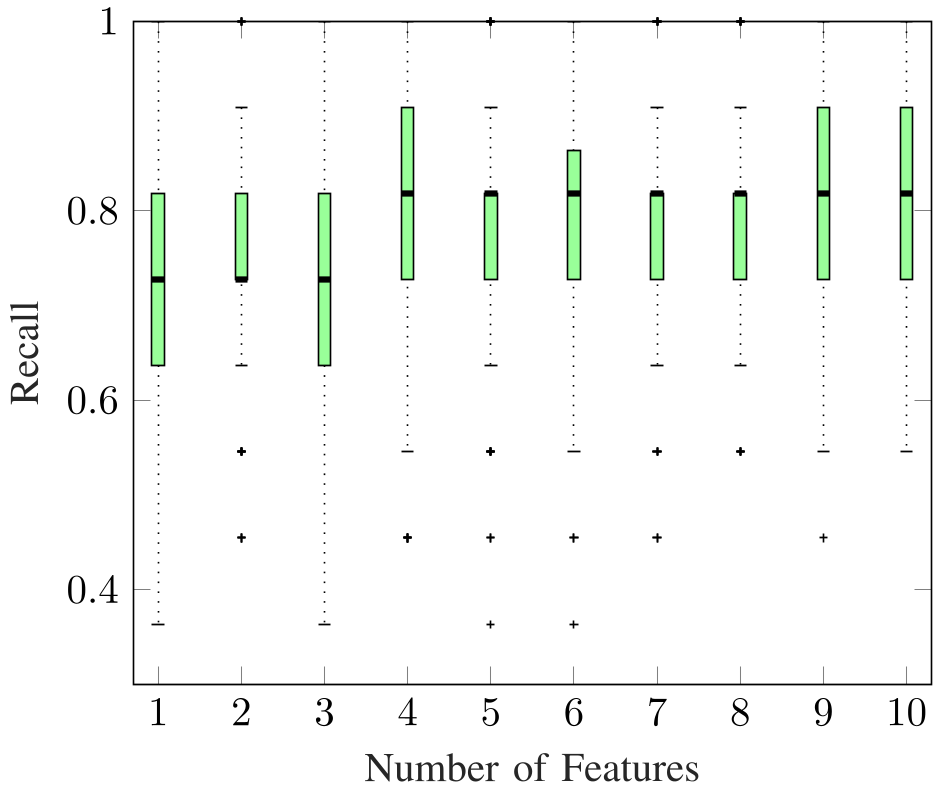 Figure 1: Validation performance showing the stability of Recall (a) and Accuracy (b) across iterations.
Critical Insight: Why Focus on the 2-Hour Mark?
The study concludes that high glucose values at the 2-hour mark are the strongest indicator of future risk. This suggests that the body's inability to clear glucose back to baseline within a standard window is a more significant physiological breakdown than high fasting glucose alone.
Conclusion & Future Outlook
This work demonstrates that machine learning can transform existing epidemiological data into a proactive diagnostic tool. By identifying high-risk individuals 7.5 years in advance, healthcare providers can implement lifestyle interventions that could potentially halt the progression of the disease entirely.
Future research should look toward integrating these ML models into wearable sensors (CGMs) to provide real-time risk scoring, moving from periodic clinical tests to continuous health monitoring.