
Decoding Social Friction: Using Frequent Subgraphs for Signed Link Prediction
Predicting Edge Signs in Social Networks Using Frequent Subgraph Discovery
This paper introduces a novel framework for predicting positive and negative links in signed social networks by leveraging frequent subgraph discovery. By treating edge-sign prediction as a graph classification problem, the authors utilize an SVM-based approach on three large-scale datasets (Slashdot, Wikipedia, and Epinions), achieving state-of-the-art AUC scores of up to 99.80%.
TL;DR
Social networks aren't just about who we know; they're about who we like and dislike. While most platforms treat connections as binary, signed social networks allow users to specify trust or enmity. This paper presents a breakthrough approach to predicting these signs by mining "Ego-Graphs" for frequent structural motifs. By treating network topology like a chemical molecule's structure, the authors achieve near-perfect prediction accuracy (AUC 99.8%) on real-world datasets like Epinions and Slashdot.
The "Why": Beyond Balance and Status Theories
For decades, social scientists relied on two primary pillars:
- Structural Balance Theory: The classic "friend of my enemy is my enemy."
- Status Theory: A positive link indicates the recipient has higher status than the sender.
While intuitive, these theories are often too rigid for the messy data of modern Online Social Networks (OSNs). Prior SOTA methods attempted to use global properties or simple triad counts, but they often failed to capture the nuances of local "social neighborhoods." The authors of this paper argue that the frequent subgraph patterns—small, recurring structural motifs—contain far more discriminative information than hand-crafted features or global metrics.
Methodology: The QSAR of Social Networks
The authors borrow an insight from biological sciences called Quantitative Structure-Activity Relationship (QSAR). Just as the 3D arrangement of atoms determines a molecule's toxicity, the local arrangement of links around an edge determines its sign.
The 4-Step Pipeline:
- Ego-Graph Construction: For every edge , they build a local subgraph consisting of , , and their common neighbors.
- Frequent Subgraph Discovery: They search for induced subgraphs of size (3 or 4 nodes) that appear more frequently than a set threshold.
- Vectorization: Each ego-graph is converted into a feature vector based on the frequency of these discovered motifs.
- SVM Classification: A Support Vector Machine uses these vectors to classify the edge as (Positive) or (Negative).
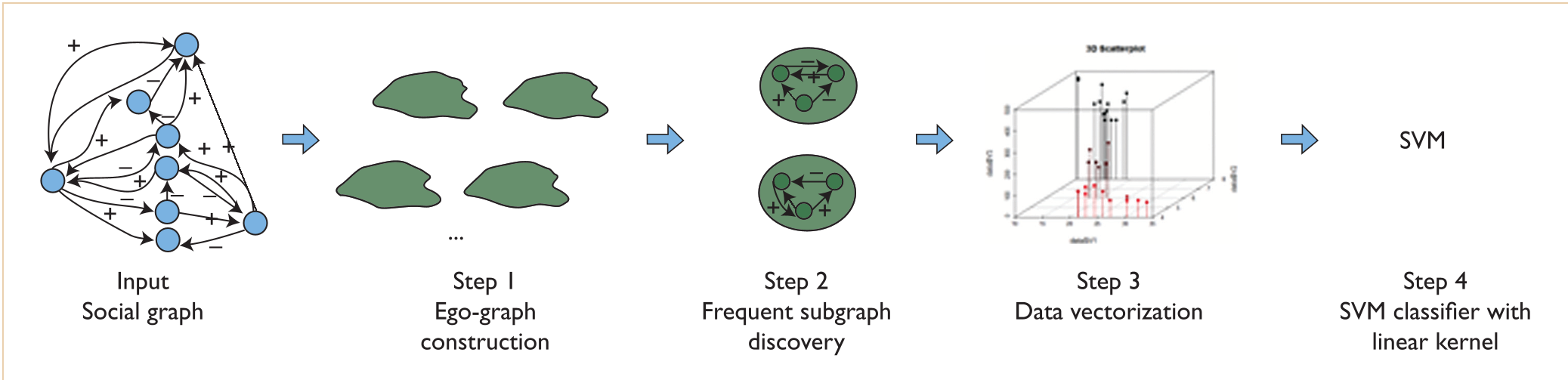 Figure 1: The training process, from Ego-graph construction to the final SVM classifier.
Experiments & Empirical Evidence
The study evaluated the framework on three massive datasets: Slashdot (Friend/Foe), Wikipedia (Vandalism/Admin voting), and Epinions (Trust/Distrust).
Key Result: Sashing the Baseline
The results confirm that frequent subgraphs are highly informative. Even with a subgraph size of , the model significantly outperformed the classic logistic regression baselines.
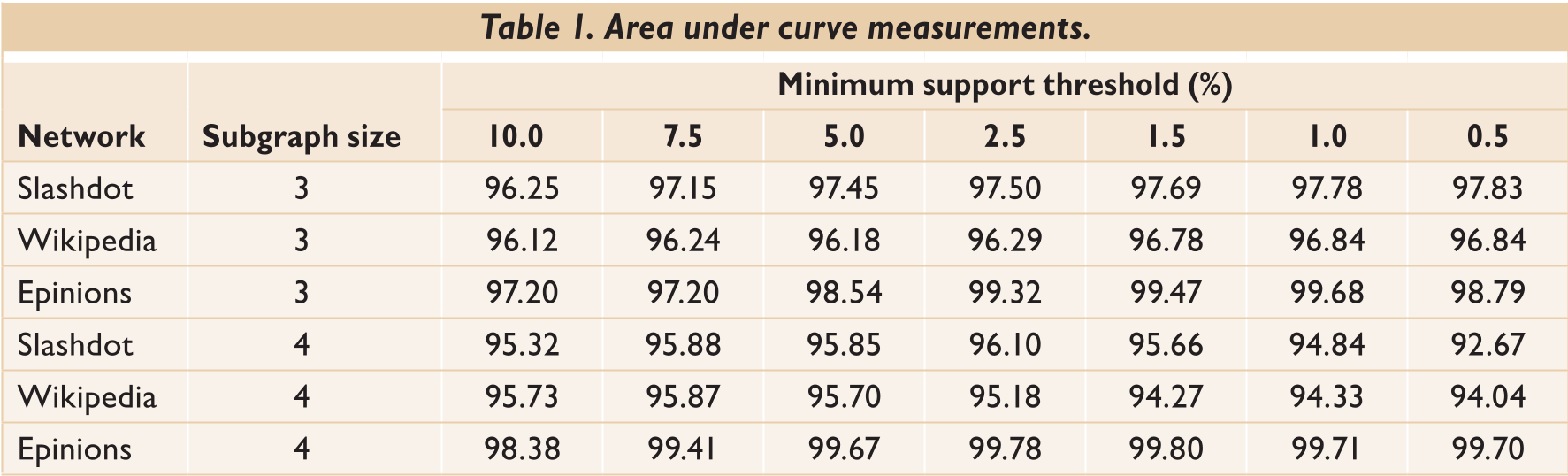 Table 1: AUC measurements across different networks and support thresholds. Note the near-perfect scores on Epinions.
Visualizing "Friendship" vs "Enmity"
One of the paper's most profound contributions is the visualization of the motifs themselves. The authors found that:
- Positive links exist in dense, complete subgraphs where everyone likes everyone.
- Negative links follow "Two-Group Dynamics." In these patterns, we often see two opposing clusters where positive links are internal to the cluster and negative links cross between them.
Deep Insights & Future Outlook
This paper proves that local topology is king. While global graph metrics provide context, the secret to predicting human relationships lies in the immediate "social neighborhood."
Limitations: The primary bottleneck is the computational cost of finding frequent subgraphs as increases. While the paper successfully uses , scaling to or larger would require more advanced sparse coding or approximate graph mining.
Future Directions: This method paves the way for "Synthetic Signed Networks"—inferring trust and distrust on platforms like Facebook or Twitter that only officially support "Follow" or "Friend" links. By identifying these negative motifs in undirected graphs, researchers could preemptively detect toxic community splits before they happen.