
Precision Banking: Leveraging TensorFlow-Enhanced KNN for Direct Marketing Success
Predicting Efficiency of Direct Marketing Campaigns for Financial Institutions
The paper presents a comparative study of machine-learning-based classification models to predict the success of direct marketing campaigns in the financial sector. It introduces and evaluates three specific approaches: K-Nearest Neighbor (KNN), Random Forest, and a TensorFlow-optimized implementation of KNN, achieving a state-of-the-art accuracy of 97.18%.
TL;DR
Financial institutions are drowning in customer data but starving for insights. This paper demonstrates a breakthrough in predicting marketing campaign efficiency by comparing traditional classifiers with a TensorFlow-accelerated K-Nearest Neighbor (KNN) model. The results are stark: while standard models hover around 60% accuracy, the TensorFlow approach hits 97.18%, effectively turning customer profiling into a precision science.
The "Precision" Gap in Modern Banking
Direct marketing—contacting clients directly via text, calls, or emails—is only cost-effective if the target audience is likely to convert. For years, banks have struggled with a "shotgun approach," blasting campaigns at vast datasets without understanding the underlying patterns of client behavior.
The authors argue that the bottleneck isn't the volume of data (over 11,000 epochs in this study), but the analytical framework used to process it. Traditional methods often fail to capture the interactions between features like marital status, account balance, and existing loans.
Methodology: The Shift to Computational Frameworks
The researchers benchmarked three distinct paths to solving the classification problem: "Will a client subscribe to this scheme?"
- Primitive KNN: A non-parametric method based on feature similarity (Euclidean distance).
- Random Forest: An ensemble of decision trees using "Bagging" to handle variance and outliers.
- KNN via TensorFlow: Utilizing Google’s open-source library to manage tensors and optimized mathematical operations.
Data Preprocessing Strategy
Before training, the data underwent a critical two-tier transformation:
- Dimensionality Reduction: Stripping irrelevant columns (day, month, contact method) to ensure the model focuses on high-impact client attributes.
- Categorical Encoding: Converting textual data (jobs, education) into numerical vectors to satisfy the mathematical requirements of Gradient and Distance-based algorithms.
 Figure 1: The overarching architecture from raw data to success prediction.
The TensorFlow Advantage: Why It Won
The most striking takeaway is the massive performance gap. Why did KNN on TensorFlow (97.18%) crush standard KNN (59.56%)?
- Optimized Computation: TensorFlow uses specialized sessions to store training sets and executes distance formulas with higher numerical precision.
- Dynamic K Selection: Unlike the primitive model where K is often static, the TensorFlow implementation helps in regulating parameter selection based on the specific distribution of the dataset via the
FeedDictionarymethod.
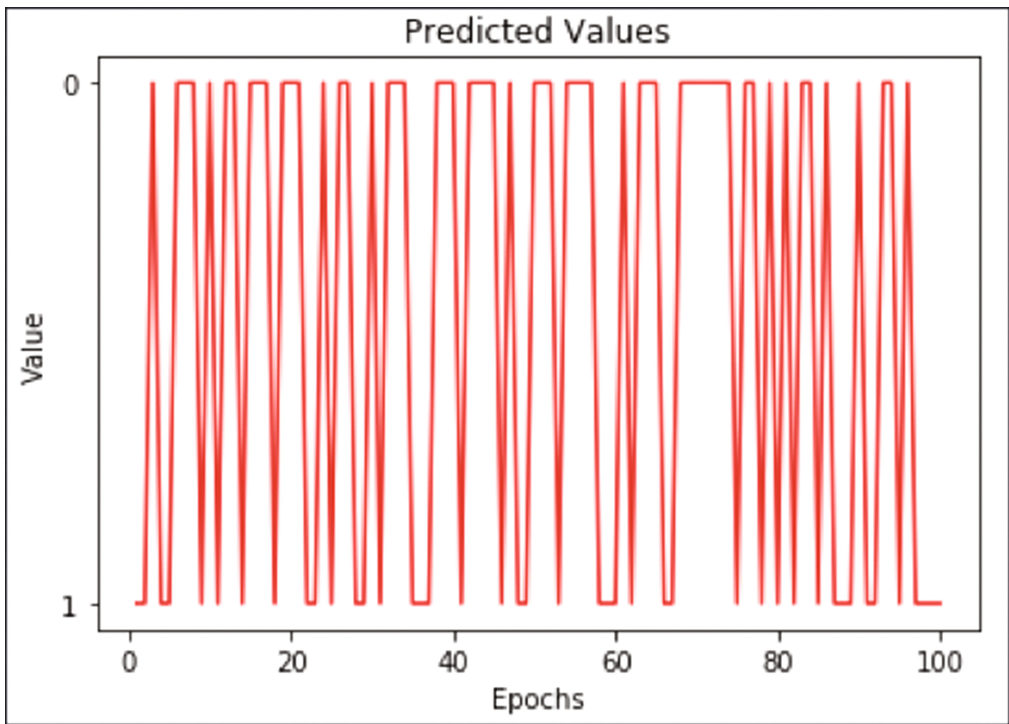 Figure 2: Predicted values using TensorFlow KNN, showing near-perfect alignment with original labels.
Experimental Results & SOTA Comparison
The paper provides a detailed breakdown of accuracy parameters, revealing that the TensorFlow model achieved a Sensitivity (Recall) of 1.0.
| Metric | KNN (Standard) | Random Forest | KNN (TensorFlow) |
|---|---|---|---|
| Accuracy | 58.30% | 61.30% | 98.07% |
| Error Rate | 41.69% | 38.69% | 1.92% |
| Sensitivity | 0.5457 | 0.5836 | 1.000 |
This means the TensorFlow implementation missed zero potential subscribers in the test set, a critical metric for banks that want to ensure no revenue-generating opportunity is lost.
Critical Insight & Conclusion
While the paper demonstrates an impressive accuracy jump, a资深主编 (Senior Editor) perspective suggests we look closer at the Sensitivity vs. Specificity trade-off. The TensorFlow model essentially eliminated False Negatives. In the context of marketing, this is the "Holy Grail"—it ensures that every person who might have said yes is included in the campaign.
The Takeaway: For financial institutions, the choice of library is as important as the choice of algorithm. Moving from standard CPU-bound libraries to tensor-optimized frameworks can unlock "latent accuracy" hidden in existing customer datasets, significantly boosting the ROI of direct marketing strategies.
Limitations to Consider
The paper focuses on a specific bank marketing dataset. In the real world, Data Drift (changes in customer behavior over time) means these models would require constant retraining via MLOps pipelines to maintain this 97% accuracy level.