
Beyond Positive and Negative: Predicting Reader Emotions in Informal Text
Predicting Emotional Responses to Long Informal Text
This paper explores the prediction of emotional responses to long informal social media text using the dimensional model of affect (Valence and Arousal). The authors introduce a human-annotated dataset of forum discussions and propose unsupervised, dictionary-based methods—including a novel Gaussian Mixture Model (GMM)—leveraging the ANEW lexicon to achieve a high correlation of 0.89 for valence.
TL;DR
Most sentiment analysis feels like a blunt instrument—grading text as simply "good" or "bad." This research shifts the focus from the writer’s intent to the reader’s emotional response using a two-dimensional psychological scale: Valence (pleasure) and Arousal (excitement). By applying dictionary-based aggregation methods to long forum discussions, the authors achieved a remarkable 0.89 correlation with human judges in valence, proving that the words we read have a quantifiable, predictable impact on how we feel.
Context: Why "Positive/Negative" Isn't Enough
In the landscape of social media, sentiment is often messy, argumentative, and deeply subjective. Prior work has largely focused on binary classification or star ratings. However, the authors argue that this ignores the act of communication. Writing on a forum is intended for an audience; therefore, the true "success" of a message lies in the emotion it elicits in the reader.
Using the Core Affect theory, the researchers move toward a continuous scale (1-9). This transition is vital because it maps more closely to how human emotions actually fluctuate, moving away from categorical "basic emotions" (like anger or fear) which often fail to capture the "blended" nature of real-life interactions.
Methodology: The Power of the Dictionary
Instead of using black-box machine learning models that often fail when moving between domains (e.g., from movie reviews to political forums), the authors chose an unsupervised, dictionary-based approach using the ANEW (Affective Norms for English Words) lexicon.
Three core algorithms were tested:
- Weighted Arithmetic Mean (wAM): A standard frequency-based average.
- Weighted Geometric Mean (wGM): An approach designed to dampen the effect of extreme outliers.
- Gaussian Mixture Model (GMM): The paper's most innovative contribution. It treats each word not just as a single value, but as a distribution. Words with high variance (meaning different people disagree on their emotional weight) are automatically "penalized" so they don't skew the results.
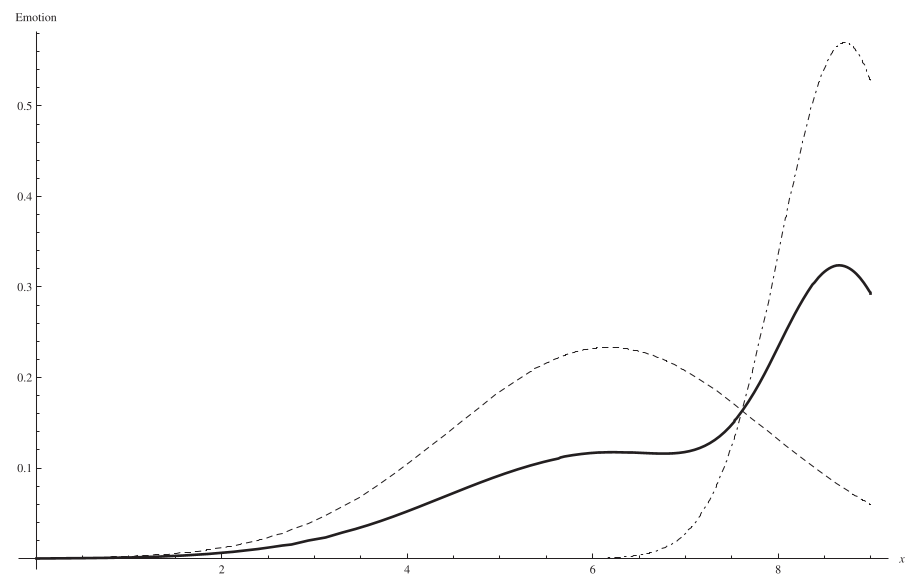 Figure: Visualization of the GMM approach where words like "love" (low variance) carry more weight than "bake" (high variance).
Experiments & Results: The Valence-Arousal Gap
The researchers tested these methods on a purpose-built dataset of 20 forum threads. The results revealed a fascinating disparity between the two dimensions.
1. Valence: Highly Predictable
Valence results were stellar. By using boolean weights (counting the presence of a word rather than its frequency) and filtering out words with high standard deviations, the correlation hit 0.89. This suggests that our "vocabulary of pleasure" is relatively stable and recognizable.
2. Arousal: The "Holy Grail" of Difficulty
Arousal was much harder to pin down (max correlation 0.42). Interestingly, the paper found that human judges also disagreed more on arousal than on valence. If humans can't agree on how "exciting" a text is, it's perhaps unfair to expect a simple algorithm to solve it perfectly.
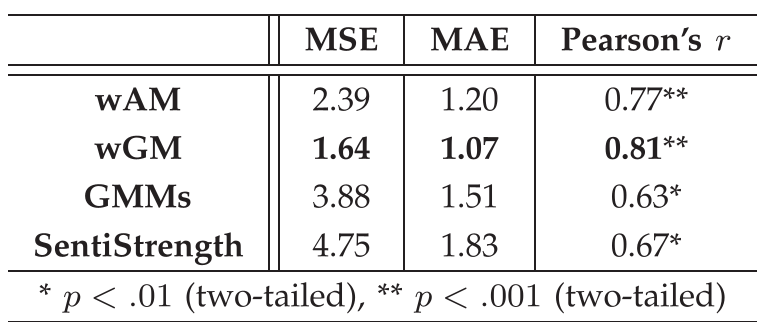 Table: Performance of various methods, showing the superiority of wGM in predicting valence.
Critical Insight: The "Boomerang" of Emotion
The study observed a "boomerang" shape when plotting valence against arousal (as seen in Figure 2 below). It is naturally difficult to find texts that are "neutrally pleasant" but "highly exciting," or "highly negative" but "calm." This physical boundary of human emotion explains why certain emotional states are rarely encountered in online discourse.
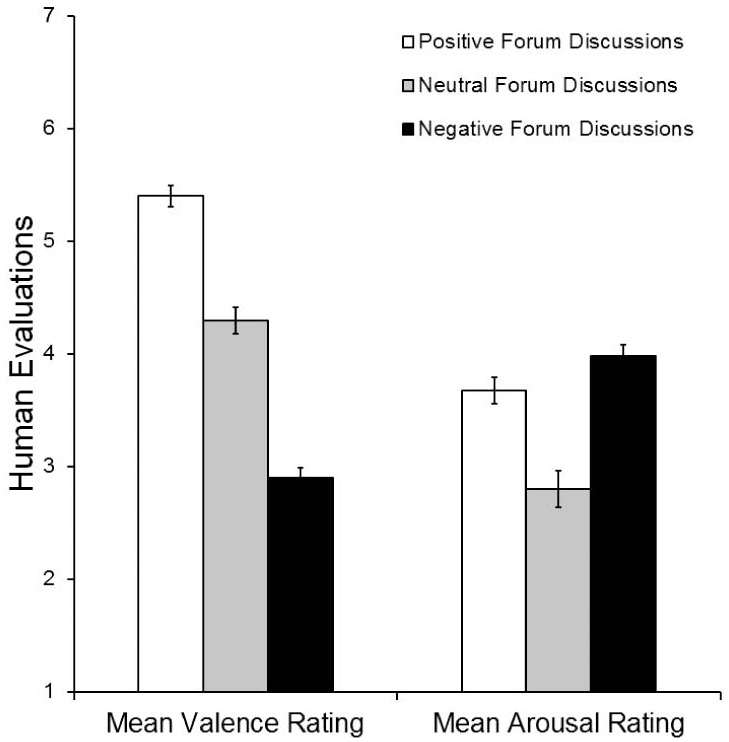 Figure: The distribution of emotional responses follows a standard psychological "boomerang" pattern.
Conclusion and Future Outlook
This work demonstrates that we don't always need massive neural networks to achieve Senti-SOTA (State of the Art) results. By leaning on established psychological lexicons like ANEW and using refined aggregation techniques like Geometric Means, we can accurately predict how readers will react to long-form text.
The Takeaway? If you want to predict the emotional impact of a message, look at the diversity of words (boolean counts) rather than just the frequency. While arousal remains a frontier for future NLP research, our ability to map the "pleasure" of text has reached a remarkably high level of precision.