
Beyond BLAST: Harnessing Diffusion Kernels for Automated Gene Annotation
Predicting gene ontology annotations from sequence data using kernel-based machine learning algorithms
This paper presents a machine learning framework for predicting biological processes in the Gene Ontology (GO) using primary amino acid sequences. By leveraging Support Vector Machines (SVM) combined with innovative diffusion kernels on sequence and structural similarity graphs, the authors achieve SOTA-level functional annotation for Saccharomyces cerevisiae without requiring expensive experimental proteomics.
TL;DR
Predicting what a gene actually does—its biological process—is the "Holy Grail" of genomics. This paper introduces a method to predict Gene Ontology (GO) terms using only amino acid sequences. By combining Diffusion Kernels with SVMs, the authors map the intricate relationships between proteins in a genomic graph, successfully annotating the yeast proteome without traditional wet-lab experiments.
Background: The Gap Between Sequence and Function
In the early 21st century, the explosion of genomic data outpaced our ability to characterize protein functions. Conventional wisdom relied on experimental assays like microarrays or "pull-down" assays, which are prohibitively slow. The research intuition here is elegant: Biological function is encoded in the relationships between proteins. If we can capture these relationships—phylogenetic history, structural similarity, and sequence motifs—we can predict function digitally.
Methodology: The Heat of the Network
The core of this work lies in the Diffusion Kernel. Instead of just looking at isolated protein features, the authors treat the entire proteome as a graph where nodes are proteins and edges represent similarities.
1. Feature Engineering from Sequence
The authors didn't just use raw sequences; they extracted deep evolutionary and structural signals:
- Phylogenetic Profiles: Tracking the presence/absence of a protein across 92 genomes.
- Secondary Structure: Using PSIPRED to predict alpha-helices and beta-sheets.
- Position-Specific Scoring Matrices (PSSM): Capturing evolutionary conservation.
2. The Diffusion Mechanism
The mathematical heart is the graph Laplacian . The kernel is defined as: This is analogous to "heating" a node and watching the thermal energy (information) flow to neighboring nodes. This allows the model to capture not just direct matches, but subtle, transitive relationships across the protein manifold.
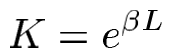 Note: The diffusion kernel formulation enables global information flow across the protein similarity graph.
Experiments and Results
The study focused on Saccharomyces cerevisiae (yeast). Using a 3-fold cross-validation, the SVMs were trained to classify proteins into specific GO categories.
- Success in Metabolism: The model was exceptionally accurate at predicting biosynthetic and metabolic processes. The authors hypothesize that these pathways were inherited as cohesive "modules" throughout evolution, making their phylogenetic signatures very strong.
- BLAST Improvement: While standard BLAST searches are a baseline, the diffusion kernel on homology relationships provided superior "smoothing," allowing for better classification in the "twilight zone" of sequence similarity.
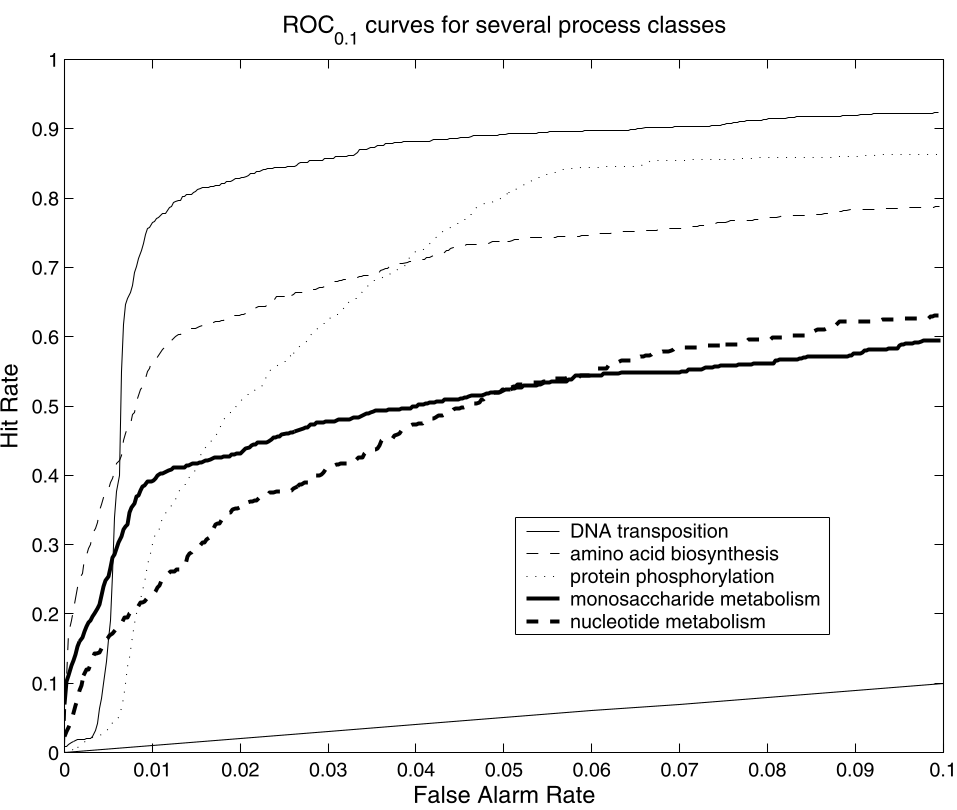 Figure 1: ROC curves showing the performance of linear SVMs on phylogenetic profiles, demonstrating clear predictive power over random assignment.
Critical Insight & Future Outlook
The primary value of this paper is its inductive bias: by assuming that protein function is "smooth" over the graph of structural and evolutionary similarity, it provides a principled way to propagate labels.
Limitations: The kernel on structural similarity performed lower than expected. This suggests that the "structural alignment" scoring in 2004 wasn't yet sensitive enough to distinguish fine-grained functional differences.
The Legacy: Today, this line of thinking has evolved into Graph Neural Networks (GNNs) and Protein Language Models. However, the fundamental concept—that protein function is a manifestation of its position within a high-dimensional evolutionary and structural graph—remains the cornerstone of modern computational biology.