
Predicting Group Stability: Decoding Why Online Communities Live or Die
Predicting group stability in online social networks
The paper "Predicting Group Stability in Online Social Networks" investigates why some online communities thrive while others collapse using data from World of Warcraft (WoW) and DBLP. It introduces predictive models based on member diversity, social activity, and structural features, achieving high classification accuracy (up to 85% for WoW and 90% for DBLP).
TL;DR
In the digital age, social groups are highly dynamic. While many studies focus on how communities grow, this paper shifts the lens to stability and shrinkage. By analyzing World of Warcraft (WoW) guilds and DBLP co-authorship networks, the authors demonstrate that group death can be predicted with up to 90% accuracy by looking at member diversity, the "prolificness" of core contributors, and intensive internal social activity.
Background: Beyond the Growth Bias
Most academic literature treats online communities as entities that either grow or plateau. This is because, in many platforms (like Facebook or LinkedIn), people rarely "unfriend" or "quit" a group—they simply stop participating. This paper argues that stagnation is a form of shrinkage. By comparing a high-churn environment (WoW) with a stable, professional one (DBLP), the researchers aimed to find the universal "DNA" of a stable group.
Problem & Motivation: The "Stickiness" Fallacy
The authors identify a critical gap: prior work focuses on "diffusion" (the spread of influence to attract new members). However, a group can attract members and still be "dying" if it loses its core expertise or if its internal connectivity becomes brittle. The research intuition here is that diversity acts as an insurance policy—a group with a wide range of skill levels and roles can survive the departure of a few key individuals better than a homogeneous one.
Methodology: Quantifying the Intangible
The core innovation lies in how the authors measure stability across different network types:
- For Exclusive Groups (WoW): A simple threshold-based churn (losing >15% members) was used.
- For Non-Exclusive Groups (DBLP): The authors developed a Membership Score. This isn't just a count of heads; it uses an exponential summarization kernel to weight recent activity more heavily than old history and accounts for the "prolificness" (repute) of the members.
The Feature Stack
The researchers utilized three categories of features:
- Composition: Entropy of classes/roles (Diversity).
- Activity: Collaboration time and "Loyalty Coefficients."
- Structure: Clustering coefficients and degree distribution entropy.
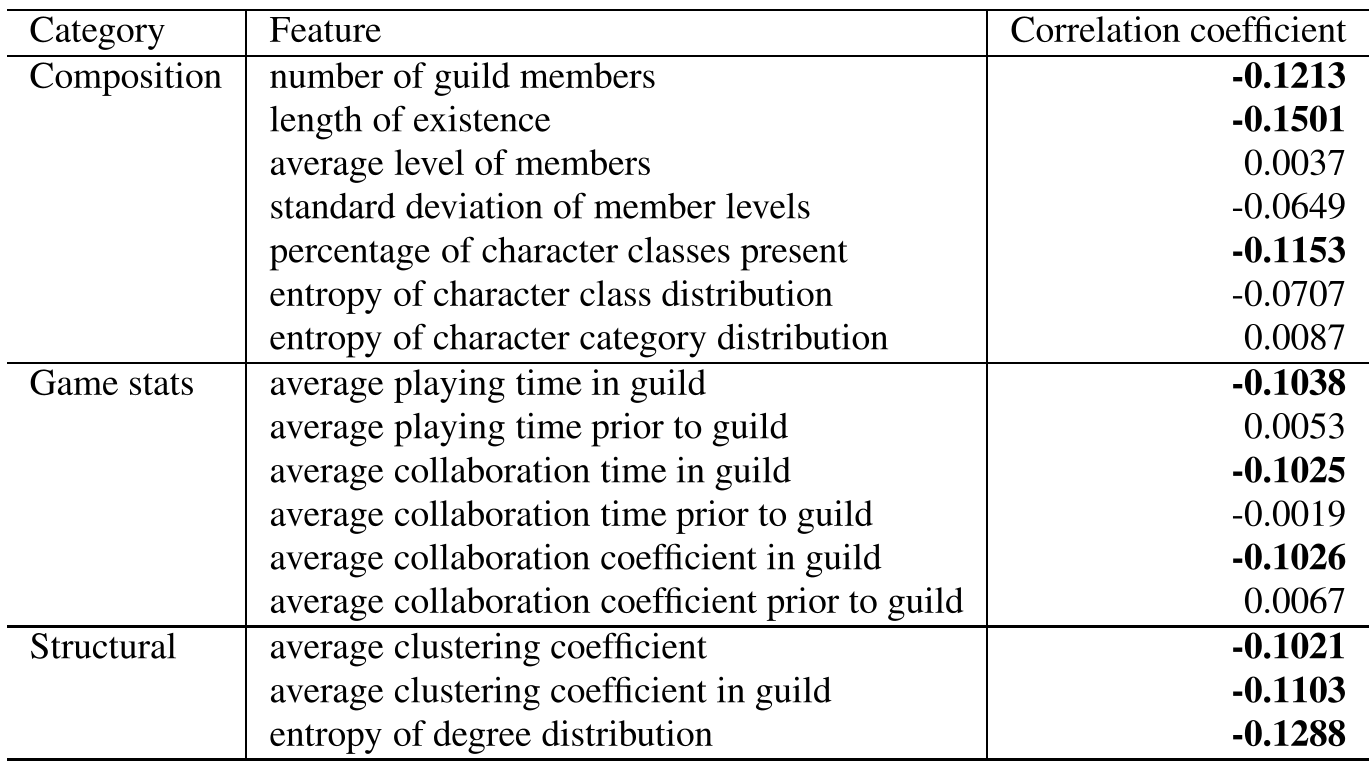 The table above highlights that "Number of Members" and "Collaboration Time" are paramount for stability in gaming communities.
Experiments & Results: The Power of Prolific Members
Using a Random Forest classifier, the study achieved remarkable results:
- WoW accuracy: 84.8%
- DBLP accuracy: 90.6%
A standout insight from the DBLP analysis was the role of "Prolificness." Groups with authors who contribute frequently and have high standing are significantly more stable. Interestingly, in WoW, "Age of the Guild" serves as a survival signal (older is more stable), whereas in DBLP, the age of a conference had almost no correlation with its future stability.
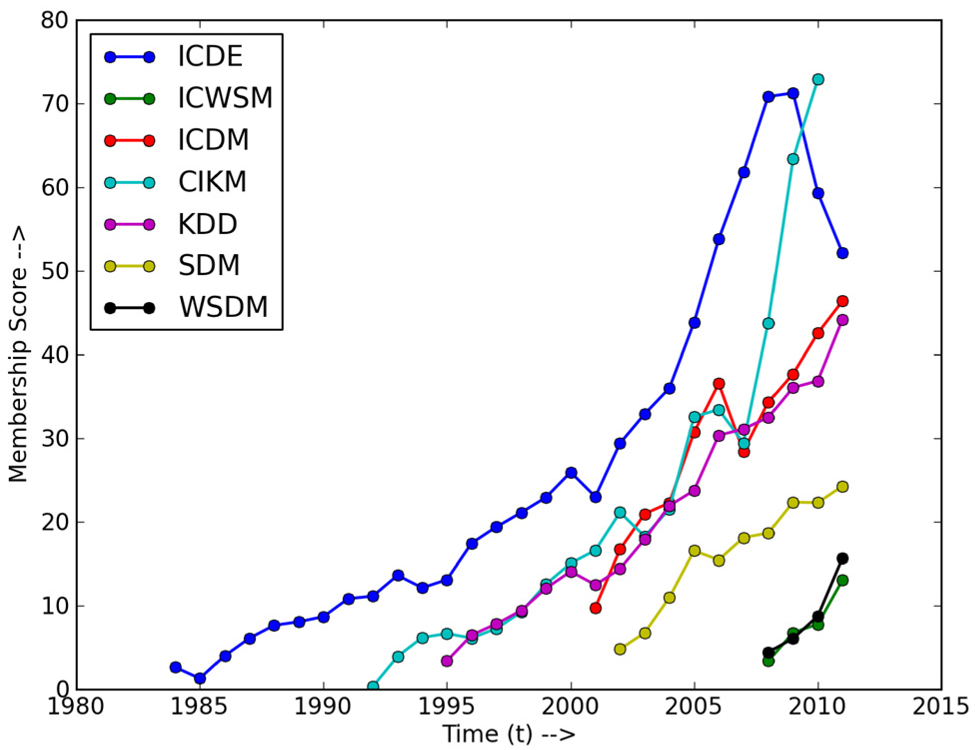 Visualizing the Membership Score: ICDE and CIKM show distinct patterns of stability versus growth over time.
Critical Insight: Trust vs. Information
The paper revisits the classic debate: Do people join groups because their friends are all there (Trust Advantage) or because they provide unique information (Informational Advantage)?
- In DBLP, the Trust Advantage won: high clustering encourages joining.
- In WoW, evidence suggested an Informational Advantage: gamers join based on shared objectives and utility rather than just following a dense cluster of friends.
Conclusion & Takeaways
The survival of an online community is a predictable science.
- Diversity is Strength: Homogeneous groups are fragile. To stay stable, a group needs a mix of "experts" and "novices."
- Recent Activity > Historical Size: A large group that has stopped collaborating is already in a "shrinking" phase, regardless of its member count.
Limitations: The study relies on co-occurrence and co-authorship as proxies for friendship. In the modern era of remote work and social media, "social ties" are even more nuanced and may require deeper NLP-based sentiment analysis to truly gauge stability.
Future Outlook: This framework is highly transferable to managing modern DAOs or corporate open-source projects, where identifying "at-risk" communities early can allow for strategic interventions.