
Sensing the Invisible: High-Precision Human Counting via Gaseous Footprints
Predicting Human Count through Environmental Sensing in Closed Indoor Settings
This paper introduces a non-intrusive human counting methodology for closed indoor environments using multi-modal environmental sensing. By utilizing the "Ecoradar" device to monitor gaseous (CO2, LPG, NO2, SO2) and weather parameters (temperature, humidity), the study employs ensemble machine learning techniques—specifically IBK, Random Forest, and J48—to achieve human counting accuracy exceeding 99% for up to 10 individuals.
TL;DR
Researchers from BUET have developed a "hidden" surveillance method that counts humans in a room without using cameras or motion detectors. By sensing minute changes in gases like CO2 and NO2 along with temperature, their system—Ecoradar—reaches over 99% accuracy using Random Forest and Bagging algorithms, even when the sensors are completely out of sight.
Perspective: Why Gaseous Sensing Matters
In high-security environments like bank vaults or armories, traditional security has a fatal flaw: visibility. If an intruder can see a camera or a PIR sensor, they can blind or bypass it. This paper shifts the paradigm from "seeing" to "smelling." Because humans naturally alter their chemical environment through respiration and thermal emission, they leave an "environmental footprint" that is nearly impossible to mask and can be detected by sensors hidden inside walls or furniture.
The "Ecoradar" Methodology
The core of the work lies in the Ecoradar device, a multi-sensor node capturing:
- Gaseous Markers: CO2, LPG, NO2, and SO2.
- Climate Markers: Temperature and Humidity.
While previous works relied heavily on CO2, this study proves that a synergistic approach—combining nitrogen and sulfur oxides with weather data—provides a much more resilient feature set for machine learning.
Architecture and Deployment
The system uses a GPRS-enabled device to stream data to a central server. The authors meticulously tested this in three different room scales (from 144 to 600 sq. ft) with varying occupant levels.
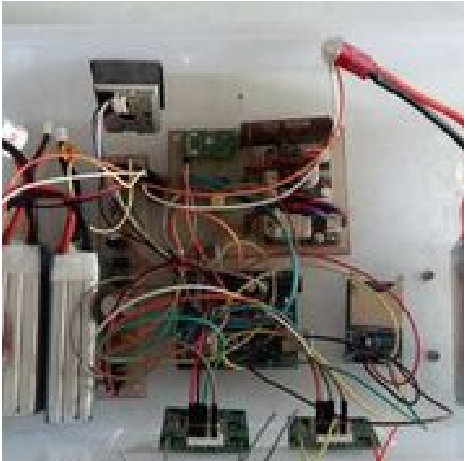 (a) Top View and (b) Side View of the Ecoradar sensing unit.
Data Science: From Raw Gas to Human Counts
The researchers found that human presence isn't just a "bump" in a single gas line. It's a complex, multi-variable shift. To process this, they used Principal Component Analysis (PCA) to filter out environmental noise—such as fluctuations caused by fans or open windows.
Performance Comparison
A critical insight of this paper is the failure of sequential models. Hidden Markov Models (HMM) performed poorly (under 15%), suggesting that indoor gas fluctuations do not follow a simple, observable sequence of states in this context. Instead, Ensemble Learners (Random Forest, Bagging) and Instance-Based Learning (IBK) emerged as the champions.
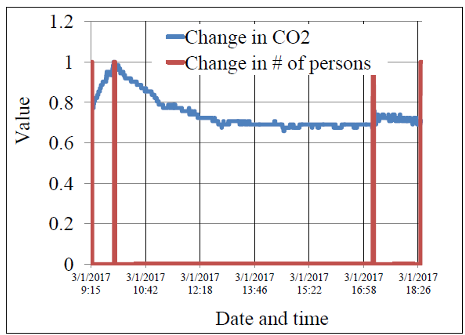 Figure: The clear correlation between CO2 levels and the number of persons present.
Key Results
- Accuracy: Top-tier classifiers achieved 99.9% accuracy in the controlled training environment of Room-1.
- The 37.5s Rule: The authors identified that uploading data every 37.5 seconds maintains high accuracy while drastically extending the battery life of the wireless nodes.
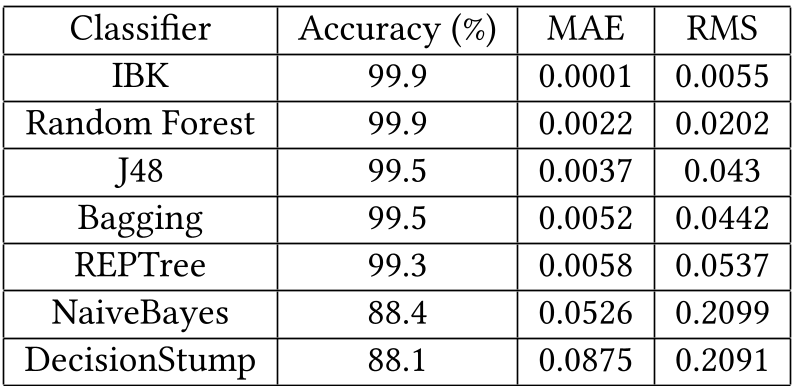 Table: Comparison of accuracy across different non-sequential classifiers.
Critical Insight & Conclusion
This work demonstrates that "Environmental Intelligence" is a viable alternative to "Visual Intelligence." By moving away from pixel-based surveillance, we gain:
- Privacy: No images of individuals are captured.
- Security: Sensors can be hidden from physical tampering.
- Versatility: Works in total darkness and through smoke.
Future Challenges: The current model thrives in "closed" settings. The next frontier for this tech is the "Open Space" problem—how do we count humans via gas when the wind is blowing? For now, however, Ecoradar represents a significant leap for indoor ubiquitous sensing.