
OSN Group Prediction: Forecasting the Next "Micro-Influencer"
Predicting Influential Users in Online Social Network Groups
2021-04-21
Summary
Problem
Method
Results
Takeaways
This research article presents a general framework and methodology for predicting future influential users within Online Social Network (OSN) groups, specifically Facebook groups. By leveraging historical interaction data and Time-Aware Centrality measures, the authors successfully predict approximately one-third of a group's top-10 influencers.
## TL;DR
While identifying the "Kardashians" of the internet is easy, predicting who will command the next wave of attention within specific interest groups (like a 50,000-member DIY hobbyist group) is a complex challenge. This paper introduces a modular framework to predict future influencers in Facebook groups by modeling temporal interactions. By treating social groups as "Temporal Networks," the researchers can forecast the top-10 most influential members with surprising accuracy, identifying "rising stars" before they peak.
## Background & Positioning
In the academic landscape of Online Social Network (OSN) analysis, most literature targets Twitter due to its open API and simple "Follow" structure. However, Facebook's "Group" ecosystem represents a fundamentally different social dynamic—one based on shared topics and active participation rather than just passive following. This paper addresses the **Influencer Prediction** problem, shifting the focus from "Who is important now?" to "Who will be important next week?"
## The Core Innovation: Temporal Modeling
The authors argue that influence is not static; an interaction from six months ago is less relevant than one from yesterday. To solve this, they utilize a **Temporal Network** approach.
### 1. Data Modeling & Slicing
Instead of a single static graph, the methodology represents a group as a sequence of "slices" ($\Delta$).
- **Granularity Matters**: The study found that a 1-week slice duration ($\Delta = 1$ week) provides the best balance between capturing detail and filtering out "daily noise."
- **Active vs. Passive**: The model strictly focuses on *active* observable actions (posts, comments, replies) rather than "lurking" (viewing), as the former drives the community's evolution.
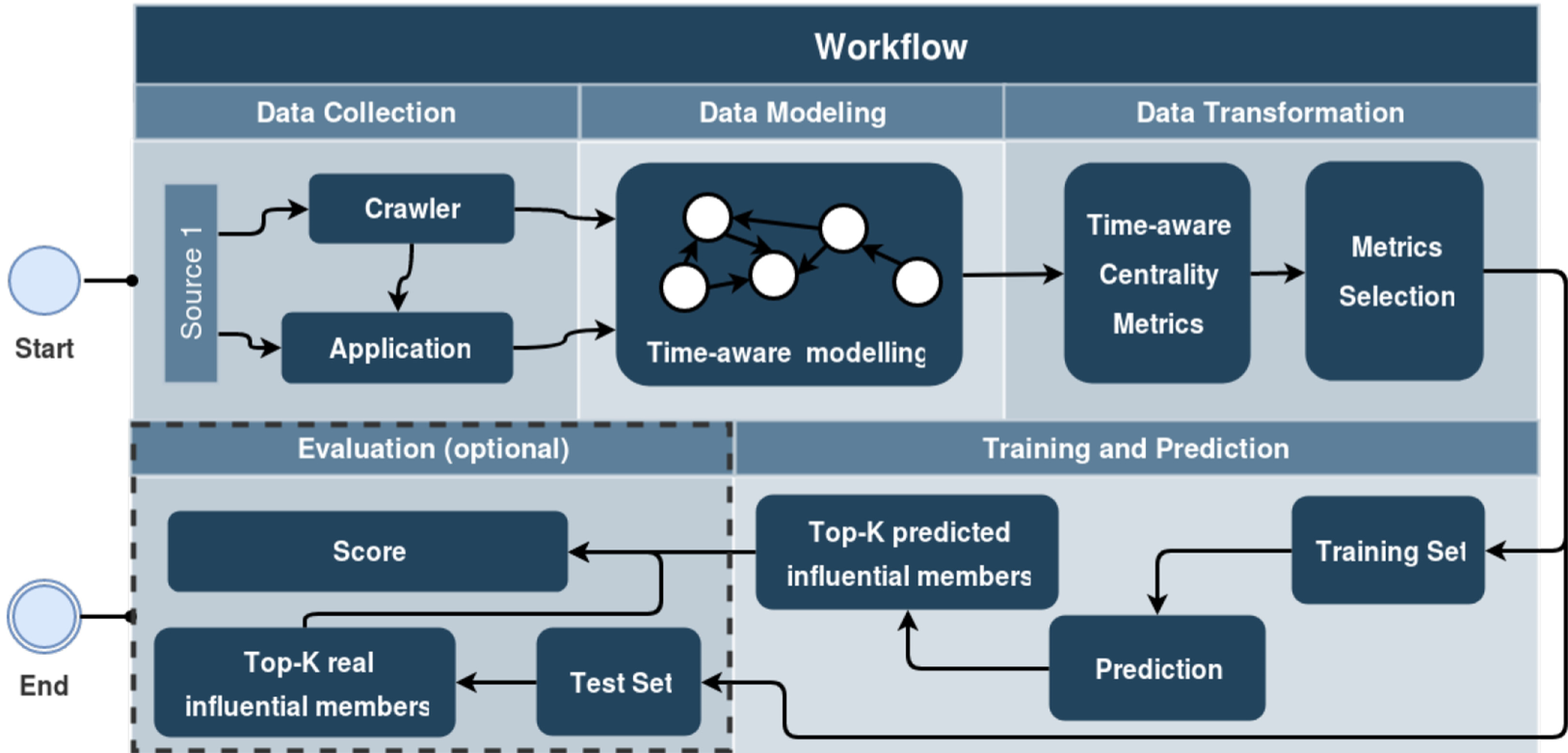
### 2. The Methodology Pipeline
The workflow is designed to be modular:
1. **Data Collection**: Using a Selenium-based crawler to gather interactions (reactions, author IDs, timestamps) across 18 heterogeneous Facebook groups.
2. **Centrality Transformation**: Computing 11 metrics including PageRank, H-Index, and Edge Degree.
3. **Dimension Reduction**: Using PCA to distill these 11 metrics into 1-2 "Principal Components" to avoid multicollinearity and simplify the input for the predictor.
## Experimental Insights: What Makes a Predictor Effective?
The researchers tested six major algorithms: Linear Predictor (LP), Linear Regression (LR), KNN, CART, SVR, and MLP.
### KNN: The Surprise Winner
Counter-intuitively, the **K-Nearest Neighbors (KNN)** algorithm outperformed complex Neural Networks (MLP) and Support Vector Machines (SVR).
- **Why?** Social influence in groups often follows local patterns. Users who exhibit interaction trajectories similar to past influencers are likely to become the next influencers. KNN effectively captures these "neighboring" behavioral patterns.
### The "Sweet Spot" for Training
The study conducted extensive ablation on the training window size:
- **Insight**: 1 month of training data yielded better results than 4 months.
- **Intuition**: Social attention is fleeting. Too much historical data (the "long tail") introduces obsolescence, where the predictor gets distracted by users who were once active but have since left the community.
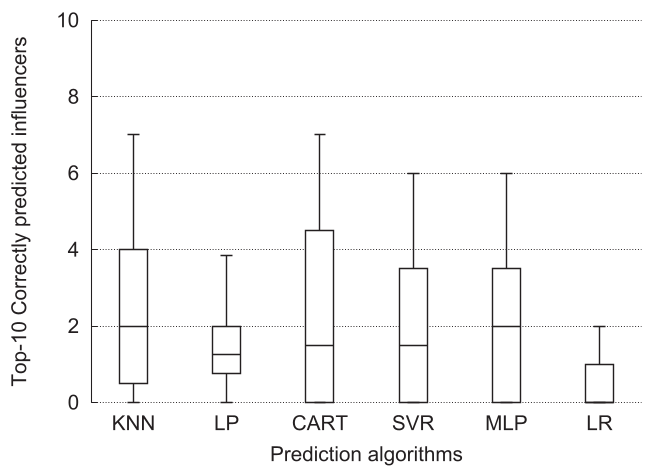
*Fig: Comparison of prediction algorithms showing KNN's superior median accuracy.*
## Critical Analysis & Business Value
This research has significant implications for **Influencer Marketing**. By identifying future influencers early, companies can secure long-term contracts at a lower cost—essentially "investing in the stock" of a user's attention before it hits the mainstream.
### Limitations
1. **Privacy & Access**: The dependency on a crawler is a byproduct of Facebook's increasingly restrictive API. In a production environment, this may face significant technical hurdles.
2. **Content Neutrality**: The model treats all interactions equally. It doesn't analyze the *sentiment* or *quality* of the text, only the structural volume of the response. A user who is "influential" because they are inciting controversy might be flagged the same as a helpful expert.
## Conclusion
The transition from **Identification** to **Prediction** is a leap in OSN research. By combining temporal graph theory with classical ML, this framework proves that the "future leaders" of a digital community leave a mathematical trail in their historical interactions. Future research combining these structural metrics with Natural Language Processing (NLP) could provide an even more nuanced "Influence Score."