
Cracking the Virality Code: Modernizing Twitter Diffusion Prediction
Predicting information diffusion on Twitter – Analysis of predictive features
This paper presents a robust machine learning framework for predicting Twitter information diffusion, specifically addressing whether a tweet will be retweeted and its subsequent popularity volume. Utilizing a Random Forest classifier and 29 multidimensional features across 16 million tweets, the model achieves a significant F-measure improvement of 5% over existing SOTA baselines.
TL;DR
Researchers have developed a new predictive model for Twitter information diffusion that outperforms existing standards by 5% in F-measure. By analyzing 16 million tweets and introducing 22 new features—ranging from the number of communities a user belongs to, to whether the tweet was posted during a holiday—the study provides a more nuanced understanding of why some content "goes viral" while others vanish.
Context: The Battle Against Data Imbalance
In the world of social media analytics, the primary hurdle isn't just data volume; it's imbalance. The vast majority of tweets are never retweeted. Predicting the "black swans"—the tweets that get thousands of shares—is a needles-in-haystacks problem. Traditional models often relied heavily on follower counts or the mere presence of hashtags, but these are no longer sufficient to capture the complexity of modern social interactions.
Methodology: The Three Pillars of Diffusion
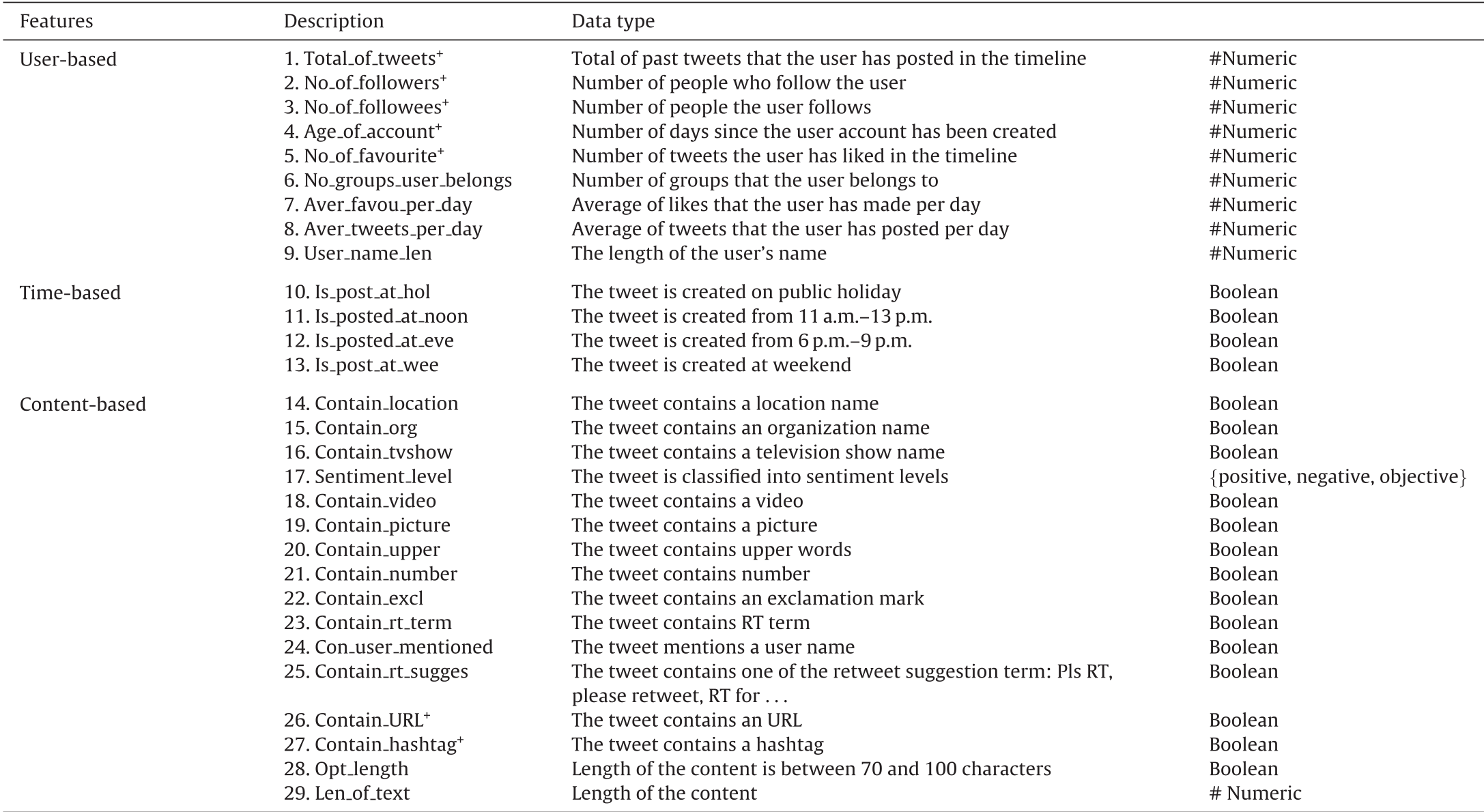
The authors hypothesize that diffusion is a symphony of three factors: Who you are, When you post, and What you say.
1. User-Based Features (The Power of Communities)
While follower count remains a baseline, the authors discovered a hidden gem: No_groups_user_belongs. This identifies how many Twitter communities or lists a user is part of. It serves as a proxy for the user's "social density" across various niches.
2. Time-Based Features (The "Free Hour" Theory)
The study moves beyond simple timestamps to look at "Life Context." Is it a public holiday (Is_post_at_hol)? Is it lunch time (Is_posted_at_noon)? Or the prime-time evening slot (Is_posted_at_eve)? Content posted when users are idle is statistically more likely to be forwarded.
3. Content-Based Features (Beyond the Text)
The model extracts Named Entities (is a TV show or a company mentioned?) and sentiment levels. Interestingly, it also looks at "Content Enhancement"—does the tweet contain a "call to action" like "Please RT"?
Handling the Skew: The SMOTE Strategy
To solve the multi-class classification problem (predicting 0, <100, <10,000, or >10,000 retweets), the authors used SMOTE (Synthetic Minority Over-sampling Technique). By synthetically generating data for the rare "viral" classes and balancing the non-retweeted data into subsets, they ensured the Random Forest classifier didn't simply "default" to predicting zero retweets for everything.
Key Results & Insights
The model was tested on three massive datasets, including the "Sandy" hurricane collection.
- Performance: The F-measure hit up to 82% for binary classification.
- Community Influence: The number of communities/groups was consistently the second most important feature, proving that being a "bridge" between different groups is vital for diffusion.
- The Follower Myth: While important, having many followers doesn't guarantee a high retweet rate if the timing is poor or the content lacks engagement anchors like pictures.

Critical Analysis & Future Outlook
The study's strength lies in its feature engineering. By moving from raw metadata to social and temporal indicators, it captures the "logic of attention."
Limitations: The datasets are relatively "short-term" (spanning days/weeks). Social trends or algorithmic changes by X (formerly Twitter) could shift these dynamics over months.
Future Work: The authors suggest integrating Doc2Vec to better understand the semantic "vibe" of a tweet rather than just checking for keywords. As we move toward 2026, the inclusion of AI-driven sentiment and graph-based neighbor analysis will likely be the next frontier in perfecting the virality formula.
Conclusion
This work serves as a blueprint for technical marketers and data scientists. If you want a message to spread, don't just look at how many followers you have—look at how many communities those followers participate in and make sure your post hits their feeds during their "free hours."