
The Geometry of Cyber War: Simulating the Global Security Regime
Predicting the trajectory of the evolving international cyber regime: Simulating the growth of a social network
This paper develops a Stochastic Actor-Oriented Model (SAOM) to simulate the co-evolution of state behavior and the emerging international cyber security regime. By conceptualizing states as nodes in a social network, the authors predict a trajectory toward a bipolar "Cyber Cold War" structure under current conditions.
TL;DR
Can a computer simulation predict the next Cold War? By treating the international community as an evolving social network, researchers have modeled the growth of the International Cyber Security Regime. The findings suggest we are currently on a path toward a bipolar split between democratic and autocratic blocs—a "Cyber Cold War." However, the simulation also reveals "lynchpin" strategies involving trade that could prevent this fracture.
Problem & Motivation: Beyond Static Maps
In International Relations (IR), we often describe the world in static terms: "The system is unipolar" or "These states are allies." But as any Diplomat knows, the system is a living organism.
The authors argue that previous research suffered from two major pitfalls:
- Static Reductionism: Viewing networks as snapshots rather than processes.
- Behavioral Isolation: Failing to see that the structure of a regime (who is tied to whom) and the behavior of states (how cooperative they are) change each other in a feedback loop.
In the realm of Cyber Security, where traditional material power (tanks and missiles) is less relevant than connectivity and domestic policy similarity, understanding this "co-evolution" is critical.
Methodology: The "Micro-Step" Evolution
To solve this, the authors utilize a Stochastic Actor-Oriented Model (SAOM). Imagine the world as a network where states are nodes. In every "micro-step" of the simulation, one state is randomly chosen and given a choice:
- Social Selection: Change a connection (add or sever an agreement).
- Social Influence: Change its own behavior (become more cooperative or more competitive).
The state makes this choice based on an Objective Function—a mathematical calculation of what benefits it most at that moment. This includes factors like:
- Homophily: Do I share a domestic regime type (Democracy vs. Autocracy) with my partner?
- Bandwagoning: Is this partner already popular in the network?
- Trade Gains: Does this connection offer economic "spillover" benefits?
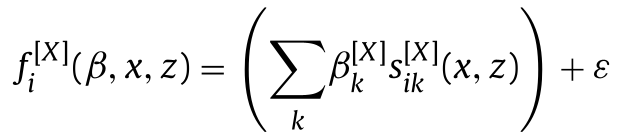 The objective function represents a state's preference to maximize its rewards based on current network structure and behavior .
The Result: A Predicted Bipolarity
The primary simulation, based on the current "real-world" configuration, yielded a sobering result. In 74% of the 5,000-iteration runs, the system fractured into two distinct, unconnected clusters.
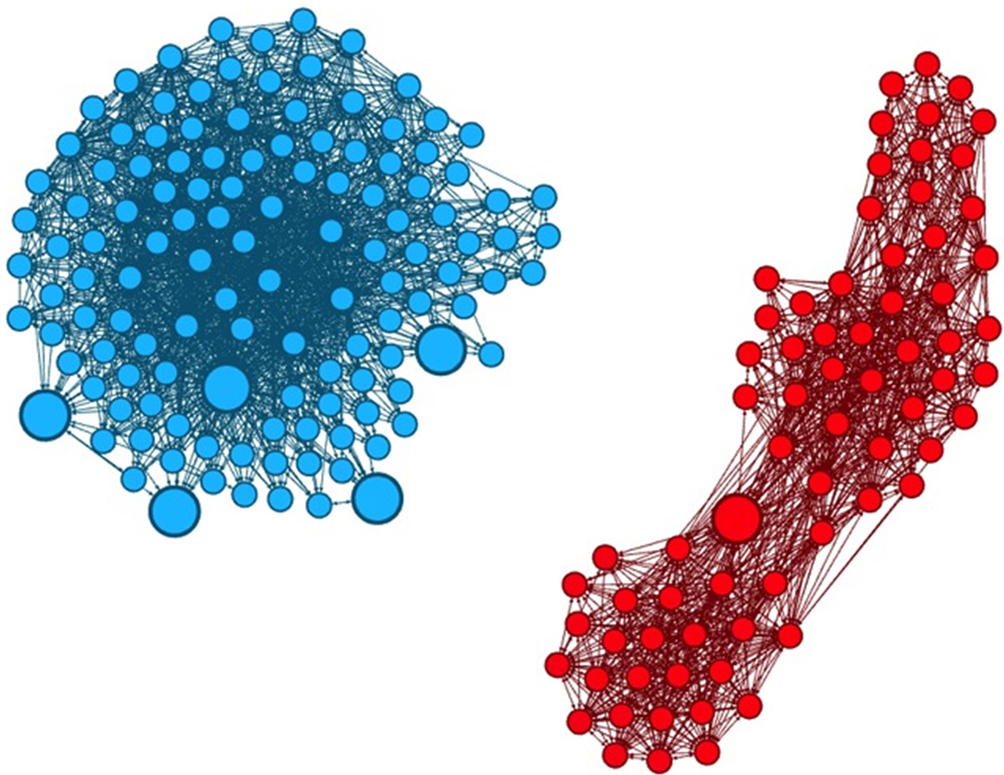 Fig 1: The model predicts a clear split. The left cluster is dominated by democracies (EU/NATO style), while the right represents autocratic configurations.
The Trade Contingency: A Path to Unity
The authors then asked: What if we prioritize trade? By slightly increasing the weight states place on economic benefits, the structure changed dramatically. "Lynchpin states"—typically smaller, neutral countries—began to form bridges between the two blocs, creating a unified, albeit fragile, global regime.
The Power Paradox
Interestingly, when the model prioritized states allying with those of similar material capacity, the two most powerful actors (analogous to the U.S. and China) became isolated. These isolated states then became more competitive ("Hobbesian"), proving that excluding the "big players" from the regime structure actually accelerates conflict.
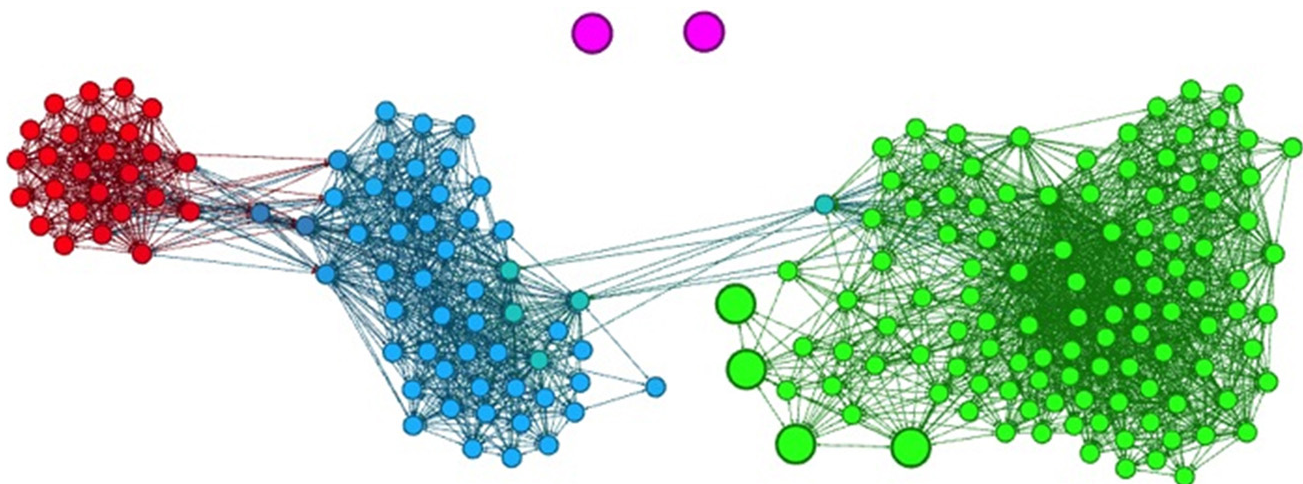 Fig 2: When trade is prioritized, lynchpin states emerge, preventing total systemic fracture.
Takeaways & Critical Analysis
The value of this work lies in its Path Dependence insight. International regimes aren't just "designed"; they grow. A decision made today to exclude a certain state based on its regime type might set off a chain reaction that makes a future global agreement mathematically impossible.
Limitations:
- The model assumes "boundedly rational" actors who only look one step ahead (myopic).
- It uses randomly assigned spatial data for some trade variables, which might not capture the nuance of real-world logistics.
Future Outlook: This methodology can be extended to model "exogenous shocks"—like a major global cyber-attack—to see if regimes are resilient enough to recover or if they shatter instantly. As we move toward 2026 and beyond, these simulations provide the "war games" necessary for digital diplomacy.
Conclusion: A Cyber Cold War is a choice, not an inevitability. By incentivizing trade and maintaining bridges through neutral mediators, the global community can "steer" the network toward cooperation.