
Game On: Predicting Math Proficiency in Children with Special Needs via Serious Games
Predicting Math performance of children with special needs based on serious game
This study presents a data mining approach to predict the mathematical performance levels of both typical students and children with special needs using serious game telemetry. By analyzing gameplay logs from 160 participants, the researchers identified key demographic and performance-based features to classify students into proficiency levels, achieving a peak accuracy of 64.12% using the JRip algorithm.
TL;DR
Researchers have successfully used serious game logs to predict the math proficiency levels of children. By testing six different machine learning algorithms, they found that JRip delivered the most accurate assessments (64.12%). Notably, the study reveals that while age and grade are great predictors for "typical" students, they fail for children with special needs, necessitating more personalized, performance-driven diagnostic tools.
The "Assessment" Bottleneck
In the Indonesian education system, mathematics remains a formidable barrier for many many elementary students. For children with special needs, traditional paper-and-pencil tests often fail to capture their true cognitive potential or can be overly discouraging.
The core motivation of this study is the Inductive Bias inherent in traditional schooling: the assumption that age and grade level are primary indicators of ability. The authors hypothesized that "Serious Games" (games designed for purpose rather than pure entertainment) could serve as a stealth assessment tool—gathering data while the student is engaged in play.
Methodology: From Gameplay to Data Points
The researchers built a mathematics game comprising 60 questions categorized into six levels (Grade 1 to Grade 6). As students play, the system records everything:
- MarkGL1-6: Cumulative score per difficulty level.
- Temporal Data: Time spent per question.
- Demographics: Age, Gender, and Grade.
The "ground truth" used to train the models was established through a combination of traditional written tests and expert teacher judgment.
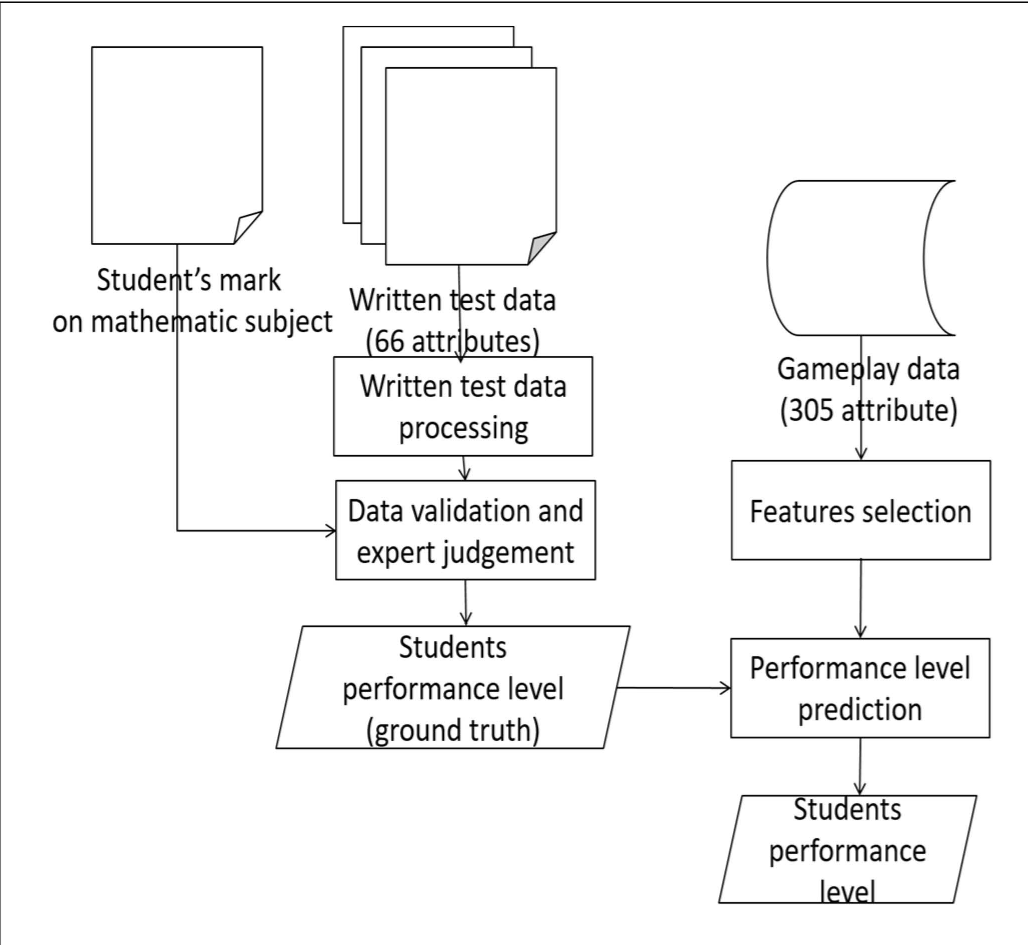 Fig 1. The workflow from data collection via the serious game to the final classification logic.
A Surprising Divergence in Predictors
One of the most profound insights of this research lies in the Feature Importance analysis.
- For Typical Students: Age, Gender, and Grade are highly correlated with Math performance.
- For Children with Special Needs: These factors show no significant correlation.
This suggests that for neurodivergent learners, biological age and school placement are "noisy" variables. Their true math skill level is best identified through direct interaction data (in-game marks) rather than demographic labels.
Evaluation & Algorithm Showdown
The study compared six popular classification algorithms. While SMO (Sequential Minimal Optimization) performed best on average across various testing scenarios, JRip (a propositional rule learner) hit the highest peak accuracy when tuned with 10-fold cross-validation.
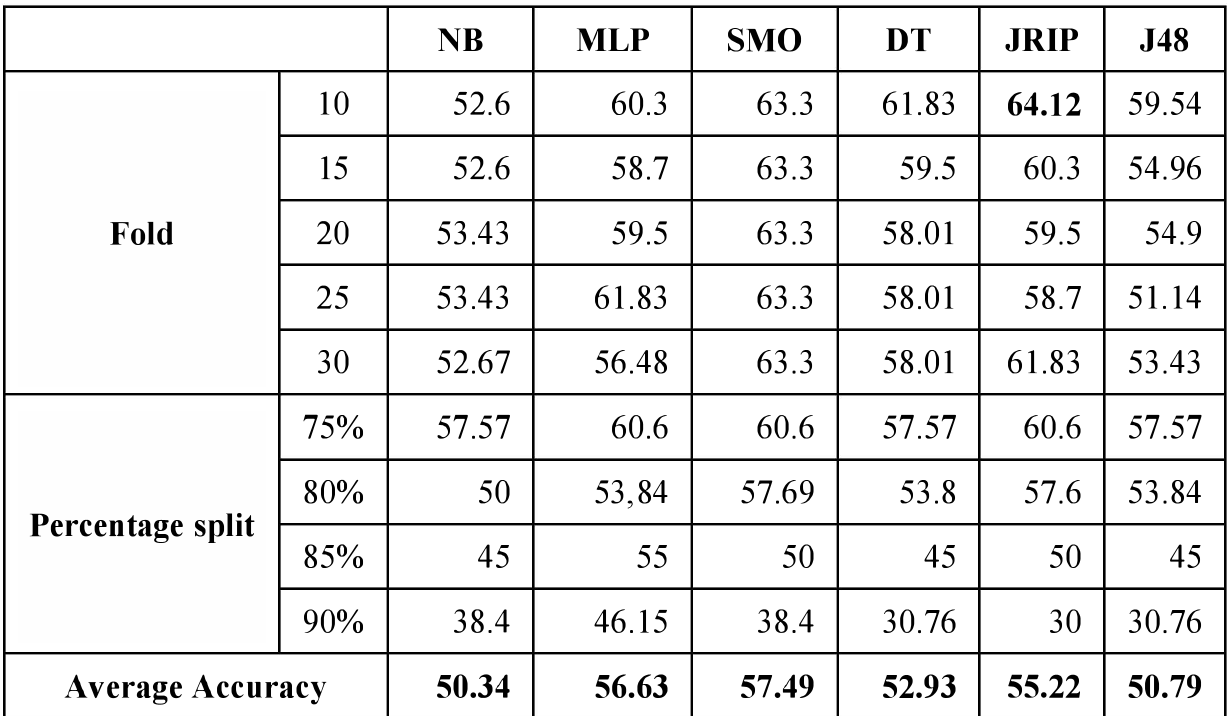 Table 1. Performance comparison of NB, MLP, SMO, DT, JRIP, and J48 across different validation techniques.
Why JRip?
JRip works by inducing simple "If-Then" rules. In an educational setting, this is highly valuable because it offers Interpretability. Instead of a "black box," teachers can see the specific rules (e.g., "If Mark at Level 2 is > 7 AND Time Spent < 20s, then Level = 3") that lead to a student's classification.
Critical Insight & Future Outlook
While an accuracy of ~64% is a solid start for a pilot study with 160 participants, it leaves room for improvement. The limitation lies in the small sample size for special needs children (25 vs. 135 typical students), which likely introduced some class imbalance issues.
The Takeaway: The future of inclusive education lies in Intelligent Tutoring Systems (ITS). By embedding JRip or similar transparent classifiers into educational software, we can create games that dynamically adjust their difficulty in real-time, providing a tailored learning path for every child, regardless of their starting point.
References
- Shahiri et al. (2015) on student performance prediction.
- Sukajaya et al. (2015) on Bloom's Taxonomy in serious games.