
Beyond the Avatar: Decoding Player Gender through Machine Learning
Predicting MMO Player Gender from In-Game Attributes Using Machine Learning Models
This study utilizes behavioral logs from over 4,000 EverQuest II players to predict offline gender using machine learning models (JRip, J48, Random Tree). The research demonstrates that in-game attributes, particularly primary character gender and character count, can predict player gender with an F-measure of up to 0.94.
TL;DR
Is your virtual character a mask or a mirror? This research analyzes over 4,000 players in EverQuest II to prove that machine learning can predict a player's real-world gender with up to 94% accuracy. By looking at what you play (Avatar) and how you play (Behavior), researchers have found that our offline identities are far more persistent in virtual worlds than previously thought.
Context: The Mirror vs. The Mask
For decades, virtual worlds were seen as "identity laboratories" where one could "leave the meat behind." However, a central debate persists: do players choose avatars to explore new identities (the Mask) or to express their existing ones (the Mirror)? This study moves past anecdotal evidence by applying rigorous data mining to behavioral logs, identifying the exact digital footprints that give away a player's offline gender.
Methodology: The Data Behind the Play
The researchers analyzed a massive 4-terabyte dataset from Sony Online Entertainment. To ensure the results weren't just a fluke of one specific playstyle, they tested three distinct server environments:
- Antonia Bayle (RP): Focused on roleplaying and narrative.
- Nagafen (PvP): High-conflict, player-vs-player combat.
- Guk (PvE): Standard monster-slaying and exploration.
They utilized three algorithms: JRip (for clear if/then rules), J48 (for decision trees), and Random Tree (for maximum accuracy).
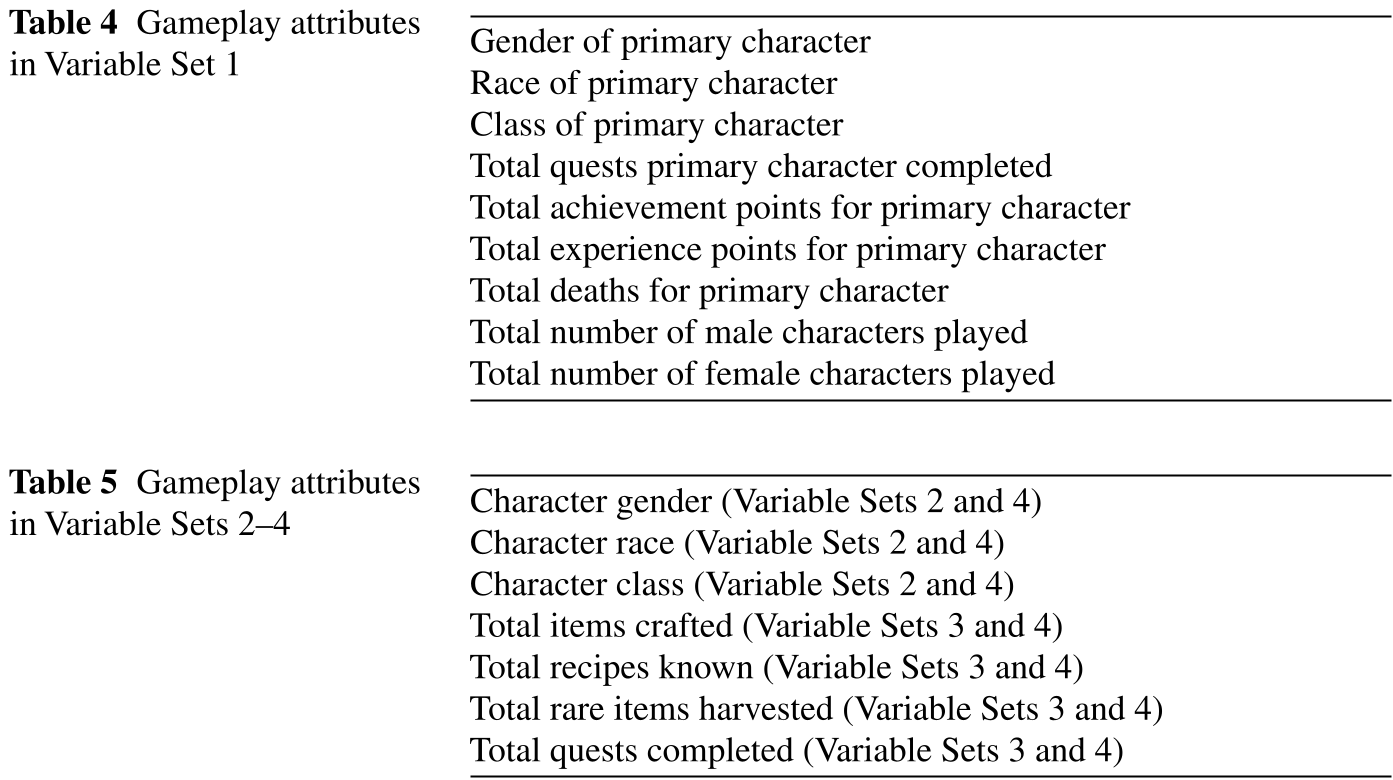 The study compared Avatar Characteristics (Race, Class, Gender) against Gameplay Behaviors (Items crafted, quests completed, deaths).
Key Performance Markers
The results were striking. The most predictive variable was not just the gender of the current character, but the total composition of a player's account.
| Server Type | Best Model | F-Measure | Key Predictors |
|---|---|---|---|
| PvE (Guk) | JRip | 0.94 | Primary Character Gender, Total Male/Female characters |
| PvP (Nagafen) | Random Tree | 0.96 | Combat frequency, low crafting (for males) |
| RP (Antonia Bayle) | J48 | 0.85 | Character Race, Class, and Questing habits |
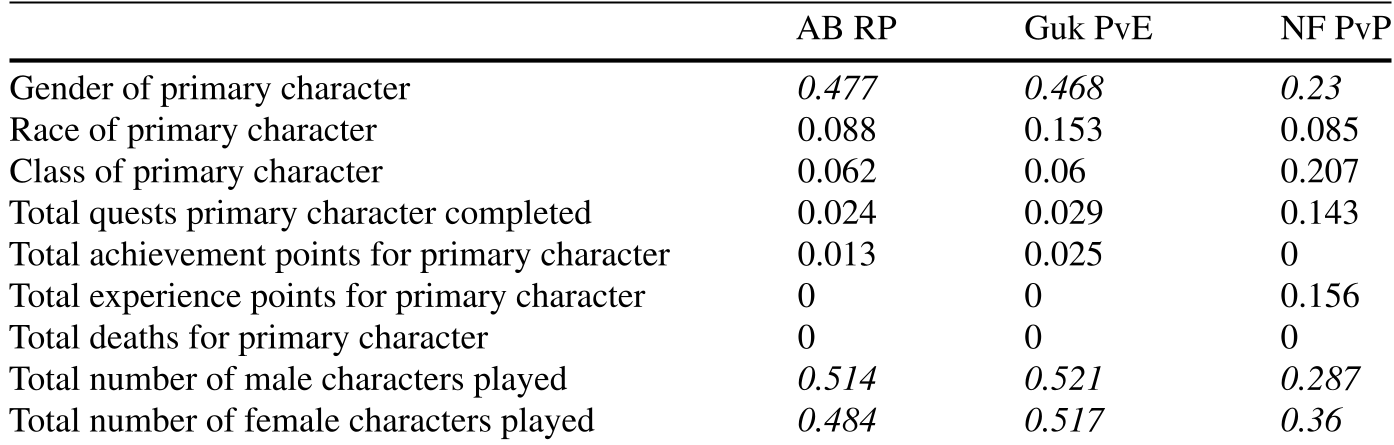 This table reveals that "Total number of male/female characters played" provides the highest information gain for predicting gender.
Why Does It Work? The Physics of Behavior
The "How" is found in the differences in immersive gameplay:
- Female Players: Show a distinct pattern of "holistic" play. They are significantly more likely to craft items, scribe recipes, and harvest rare materials. Even on PvP servers, female players often drive the in-game economy rather than just the kill count.
- Male Players: Exhibit more "instrumental" or "achievement-oriented" play. On PvP servers, men were identified by a lack of crafting and a singular focus on combat and quest efficiency.
- Primary Characters: Predictions were strongest when looking at a player's "main." While players might experiment with gender-bending on secondary characters (alts), their primary avatar remains a "stable harbor" for their real identity.
Critical Insight: The Server Matters
One of the paper's most unique contributions is showing that rulesets shape behavior. On Roleplaying (RP) servers, players choose avatars matching their real gender because it is cognitively easier to "act" a role that is close to one's own identity over long periods. Conversely, on PvP servers, gendered behavior is amplified—men lean into the "warrior" trope, while women lean into the "crafter/supporter" roles.
Conclusion & Future Impact
This research shatters the myth of the anonymous, identity-fluid gamer. By demonstrating that behavioral patterns are robust enough to "de-anonymize" gender, it opens the door for:
- Tailored Game Design: Developers can procedurally adjust content based on predicted player preferences.
- Sociological Precision: Proving that virtual behaviors are valid proxies for real-world social study.
- Privacy Concerns: If gender can be predicted with 94% accuracy, what else (age, income, personality) is visible in our digital play?
As we move toward a "Metaverse" future, this paper serves as a reminder: you can change your skin, but you can rarely hide your soul—or at least, your crafting habits.