
Predicting Personality Traits from Chinese Social Media: Beyond the Language Barrier
Predicting personality traits of Chinese users based on Facebook wall posts
This paper presents a machine learning framework for predicting Big Five personality traits of Chinese Facebook users based on their wall posts. By integrating the Jieba segmentation tool with Support Vector Machines (SVM), the authors specifically address the challenges of Chinese NLP to achieve a Peak Accuracy of 73.5% in Extraversion classification.
TL;DR
Understanding a user's personality can transform recommendation systems from simple history-trackers into proactive personal assistants. This paper tackles the "bottleneck" of Chinese text analysis—word segmentation—to predict Extraversion from Facebook posts. By combining the Jieba tokenizer, SVM, and social metadata (friend counts), the researchers achieved a 73.5% accuracy, proving that linguistic style often outweighs specific content in personality detection.
The "Space" Problem in Chinese NLP
In English, words are naturally separated by spaces. In Chinese, a computer sees a continuous string of characters. If you use a standard tokenizer designed for Western languages on Chinese text, it often treats entire sentences as single tokens, leading to sparse and useless data. This paper identifies that text segmentation isn't just a preprocessing step; it is the "make-or-break" factor for psychographic profiling in non-Latin languages.
Methodology: The Architecture of Prediction
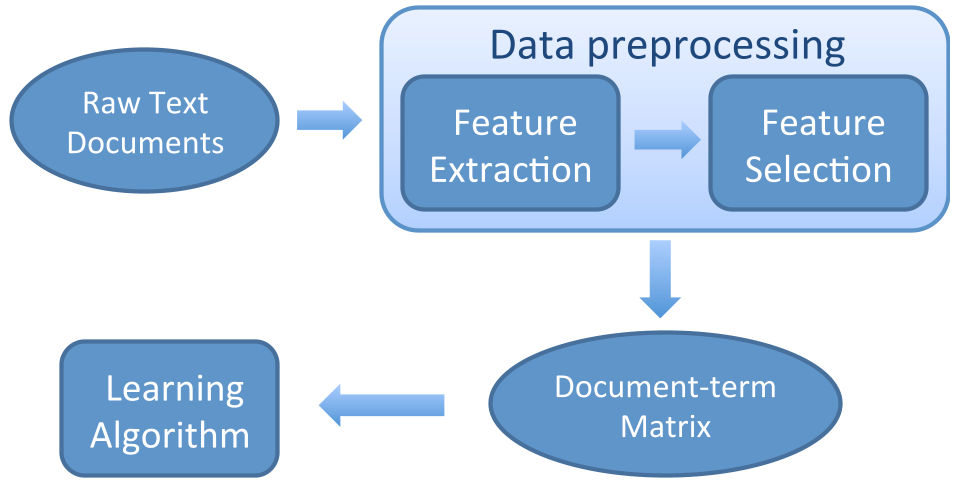
The authors followed a robust pipeline: Raw Text Jieba Tokenization Feature Selection ( or RFE) SVM Classification.
Why TF beat TF-IDF?
In most Information Retrieval tasks, TF-IDF is king because it suppresses "stop words" like "I," "the," or "and." However, this study found that TF (Term Frequency) performed significantly better. Why? Because in personality psychology, the frequency of common, functional words (e.g., high usage of "we," "all," or emojis like "QQ") is a primary indicator of social orientation. Extraverts don't necessarily use "rare" words; they use "common" words more frequently and with more energy.
Experimental Insights: What Makes an Extravert?
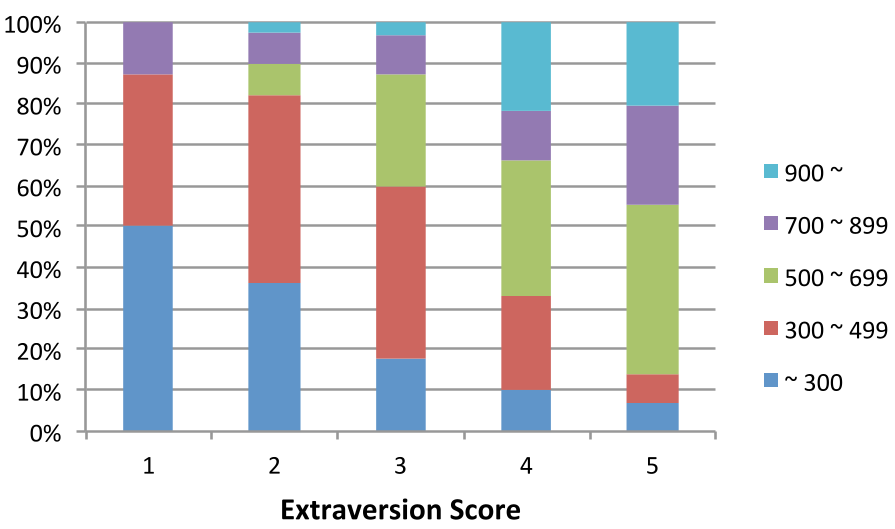
The study focused on Extraversion, the trait most visible on social media. One of the strongest findings was the correlation between social "side information" and personality.
Key indicators uncovered:
- Friend Count: Users with >900 friends almost invariably scored high in Extraversion.
- Sentence Density: High occurrence of the newline character (
- Vocabulary: Extraverts used common words and expressed emotions through colloquialisms (e.g., "hahaha", "really", "together").
Results & Benchmarks
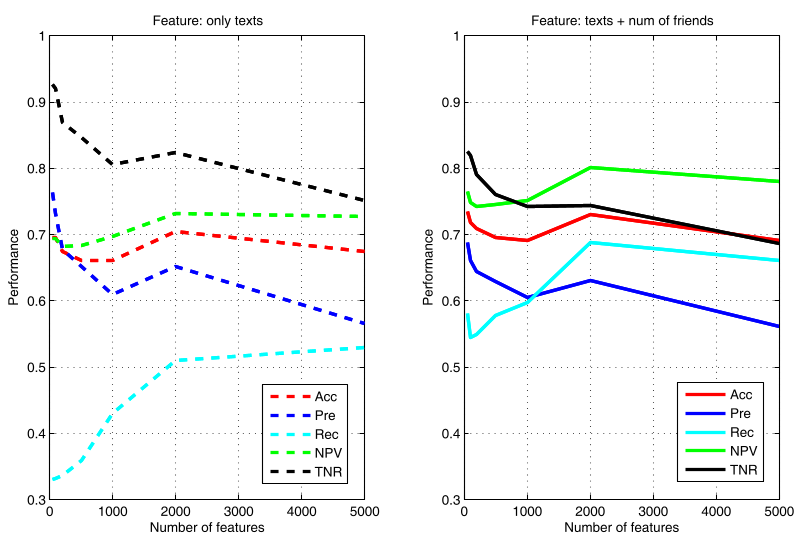
The combination of linguistic features and metadata provided a substantial boost. While text alone reached ~70% accuracy, adding the number of friends as a feature pushed the model to 73.5%.
Critical Analysis & Takeaways
This work serves as a vital bridge between traditional psychometrics and Chinese computational linguistics. However, there are limitations:
- Sampling Bias: The 222-user dataset consisted mostly of students, leading to high "Agreeableness" and "Openness" scores that might not represent the general population.
- Methodological Simplicity: While SVM is reliable, modern LLMs (like BERT or GPT-based embeddings) could likely capture the "context" of posts better than a Bag-of-Words model.
Future Outlook: The next frontier is moving beyond "Extraversion" to more elusive traits like "Neuroticism" or "Conscientiousness," which may require deeper emotional analysis (using sentiment dictionaries) rather than simple word counts. For developers, this research proves that metadata (friend count) is often just as valuable as content for user profiling.