
Decoding Initiative: Predicting Proactive Personality Through Hybrid Text Mining
Predicting Self-Reported Proactive Personality Classification With Weibo Text and Short Answer Text
This study develops a text mining framework to classify "Proactive Personality" using a multi-source dataset of Weibo posts and targeted short-answer texts. By evaluating five machine learning algorithms, the authors demonstrate that an SVM-based approach can effectively predict self-reported personality traits, achieving high stability and accuracy.
TL;DR
Researchers have developed a machine learning framework that predicts a person's "Proactive Personality" by analyzing their Weibo posts and specific short-answer responses. By moving beyond simple questionnaires, this study achieves nearly 90% accuracy using Support Vector Machines (SVM), proving that a combination of daily digital footprints and targeted text prompts provides the most stable psychological profile.
Background: The Limits of Asking Directly
In organizational psychology, a Proactive Personality is a golden ticket—it identifies individuals who take the initiative to change their environment rather than just reacting to it. Historically, measuring this trait required long, self-reported surveys. However, humans are notoriously bad at objective self-assessment; we often answer based on who we want to be (social desirability) rather than who we are.
Data mining offers a path toward "Social Media Psychometrics," but there is a catch: social media text is messy, filled with slang, emojis, and incoherent fragments.
The Methodology: Hybrid Intelligence
The researchers collected data from 901 participants, merging two distinct types of text data:
- Passive Data: 13,511 Weibo posts (natural, daily digital footprints).
- Active Data: Short-answer responses to questions like "What would you do if your talents were constrained by your environment?"
By combining these, they created a "Mixed Long Text" dataset. They then put five classic algorithms to the test: SVM, XGBoost, KNN, Naïve Bayes, and Logistic Regression.
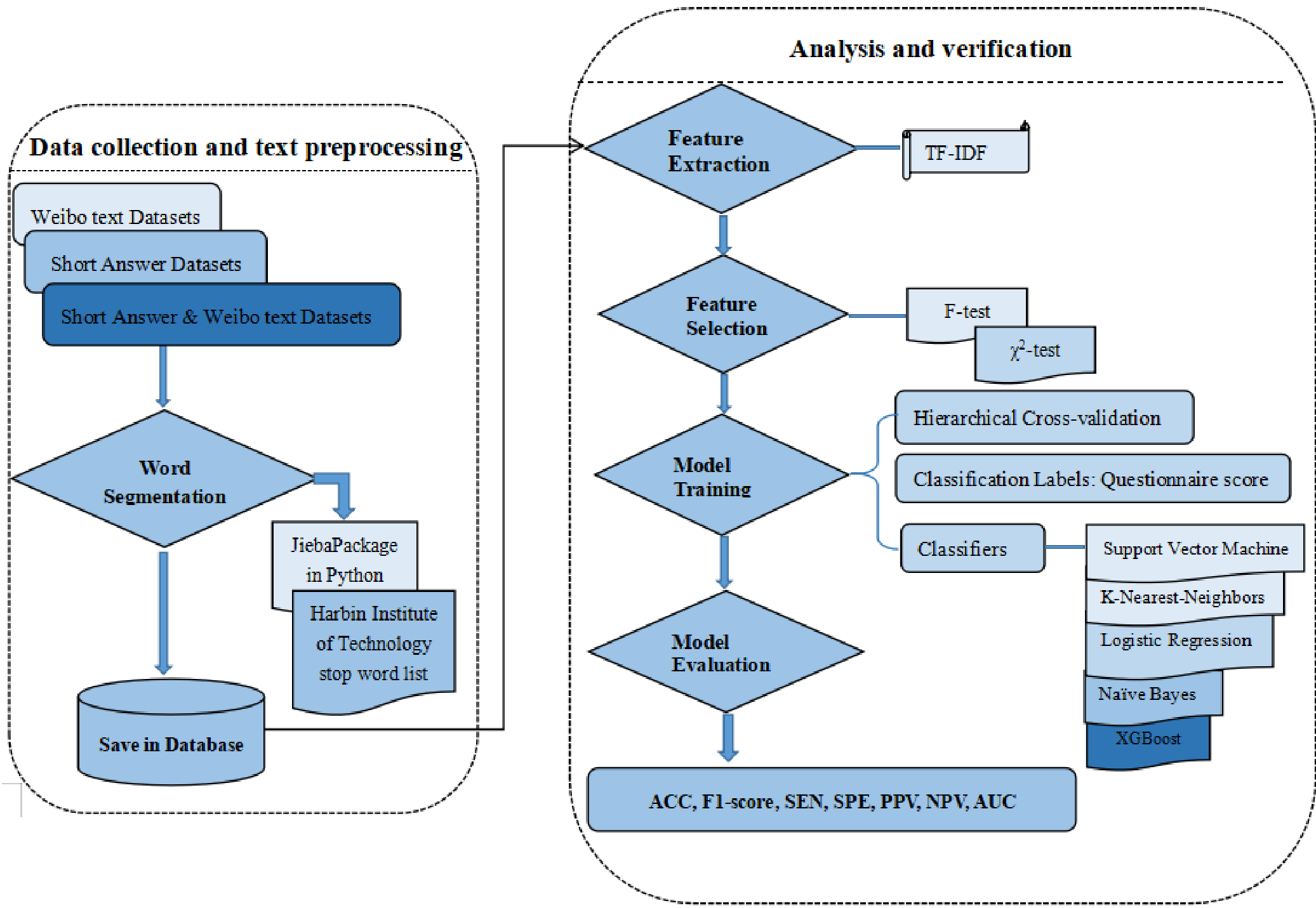 The workflow from data collection and preprocessing to feature extraction and classification.
Why SVM Still Rules Small Data
While deep learning (CNNs/RNNs) is the industry standard for massive datasets, this study highlights the continued dominance of Support Vector Machines (SVM) in psychological research where sample sizes are often limited (N=901).
The team used TF-IDF to weigh the importance of words and two statistical filters for feature selection:
- F-test: Better for sensitivity and recall.
- Chi-square (): Effective at finding the most "independent" words that define a category.
Key Findings
- The Power of Combination: Short-answer text alone was good, but adding Weibo data stabilized the model's performance significantly.
- Performance Peak: Using the F-test with a threshold of and the hybrid text, SVM reached an accuracy of 89.6% and a PPV (Precision) of 96.9%.
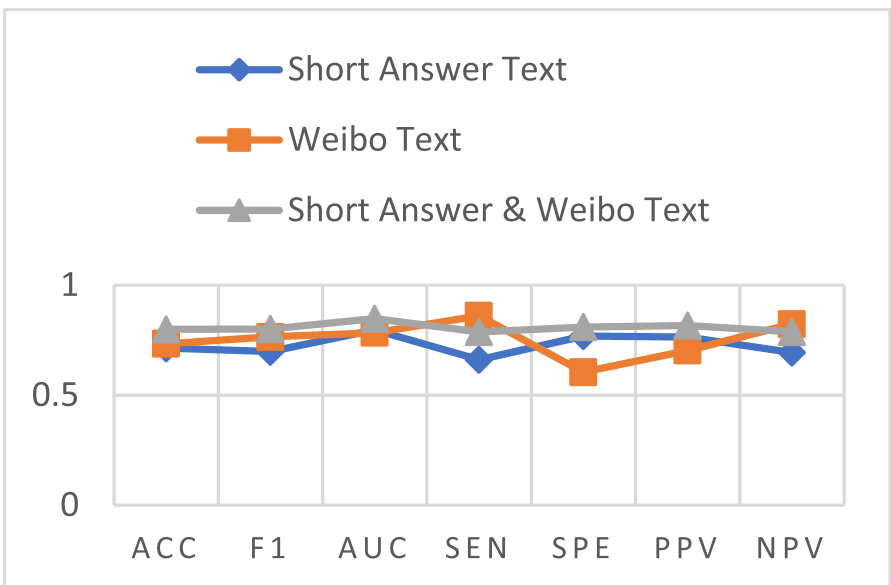 Figure 1: Comparison showing that the "Short Answer & Weibo" combination (in green) yielded the highest and most stable scores across all metrics.
Critical Insight: Why Does the Hybrid Model Work?
The study reveals a fundamental truth about digital psychology: Context matters. Weibo text provides a window into a user's spontaneous, daily habits, but lacks focus. Short-answer questions provide the "stress test" needed to see a personality trait in action.
When analyzed via SVM, the specific vocabulary associated with agency and change (extracted through feature selection) becomes a high-dimensional signature of proactivity. Interestingly, while Naïve Bayes performed admirably in certain scenarios, SVM was the most consistent, even when dealing with the high "noise" of social media snippets.
Future Outlook & Limitations
Despite the success, the study acknowledges that Weibo text is "unsuitable to be analyzed as long text" in isolation due to its fragmented nature. The participants were also skewed toward a female college student demographic (801 females vs 100 males), which may limit the generalizability to the broader workforce.
For future HR tech and psychological research, the message is clear: the future of personality assessment isn't just in the questions we ask, but in how we correlate those answers with the digital trails we leave behind every day.
Conclusion
By leveraging text mining and SVM, we can now move toward more objective, automated, and accurate personality profiling. This work bridges the gap between traditional psychometrics and the "Big Data" era of psychology.