
Debunking the Influencer Myth: Predictive Modeling for Product Adoption in 100M+ User Networks
10940_Predicting product adoption in large-scale social networks.
The paper introduces a data-driven approach to predict the adoption of a paid VoIP service ("PC To Phone") within a massive Instant Messenger (IM) network of 100M+ users. By comparing mass marketing heuristics with predictive modeling, the researchers demonstrate that combining user-level behavioral data with social network features significantly boosts the accuracy of identification for both direct and viral marketing.
TL;DR
Is the "Influencer" dead? In this classic study of a large-scale Yahoo! Instant Messenger network (100M nodes, 1B edges), researchers found that high-degree users are surprisingly ineffective at driving product adoption. Instead, peer pressure and local social neighborhoods are the real drivers. By combining behavioral data with social features, they built a predictive system that outperforms traditional marketing heuristics.
Background: The Low-Adoption Challenge
In 2010, the "PC To Phone" product was a niche premium service in a sea of free IM users. Marketing this was a nightmare: the baseline adoption rate was extremely low. The study asks a fundamental question: Should we just blast ads to everyone (Mass Marketing), or can we use the social graph to find the "tipping point"?
The "Influencer" Fallacy
The most striking finding of this research is the critique of degree-centrality. Conventional wisdom suggests you should target the person with the most friends. However, the data shows:
- Short Cascades: 80% of adoption chains die within two steps. Viral "explosions" are myths in this context.
- Lower Conversion Efficiency: While high-degree users have more friends who adopt (by pure probability), the fraction of their friends who follow them is actually lower than that of medium-degree users.
- Peer Pressure > Influence: Adoption is a function of the threshold model. A user is more likely to buy the product if 20% of their friends already have it, regardless of how "influential" those friends are.
Methodology: The Core Predictive Engine
The researchers moved beyond simple heuristics to a dual-strategy framework powered by machine learning (C5.0 and GBDT).
1. Direct Marketing (Propensity Modeling)
The goal is to find individuals with the highest probability of converting next month. The model integrates:
- User Features: Logins, age, gender, and the critical "PC-to-PC" call frequency.
- Network Features: Number of premium friends (prem_bdy) and connected component size (reach_bdy).
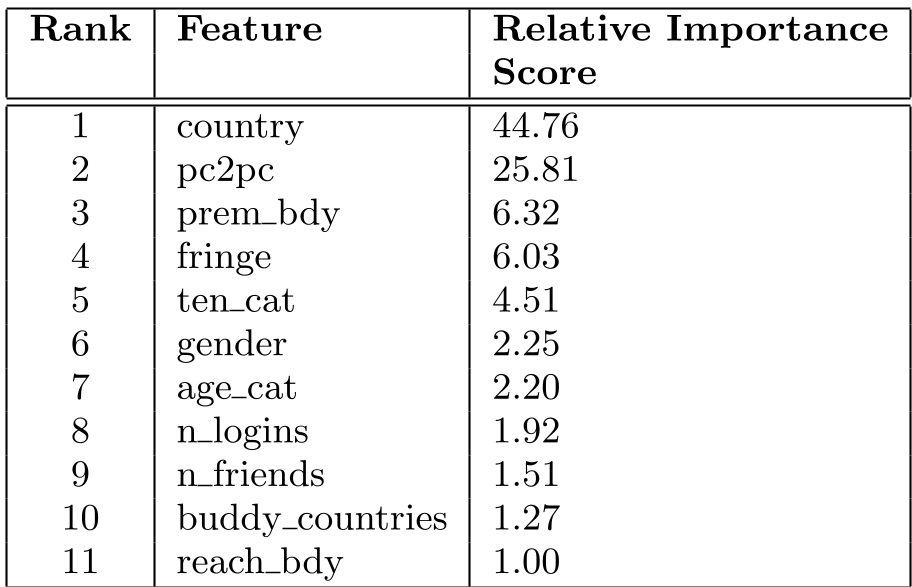 Table: Ranking of Top Features for Predicting Adoption
2. Social Neighborhood Marketing
Instead of targeting individuals to buy, this targets individuals to spread. The score measures how many neighbors adopt after a seed set is targeted.
Experimental Evidence
The results prove that "the whole is greater than the sum of its parts." Using only social data or only behavioral data (like clickstreams) provides a baseline, but the Combined Model provides a massive lift in the "Cumulative Gains" chart.
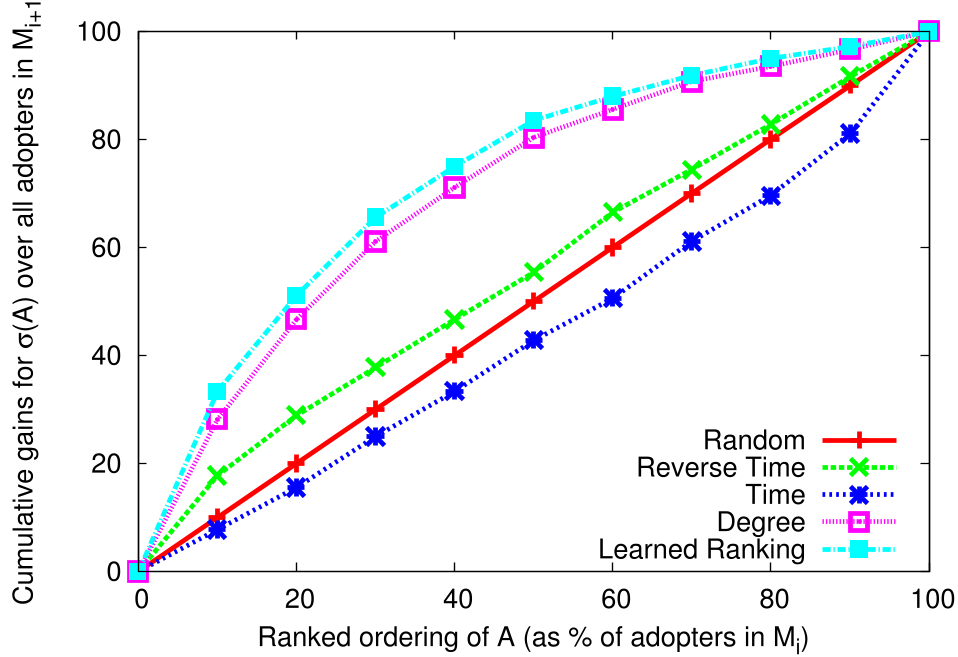 Figure: The Combined Model (User + Social) consistently identifies more adopters in the top-k% of the population.
Key findings from the experiments:
- Behavioral Triggers: If a user is already using free PC-to-PC calling, they have the hardware (mics/speakers) and the mindset to pay for PC-to-Phone.
- Geographic Delta: Non-US users were significantly more likely to adopt, likely due to high international calling rates in 2008-2010.
- Threshold Effects: Probability of adoption increases as the number of "Premium Predecessors" (friends who already bought) increases, but it hits diminishing returns after 5 friends.
Critical Insight: Rich Neighborhoods Get Richer
The research confirms that adoptions are clustered. If a "social pocket" already has a few adopters, it acts as a pressure cooker, making it much easier for the remaining members to convert. This suggests that advertisers should look for dense subgraphs of partial adoption rather than individual "stars."
Conclusion and Future Outlook
This work shifted the paradigm from "Global Influencers" to "Local Peer Effects." It proved that in massive, sparse networks, the "viral" effect is actually quite local.
Limitations: The study was conducted on historical data (offline). To truly prove the "Influencer" effect is dead, an online A/B test with actual ad delivery is required. Furthermore, as social networks evolve into the TikTok/Short-video era, the definition of a "neighbor" may shift from direct friends to algorithmic "interest clusters," though the underlying threshold models likely still apply.