
Beyond the Global View: Decentralized Retweet Prediction via Localized "Ego Networks"
Predicting Retweet Behavior in Online Social Networks Based on Locally Available Information
The paper introduces REPULSE and HOTPIE, two decentralized frameworks designed to predict retweet behavior and tweet popularity using only locally observable "ego network" information. By leveraging a novel set of community-related features extracted from retweet-paths via Biterm Topic Modeling (BTM), the authors achieve high-accuracy predictions without requiring global network topology.
TL;DR
Researchers from the Chinese University of Hong Kong have developed REPULSE and HOTPIE, frameworks that prove you don't need a bird's-eye view of a social network to predict its behavior. By focusing on the "ego network"—the immediate vicinity of a user—and treating "retweet-paths" as text topics, they achieved an F1 score of 0.91 in predicting retweets. This work sidesteps the growing walls of API restrictions and privacy protections that cripple global data collection.
Problem & Motivation: The Privacy Wall
Traditionally, predicting if a tweet will go viral or if a specific user will retweet it required "Global Network Information." Researchers needed the full social graph to calculate centralities and community structures. However, we are entering an era of data silos:
- Privacy Concerns: Platforms like Renren, Facebook, and Twitter are restricting third-party access to protect user data.
- Infeasibility: For large-scale OSNs, crawling the entire graph is computationally prohibitive.
- Noise: Analysis of tweet content (text/emojis) is often too noisy for reliable prediction.
The authors asked: Can we achieve SOTA accuracy using only what an individual user (an "ego") can see from their own perspective?
Methodology: Retweet-Paths as Social DNA
The core innovation lies in the use of Retweet-Paths. In networks like Renren or Sina Weibo, a tweet's header contains a hop-by-hop record of who relayed it.
Community Detection as Topic Modeling
The authors made a brilliant intuitive leap: if two people are on the same retweet-path, they likely share a community of interest. Instead of standard graph partitioning, they used Biterm Topic Modeling (BTM).
- The Logic: Treat each user as a "word" and each retweet-path as a "document."
- The Solution: BTM is specifically designed for short texts where standard LDA fails. By maximizing biterm (word pair) co-occurrence, it maps users into latent "communities" using only the sparse data available in a local neighborhood.

Frameworks: REPULSE & HOTPIE
- REPULSE: A personalized SVM classifier for each user to predict their specific retweet actions.
- HOTPIE: A "distributed monitor" system where individual nodes predict if a tweet will become a "Super Popular" hit within their subgraph.
Experiments & Results: Local Wins
Using a massive dataset from Renren (4.8M profiles, 7.5M tweets), the authors compared their local approach against RPuG/PPuG (baselines using global information).
Key Breakthroughs:
- Feature Power: Adding community-related features increased the F1 score from 0.72 to 0.91. Interestingly, adding "Content-based" features (NLP) provided almost zero improvement, highlighting that who shared a post is more indicative of its spread than what is in the post.
- Local vs. Global: While the global model (RPuG) technically averaged higher, REPULSE outperformed the global model for about one-third of all users, specifically those who are highly active.
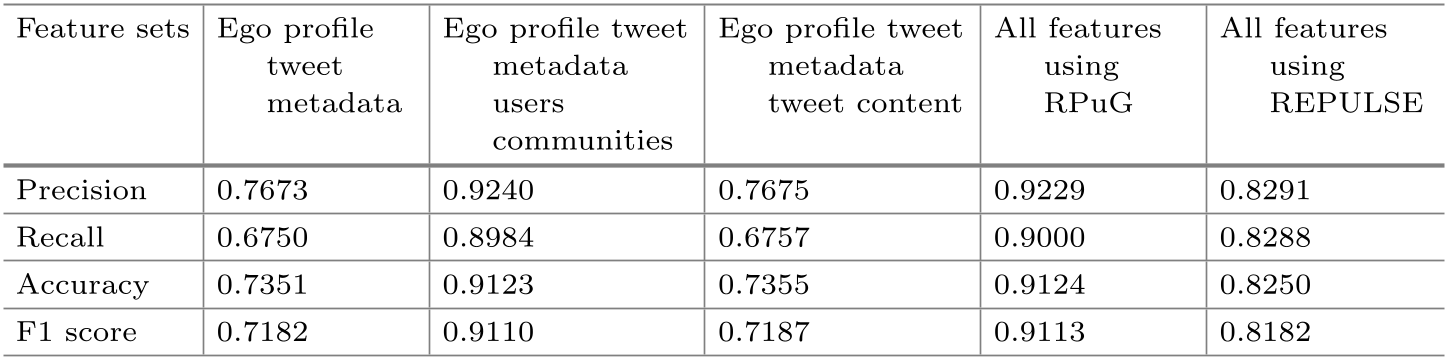
For popularity prediction, HOTPIE actually outperformed the global model by 17% in Micro F1, suggesting that localized data provides "customized" insights that global averages wash out.
Critical Analysis & Conclusion
This paper provides a strong argument for Edge Intelligence in social OSNs.
Takeaways:
- Structural Context > Semantic Content: In short-form social media, the diffusion path is a higher-fidelity signal of interest than the text itself.
- Decentralization is Viable: We don't need to violate privacy or bypass API limits to create useful recommendation or prediction engines.
Limitations: The current framework is offline. While the authors suggest that Online SVMs could make this real-time, the computational overhead of running BTM for every "ego" node in a real production environment remains an open engineering challenge. However, as an academic proof-of-concept, it successfully challenges the "Global is Better" dogma in social network analysis.
Future Outlook: Expect to see these "ego-centric" models integrated into privacy-first social apps where data never leaves the user's device, yet the "smart" features remain competitive.