
Predicting Social Dynamics: The Key to Intelligent ICN Caching
Predicting social dynamics based on network traffic analysis for CCN/ICN management
2017-01-01
Summary
Problem
Method
Results
Takeaways
Abstract
This paper proposes a social-aware Content-Centric Networking (CCN/ICN) management strategy that predicts content popularity by analyzing network traffic from cellular base stations. It introduces a methodology to infer user social dynamics (viewing/sharing patterns) directly from packet traces to optimize in-network caching decisions.
## TL;DR
Static caching is dead. This paper argues that the future of Content-Centric Networking (CCN) lies not in historical frequency, but in **Social Dynamics**. By analyzing raw packet traces at the cellular base station, the authors infer "Social Graphs" to predict what users will watch next based on their friends' sharing behavior, paving the way for proactive, socially-aware content delivery.
## The Problem: The "History Trap" in Caching
Current Information-Centric Networking (ICN) architectures often use a naive approach: if a video was popular yesterday, cache it today. However, social media content follows an ephemeral "burst and decay" cycle.
Consider a classroom scenario: An instructor shares a video. The students watch it repeatedly for a week and then never touch it again. A traditional cache would keep that video long after its utility has expired because its "history" looks strong. The missing link? **Social Context.** We need to know *who* is connected to *whom* to predict when the demand will actually stop or spread.
## Methodology: From Packets to Social Graphs
The authors propose a system that bridges the gap between raw network layer data and high-level social interactions.
### 1. Event Detection (The Pre-Processor)
By monitoring traffic at the base station (using tools like `tcpdump`), the system identifies two critical Facebook events:
* **View**: Identified via bursty traffic patterns and unique (even if encrypted) video IDs from DNS queries.
* **Share**: Detected when a call is made to `graph.facebook.com` within a 20-second window of a viewing event.
### 2. Inference Subsystem (The Architecture)
The system builds **Event Trees** for every piece of content. If User A views a video and then User B (who is connected to A) views it shortly after, the system infers a potential "social influence" edge.
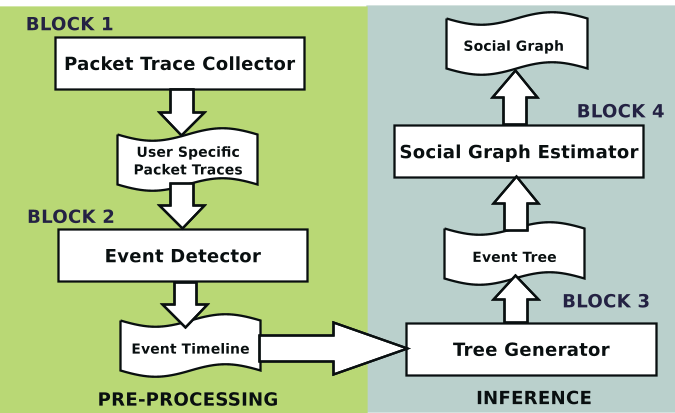
*Fig 1. The proposed system pipeline from packet collection to social graph estimation.*
## Experimental Insights: High Recall, Low Precision
To validate the concept, the authors simulated traffic using a real Facebook social graph (4,039 nodes). The core metric was how accurately the base station could reconstruct the hidden social graph just by looking at traffic.
**Key Findings:**
* **Recall is Strong**: The system is excellent at capturing most "genuine" social edges.
* **The Precision Challenge**: Precision remains low because of "coincidental edges." If two users happen to watch the same viral video but aren't actually friends, the system might incorrectly assume a social connection.
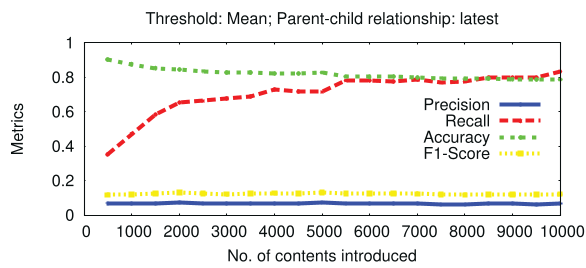
*Fig 2. Classification metrics showing that as more content is introduced, the system gets better at identifying genuine edges (high recall) but still struggles with noise.*
## Critical Analysis & Conclusion
This work is a significant step toward **proactive networking**. Instead of waiting for a request, the base station sees User A "Share" a video and immediately pre-caches it for User B.
**Limitations**:
The primary hurdle is the increasing use of **End-to-End Encryption (E2EE)**. While the authors use DNS and traffic volume patterns to bypass some encryption, as protocols like DoH (DNS over HTTPS) and QUIC become standard, purely traffic-based inference will require more sophisticated statistical fingerprints or ML-based traffic analysis.
**The Takeaway**:
The "Social Signal" is a goldmine for network efficiency. If base stations can accurately map the "Influence Forest" of their users, they can reduce backhaul traffic and latency by orders of magnitude compared to traditional LRU (Least Recently Used) caching strategies.