
Optimal Granularity: Solving the Time-Window Dilemma in Social Network Prediction
Predicting the Evolution of Social Networks: Optimal Time Window Size for Increased Accuracy
This paper introduces a data-driven framework for optimizing the time window size in social network evolution prediction. By proposing Windows Incoherence Measures (WIM) based on Jensen-Shannon divergence, the authors enable more accurate link prediction across multiple algorithms, including Triad Transition Matrix (TTM), Preferential Attachment (PA), and Common Neighbours (CN).
TL;DR
Predicting the future of a social network (who will talk to whom?) depends heavily on how you slice your historical data. This paper moves beyond "guessing" time windows by introducing Windows Incoherence Measures (WIM). By ensuring that small time-slices of a network statistically resemble the "global" network, the authors demonstrate a significant boost in link prediction accuracy across various SOTA models.
The "80% Effort" Problem in Network Dynamics
In the world of data science, we often say that data preparation is 80% of the work. Yet, in the study of complex networks, the process of turning a stream of events (like emails) into discrete snapshots is often handled arbitrarily.
If your window is too small, you see noise (random bursts of activity). If it's too large, you see stagnation (temporal patterns are smoothed out). The authors identify that the key to a meaningful prediction is maintaining a "structural resemblance" between the window and the global evolved state of the network.
Methodology: The Math of Divergence
The core innovation is the Window Incoherence Measure (WIM). Instead of just picking a window of "one week" or "one month," the authors look at the distribution of network properties (Node Degree, Shortest Path, Triad Census, etc.) and calculate how much they deviate from the total dataset using Jensen-Shannon Divergence ().
The Optimization Framework
The task is framed as a constrained optimization problem:
- Objective: Minimize the incoherence (the divergence of property ).
- Constraints: Maintain a minimum time series length and respect the required prediction horizon .
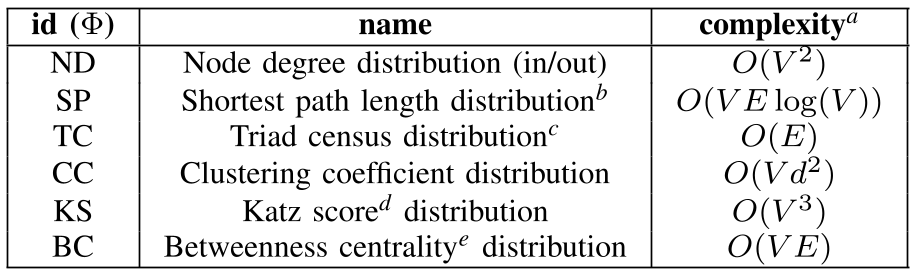 Figure 1: The standard network properties used to calculate WIM, ranging from local (Triad Census) to global (Betweenness Centrality).
Experiments: Enron Email Network
The authors tested their approach on the Enron dataset. Interestingly, they found that different predictive models respond to different WIMs. For instance, the Triad Transition Matrix (TTM)—which looks at local 3-node structures—correlates strongly with the Triad Census divergence.
One of the most powerful insights is the Locally-weighted combination (LWC). Since no single network property is a "silver bullet" for all prediction horizons, the LWC dynamically weights the importance of different properties based on the training data.
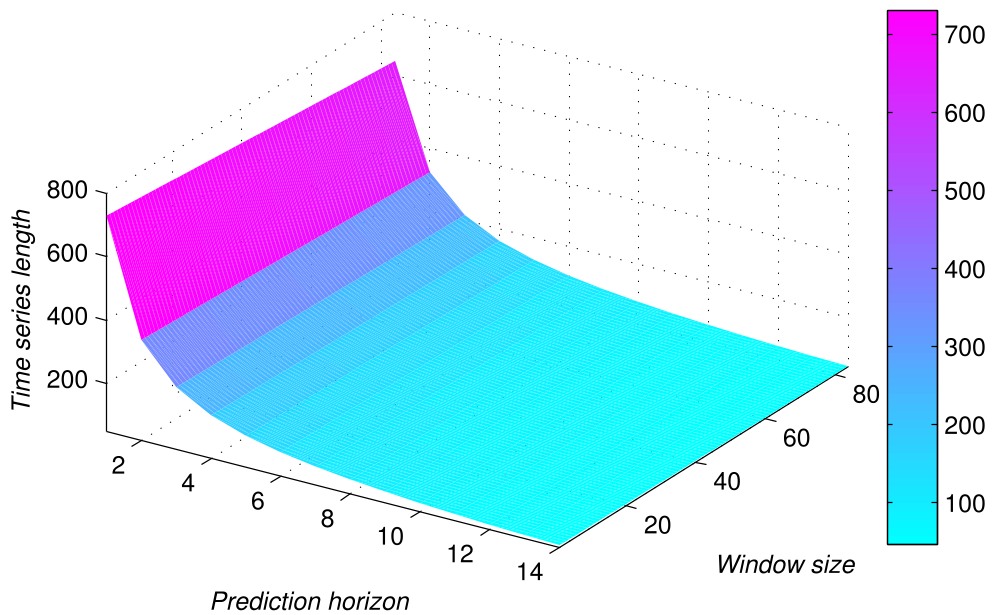 Figure 2: Evolution of Window Incoherence across different window sizes (S) and horizons (H). The black crosses indicate the statistical "sweet spot" for data slicing.
Results: Performance Boost
The proof is in the prediction. When using WIM-recommended window sizes, the link prediction accuracy for TTM, Preferential Attachment (PA), and Common Neighbours (CN) consistently approached the theoretical "best case" accuracy.
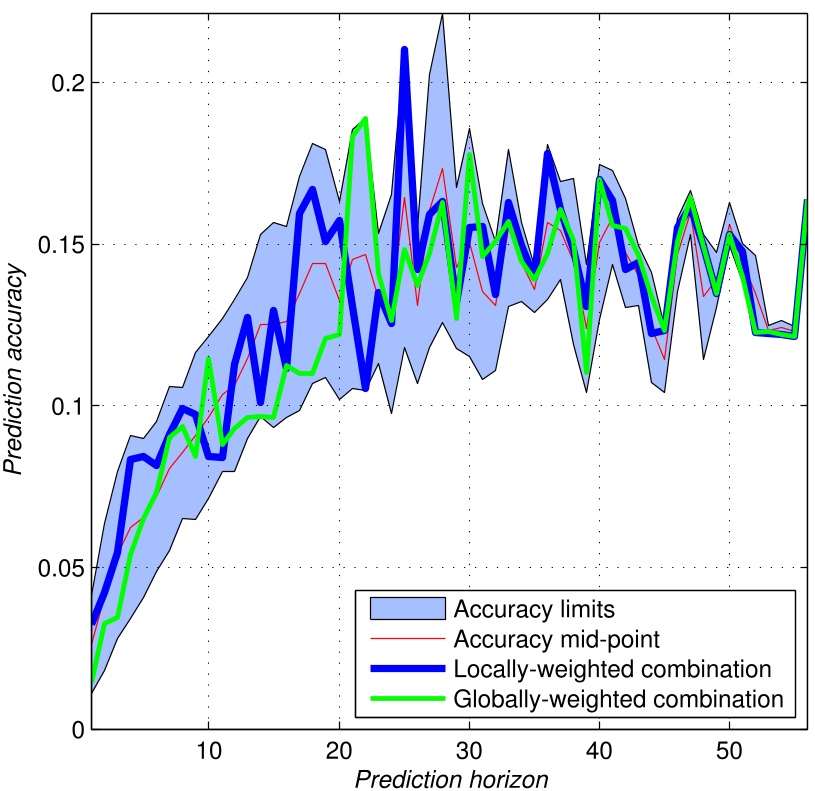 Figure 3: Accuracy comparison for the TTM predictor. The WIM-recommended window size (red/blue lines) tracks the optimal performance (top of the shaded area) much better than arbitrary selections.
Critical Insight & Conclusion
This paper shifts the focus from better algorithms to better data engineering. While we often race to build more complex GNNs, this research proves that the resolution of our "temporal lens" is just as important as the model itself.
Key Limitation: The study currently focuses on fixed-size windows. The authors suggest that variable-sized windows (windows that grow or shrink based on activity density) could be the next frontier in increasing prediction sensitivity—a strategy that would directly address the "bursty" nature of social interactions.