
Unmasking the Invisible: How Public Interactions Reveal Private Bonds in MMOGs
Predicting Social Ties in Massively Multiplayer Online Games
This paper explores the link prediction problem within Massively Multiplayer Online Games (MMOGs) to determine if public interaction data can reveal covert private social ties. Using a dataset from "Game X," the authors trained classifiers to predict guild co-membership, achieving significant performance gains by integrating public forum activities with basic demographic data.
TL;DR
Can your public forum posts reveal who your secret allies are? This research from Sandia National Laboratories demonstrates that in the complex world of Massively Multiplayer Online Games (MMOGs), public interaction data—such as who you quote or reference in a forum—can reliably predict "covert" social ties like guild membership. By applying machine learning to player data, the authors show that public digital footprints are surprisingly accurate mirrors of private social structures.
Background: Public Artifacts vs. Private Realities
In the digital age, we often mistake "connectivity" for "relationship." Following a celebrity on Twitter or posting on a public wall doesn't necessarily imply a strong social tie. The researchers argue that the "true" social network is often hidden or private. To study this, they turned to Game X, a turn-based MMOG with complex social layers: Nations (open), Agencies (social categories), and Guilds (closed, elite cooperate groups).
The core challenge is the Link Prediction problem: Can we use observable links in the "Public Network" (forum activity) to predict links in the "Private Network" (Guild membership)?
Methodology: Feature Engineering for Social Discovery
The authors categorized player data into three escalating Feature Sets to test the predictive power of different data types:
- Feature Set 1 (Baseline): Publicly visible attributes like Nation and Race.
- Feature Set 2 (Public Interaction): Adds "Co-posting" (posting in same topics), "Co-quoting," and "Co-referencing."
- Feature Set 3 (Full Insight): Adds private data like trade frequency, combat history, and private message counts.
Model Architecture and Analysis
The study utilized three classical machine learning paradigms:
- Generalized Linear Models (LM)
- Boosted Decision Trees (BT)
- Support Vector Machines (SVM)
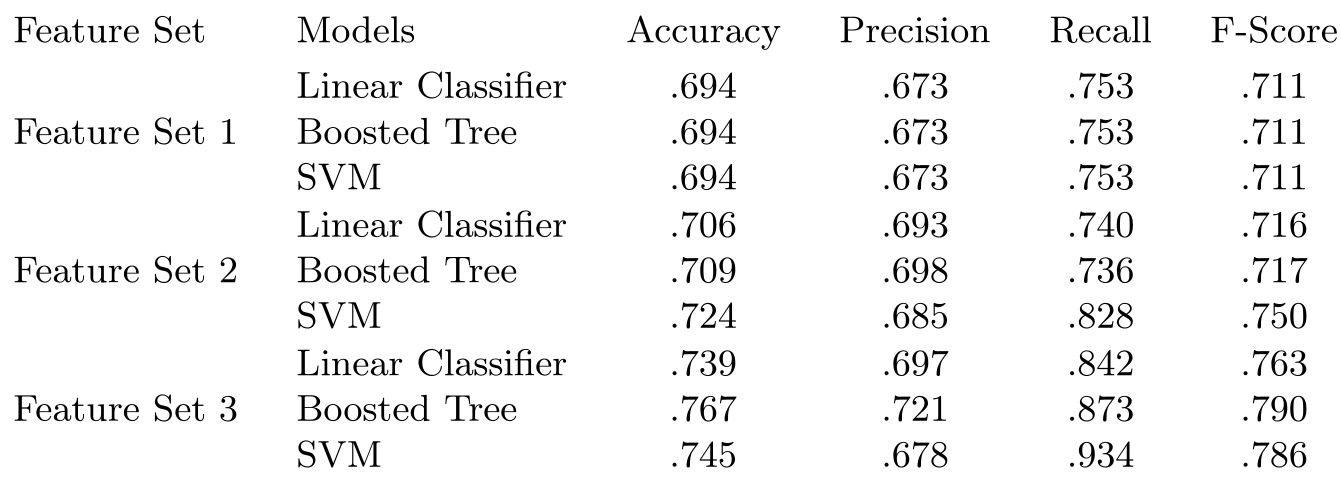
The researchers used a balanced dataset of 65,076 samples to ensure the models didn't simply learn to predict "No Relationship" by default (the majority class in real-world sparse networks).
Key Insights from the Results
The jump from Feature Set 1 to Feature Set 2 is the most academically significant. It proves that frequency of public interaction is a statistically significant indicator of private belonging.
- The Power of Public Footprints: For SVMs, moving from the baseline to public interactions raised the F-Score from 0.711 to 0.750.
- Economic Ties as Social Glue: In the most advanced models (FS3),
num-trades(number of trades between players) emerged as the single most powerful predictor of being in the same guild. This suggests that in virtual worlds, financial cooperation is the strongest signal of a social bond. - Model Performance: While SVMs excelled in high-recall scenarios for public data, Boosted Trees took the lead when rich relationship data was available, achieving near 80% F-Score.
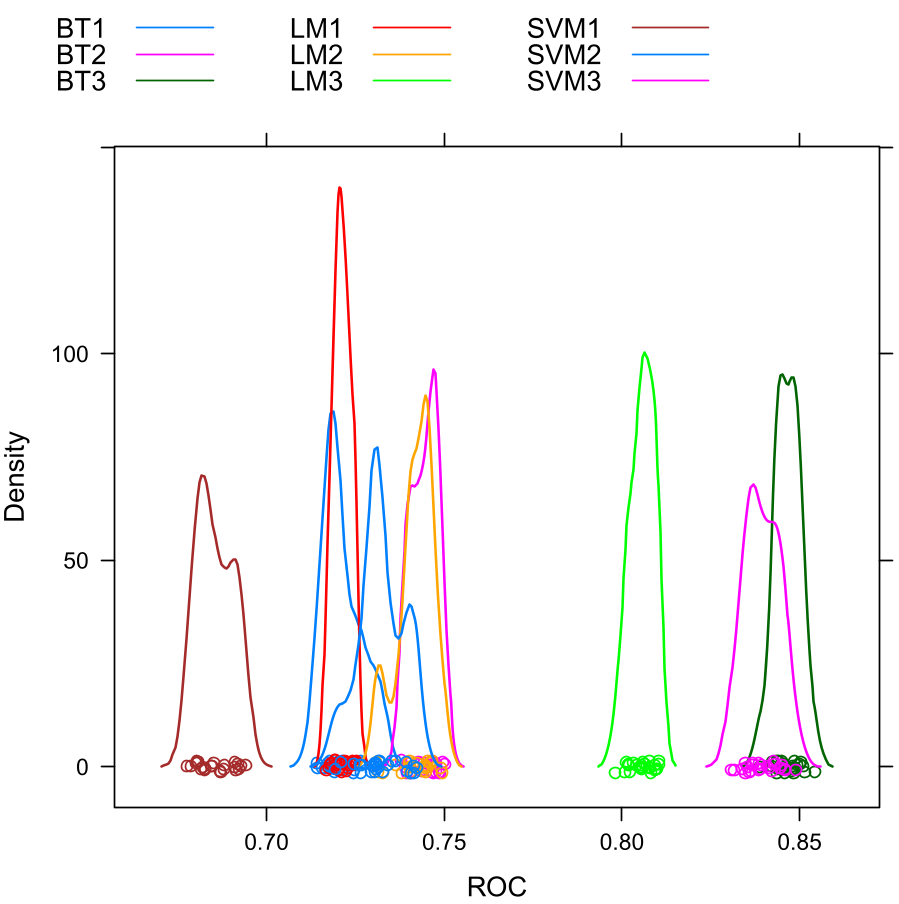 The ROC curves demonstrate a clear separation: the more interactive features we add, the better the model distinguishes between "just strangers" and "guild mates."
Critical Analysis & Takeaways
This paper serves as a foundational "proof of concept" for social network inference.
Why it matters:
- Inductive Bias: The study confirms that "homophily" (the tendency of individuals to associate with similar others) in MMOGs extends across different communication channels.
- Privacy Implications: It suggests that even if users hide their "Friend Lists," their public interactions (quoting someone on a forum) provide enough signal for an algorithm to reconstruct their private affiliations.
Limitations & Future Work:
The study relies on the frequency of interaction rather than the context. A heated argument (co-quoting) might look the same to the model as a supportive agreement. Future research integrating Natural Language Processing (NLP) to analyze the sentiment of these interactions would likely push the F-Score even higher.
Conclusion
Social ties in the digital world are rarely truly "hidden." By looking at the intersection of public discourse and in-game economics, we can map the social architecture of virtual worlds with high precision. For developers and sociologists, this work provides a roadmap for understanding how communities form and sustain themselves in massively multiplayer environments.