
Predicting Personal Social Dynamics: A Time-Series Approach to Mobile Tie Strengths
Predicting social ties in mobile phone networks
The paper introduces a novel framework for quantifying and predicting person-to-person social tie strengths using mobile phone Call Detail Records (CDRs). It combines a probabilistic affinity model with a reciprocity index and utilizes SARIMA time-series analysis to achieve an average prediction accuracy of 95.2% for socially close relationships.
TL;DR
This research shifts the focus of social network analysis from static community structures to the dynamic evolution of individual relationships. By modeling mobile phone call logs as time-series data using a specialized Affinity Model and SARIMA, the authors achieve a 95.2% accuracy in predicting how "close" two people will remain.
Motivation: The Missing "Time" in Social Ties
Most social network research treats a "link" between two people as a binary or static value. If you call someone, a line is drawn. However, human relationships breathe—they grow stronger with frequent, reciprocal interaction and wither during long silences.
The authors identify a critical gap: existing methods (like spectral clustering or triangle approaches) look at the map of the network but ignore the rhythm of the individual interactions. To solve this, they treat social-tie strength as a function of time, , allowing them to treat social evolution as a forecasting problem.
Methodology: From Call Logs to Time Series
The framework consists of three elegant mathematical layers:
1. The Reciprocity Index
Instead of just counting calls, the authors assume phone call arrivals follow a Poisson Process. They derive a reciprocity index () that measures the "tendency" of a person to return a call. This distinguishes a healthy friendship from a telemarketing relationship.
2. The Affinity Model
To quantify the "closeness" between two users ( and ), the paper utilizes the Hellinger Distance. The Affinity value ranges from 0 to 1, where 1 represents perfectly synchronized communication patterns.

3. SARIMA Prediction
Once the raw call data is converted into a bi-weekly time series of Affinity values, the authors apply Seasonal AutoRegressive Integrated Moving Average (SARIMA) models. This allows the system to account for seasonal trends (e.g., calling family more on weekends) and previous shifts in relationship intensity.

Experimental Results
The model was tested using the famous MIT Reality Mining dataset, spanning 8 months of real-world usage.
- Close Relationships: For partners who were socially "close," the model was extraordinarily accurate. The prediction for "User 60" and their partner showed an RMSE of only 0.013.
- Near Relationships: While slightly more volatile, "near" relationships were still predicted with high confidence (RMSE around 0.07-0.18).
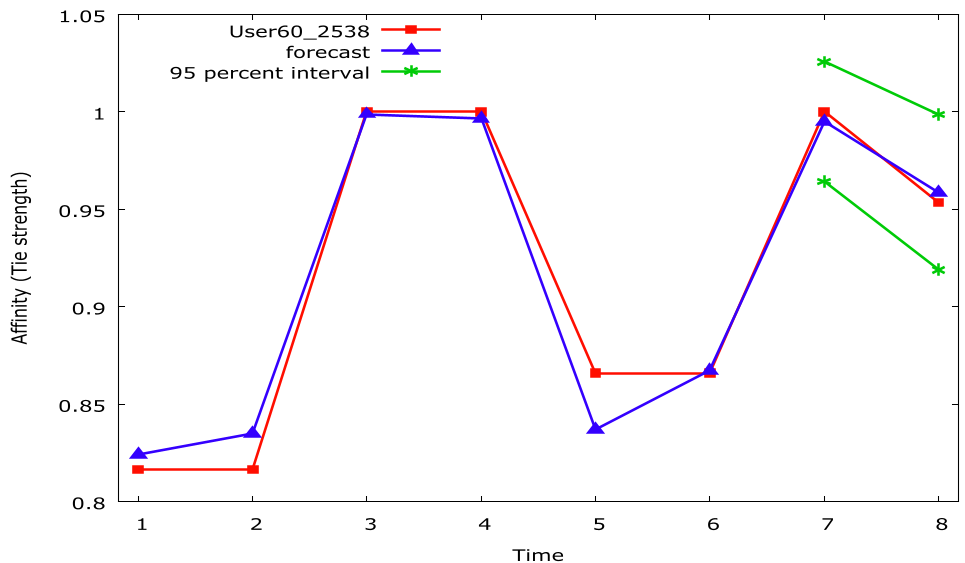 Above: The predicted vs. observed affinity values. The proximity of the triangle-line (predicted) to the block-line (observed) demonstrates the model's robustness.
Critical Insight & Conclusion
The true value of this work lies in its Inductive Bias: it assumes that human social behavior is not random but follows detectable, periodic patterns. By integrating the Reciprocity Index, the paper captures the "social obligation" aspect of relationships that pure frequency counts miss.
Limitations
- Data Sparsity: The authors note that errors increase when call volume is low. If two people rarely talk, the Poisson assumptions become less reliable.
- Medium-Limited: The study focuses solely on voice calls. In the modern era, this would need to be integrated with instant messaging (WhatsApp/Slack) to provide a holistic view.
Future Impact
This approach provides a foundation for Homeland Security (identifying anomalous shifts in terrorist cell communications) and Churn Prediction in telecom (detecting when a user’s social circle is moving to a different provider).